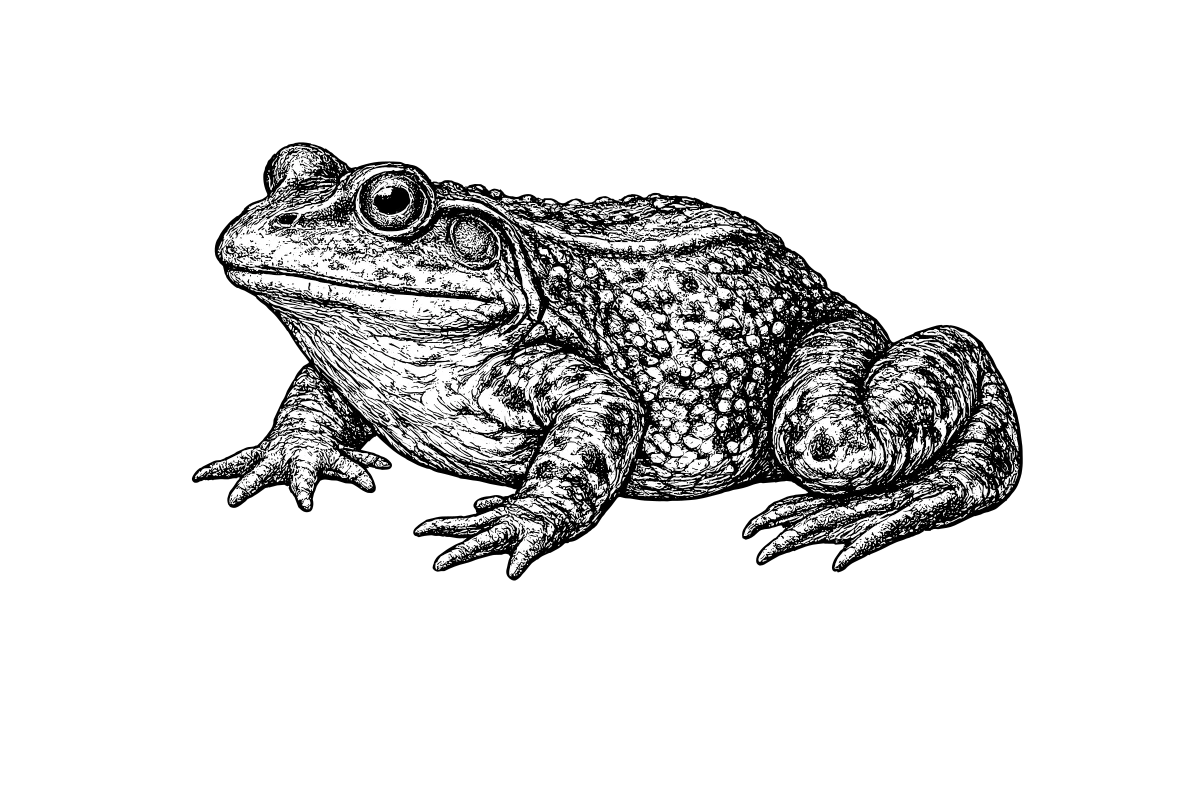
American Bullfrog
Lithobates catesbeianus
The largest frog in North America and one of the world's most damaging amphibian invaders. The bullfrog will eat anything it can fit in its mouth — insects, fish, snakes, birds, other frogs — and its appetite, plus a deep foghorn call, has carried it far beyond its native range to four other continents.
Browse the Woodcut Wild shop →Habitat
Bullfrogs live in warm, still, or slow-moving fresh water — ponds, lakes, marshes, and slow streams — with abundant vegetation along the edges. Native to eastern North America, they have been introduced widely and thrive almost anywhere warm and wet.
Behavior
Bullfrogs are sit-and-wait predators with an indiscriminate diet, lunging at anything moving and small enough to swallow whole, including other bullfrogs. Males are territorial and produce the deep, resonant 'jug-o-rum' call that gives the species its name, audible for a quarter mile. Tadpoles can take two to three years to metamorphose in cold climates. Where introduced, bullfrogs outcompete and prey on native amphibians and are a major driver of regional frog declines.
Marginalia
- The bullfrog's eardrum, the round 'tympanum' behind the eye, indicates sex — in males it's much larger than the eye, in females about the same size.
- A bullfrog will attempt to eat almost anything it can overpower, with documented prey including snakes, small turtles, bats, ducklings, and other bullfrogs.
- Bullfrogs breathe partly through their skin, absorbing oxygen directly from water, which lets them spend the winter dormant at the bottom of a pond.
- As an invasive species, the bullfrog spreads chytrid fungus — a pathogen devastating to amphibians worldwide — while being largely resistant to it themselves.
Common questions
Can you eat bullfrogs?
Yes — the bullfrog is the frog behind most American 'frog legs.' Only the hind legs are eaten, prized for pale, mild meat that genuinely tastes between chicken and fish. They are harvested by hand, gig, or hook at night and farmed commercially, and in regions where the species is invasive, eating them is openly encouraged.
Are bullfrogs poisonous or dangerous to touch?
Not poisonous, and safe to handle. Their skin carries mild secretions that can sting if rubbed into the eyes, so washing your hands afterward is sensible, but there is no real toxin. A big one can deliver a startling clamping bite if it mistakes a finger for food, more surprising than harmful.
How long do bullfrogs live?
Around 7 to 10 years in the wild, and considerably longer in captivity, where some have passed 15. Counting the two or three years many spend as tadpoles before transforming, a bullfrog can be a remarkably long-lived amphibian for its kind.
How far can a bullfrog jump?
Roughly six to ten times its body length in a single leap — well over a yard for a large adult — powered by those long muscular hind legs. The jump is both escape and ambush: a startled bullfrog launches straight for deep water, while a hunting one explodes forward to overtake passing prey.
What does a bullfrog tadpole look like?
Big, and olive-green flecked with dark spots, often three to four inches long — far larger than the tadpoles of most native frogs, which is one way to spot them. They graze algae and detritus for two or three years before sprouting legs, and their sheer size and long residence let them crowd out smaller native tadpoles where the species has been introduced.