Dodo
Raphus cucullatus
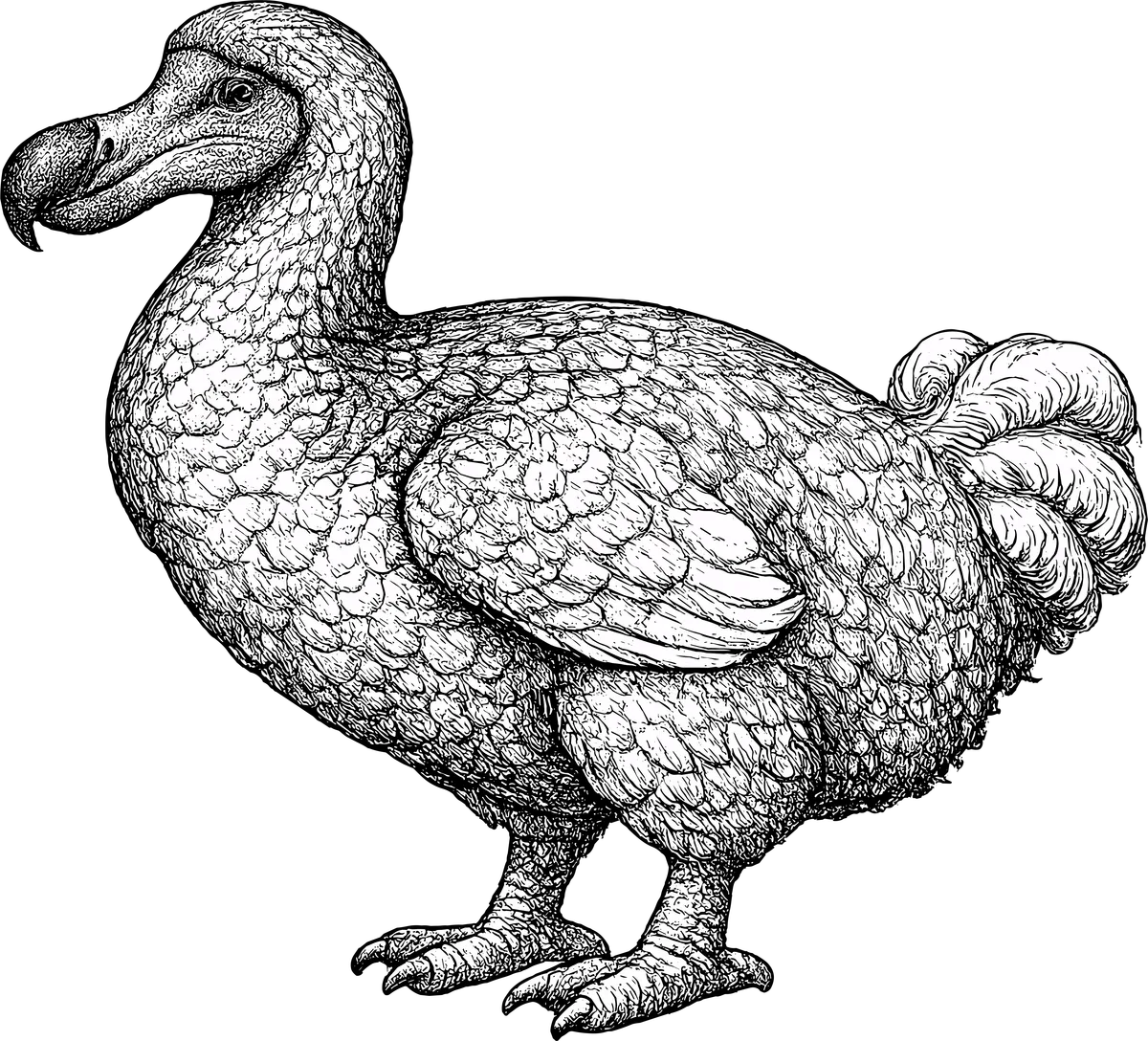
A three-foot flightless pigeon that evolved without predators on a single island in the Indian Ocean — and disappeared within a century of meeting humans. The original parable of human-caused extinction.
Browse the Woodcut Wild shop →Habitat
The dodo was endemic to Mauritius, a volcanic island roughly 700 miles east of Madagascar. Its forest ecosystem included no native land mammals and no predators of any kind. With no need to flee, the dodo lost the ability to fly, grew large, and slowed down evolutionarily. The ebony forests of the island interior were its world, and contemporary accounts describe it as both abundant and unwary.
Behavior
Almost everything known about dodo behavior comes from a handful of seventeenth-century sailors' journals and a small set of bones recovered after extinction. The bird was flightless, ground-nesting, and ate fallen fruit — including the seeds of the now-rare tambalacoque tree, whose germination may depend on passage through a dodo gut. Dodos showed no fear of humans, which made them trivially easy to club to death — and made them, in the Victorian imagination, into a symbol of evolutionary failure rather than the human failure they actually represent.
Marginalia
- The dodo is a giant flightless pigeon. Its closest living relative is the Nicobar pigeon (Caloenas nicobarica), an iridescent forest dweller of Southeast Asia.
- Dodos went extinct within roughly 80 years of Mauritius being settled — killed by hunting, deforestation, and predation of eggs by introduced pigs, rats, monkeys, and cats.
- The tambalacoque tree (Sideroxylon grandiflorum) of Mauritius almost went extinct itself in the 20th century; one hypothesis held that its seeds required passage through a dodo's gut to germinate. The 'dodo tree' hypothesis is now contested but the tree remains critically endangered.
- No complete dodo specimen survives. The most intact remains — the Oxford head and foot — were part of a stuffed specimen that mostly burned in 1755. Our modern image of the dodo is reconstructed from skeletal remains and a small number of 17th-century paintings of dubious accuracy.
- 'As dead as a dodo' entered English in the 19th century. The phrase made the bird a cultural shorthand for total, irreversible loss — fitting, given the species was the first widely-recognized human-caused extinction.