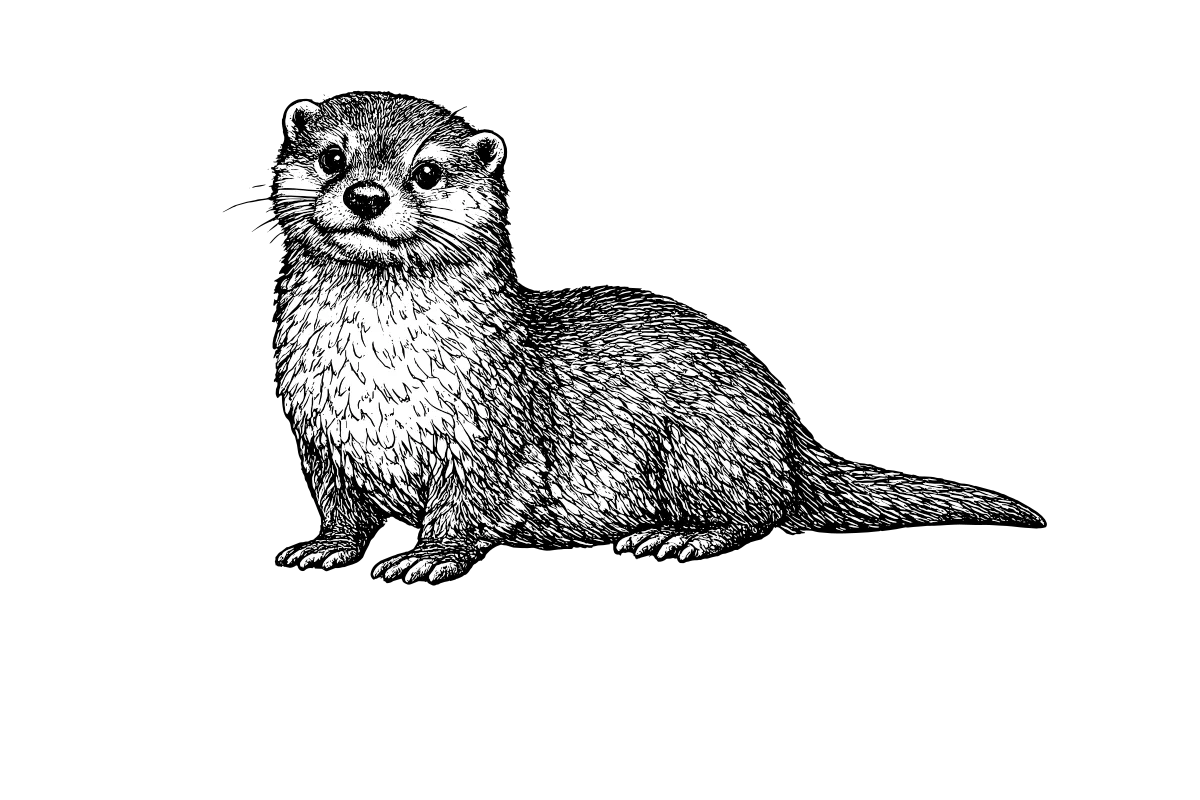
North American River Otter
Lontra canadensis
A weasel that committed fully to the water. The river otter is built end to end for aquatic hunting — webbed feet, a rudder tail, closable nostrils and ears, and a metabolism that demands it eat through much of its waking day — and it remains one of the few large predators that appears to hunt partly for fun.
Browse the Woodcut Wild shop →Habitat
River otters live along rivers, lakes, marshes, and coastlines across North America wherever the water is clean enough to hold fish. They are sensitive to pollution, and their return to a waterway is often used as an indicator that the water has recovered.
Behavior
Otters are agile, fast swimmers that hunt fish, crayfish, amphibians, and the occasional bird. They are notably playful — sliding down mud and snow banks repeatedly, wrestling, and juggling stones — behavior that serves social bonding and skill practice but also appears to be simple play. They mark territory and communicate at communal latrine sites along the bank.
Marginalia
- A river otter's fur is among the densest of any animal — up to a million hairs per square inch — trapping a layer of air that keeps the skin dry and warm, since otters lack the blubber of marine mammals.
- Otters can close their nostrils and ears underwater and have a slowed heart rate that lets them stay submerged for up to eight minutes.
- Their playfulness is genuine — otter slides are reused for no foraging purpose, and young otters must be taught to swim by their mothers, who sometimes drag reluctant pups into the water.
- River otters are a recovery success story: reintroduction programs since the 1970s have returned them to states where they had been locally extinct for most of a century.
Kin & neighbors
Common questions
What is the difference between a river otter and a sea otter?
Almost everything but the name. The river otter is a streamlined freshwater weasel that spends much of its time on land, walks well, and weighs up to about thirty pounds. The sea otter is a much heavier marine animal that rarely comes ashore, floats on its back, cracks shellfish on a stone on its chest, and is more closely related to the river otters than it looks. They are different genera that converged on a watery life.
How long do river otters live?
Usually eight to ten years in the wild, occasionally into their teens, and past twenty in captivity. Mortality is highest in the first year; pups that survive their first winter and learn to hunt well stand a good chance of a full life.
Are river otters dangerous? Do they bite?
They will bite hard if cornered or handled, and a mother defending pups is not to be approached, but unprovoked attacks on people are rare. The greater concern is dogs — an otter in the water has the advantage and can injure or drown a swimming dog that harasses it. Give a wild otter room and it will simply leave.
Can you keep a river otter as a pet?
No, and in most places it is illegal. River otters are wild mustelids with enormous space and exercise needs, a powerful musky scent, sharp teeth, and a diet of live fish that runs to several pounds a day. They are charming on a riverbank and miserable in a house.
What is a group of otters called?
A romp, or sometimes a raft when they are in the water. The terms suit them — river otters gather at communal sites and play together, and a 'romp' captures the wrestling and sliding better than most collective nouns manage.