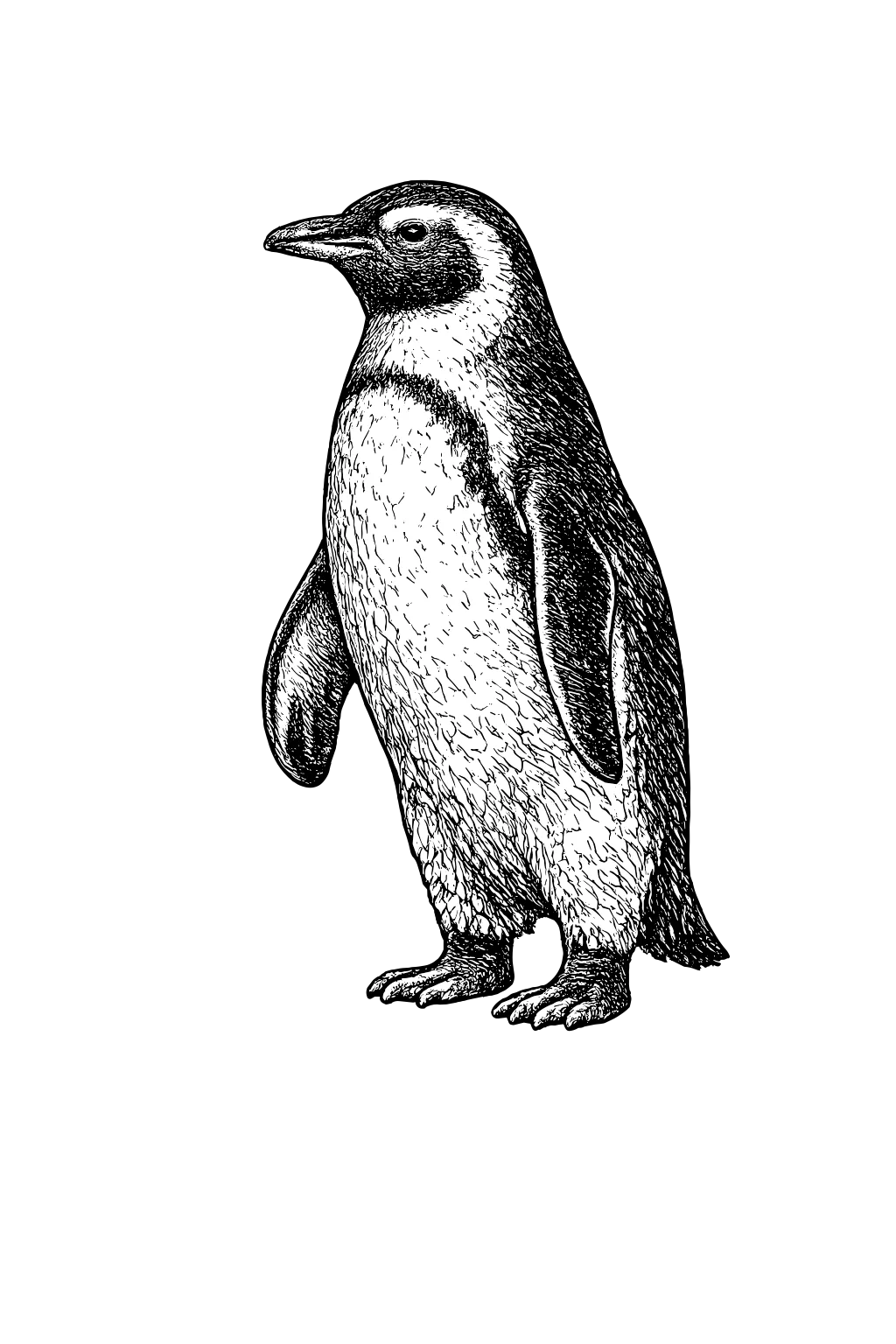
Penguin
Spheniscidae
A bird that gave up flight in the air to fly underwater instead. Penguins traded wings for flippers and feathers for a watertight wetsuit, becoming some of the most accomplished swimmers in the ocean while remaining, on land, almost comically earthbound.
Browse the Woodcut Wild shop →Habitat
The roughly eighteen penguin species live entirely in the Southern Hemisphere — not only Antarctica but also temperate coasts of South America, southern Africa, Australia, New Zealand, and the equatorial Galápagos. All are marine, coming ashore mainly to breed and molt.
Behavior
Penguins are wing-propelled pursuit divers, chasing fish, squid, and krill underwater with flippers that work as hydrofoils. On land they walk upright with the waddling gait that makes them famous, and toboggan on their bellies across ice. Most species are highly social, breeding in dense colonies of thousands, and many form long-term pair bonds, locating their mate and chick in a crowd of identical birds by voice alone.
Marginalia
- Penguins are countershaded — dark above, white below — for camouflage in open water: from above they blend with the dark depths, from below with the bright surface.
- Emperor penguins survive the Antarctic winter by huddling in tightly packed colonies that slowly rotate, moving individuals from the cold edge to the warm center and back.
- The fossil record includes penguins nearly as tall as a human — the extinct Palaeeudyptes stood around 5 ft 9 in.
- Penguins have a gland that filters salt from seawater and excretes it as a concentrated brine, letting them drink the ocean.
Kin & neighbors
Common questions
Are there penguins at the North Pole?
None — penguins are an entirely Southern Hemisphere bird, and the closest any species comes to the equator is the Galápagos. The Arctic's ecological equivalent was the great auk, an unrelated flightless diving bird that looked much like a penguin and was hunted to extinction in 1844. Polar bears and penguins never meet outside of cartoons.
Do penguins have knees?
They do, tucked up inside the body. A penguin's leg looks short because the upper leg and knee are hidden under feathers and skin, leaving only the lower leg and feet exposed. The hidden joints, set far back on the body for swimming, are also what force the upright, waddling posture on land.
Why can't penguins fly?
They traded air for water. A wing that flies in air must be light and broad, while a flipper that 'flies' underwater must be short, stiff, and dense to push through a far heavier medium — the two cannot be optimized at once. Penguins committed entirely to the second, and their solid bones, which would weigh down a flying bird, help them dive.
How fast can a penguin swim?
Most cruise at four to seven miles an hour, with the gentoo the fastest, clocked in bursts around twenty. They also 'porpoise,' leaping clear of the surface in arcs to breathe without breaking speed and to make themselves harder for a predator to track.
What eats penguins?
Different hunters at sea and on shore. In the water leopard seals, orcas, sea lions, and sharks take adults; on land and in the colony, skuas, gulls, and giant petrels target eggs and chicks. The split is why penguins are bold and fast in the water but nervous at the shoreline, where both worlds' predators wait.