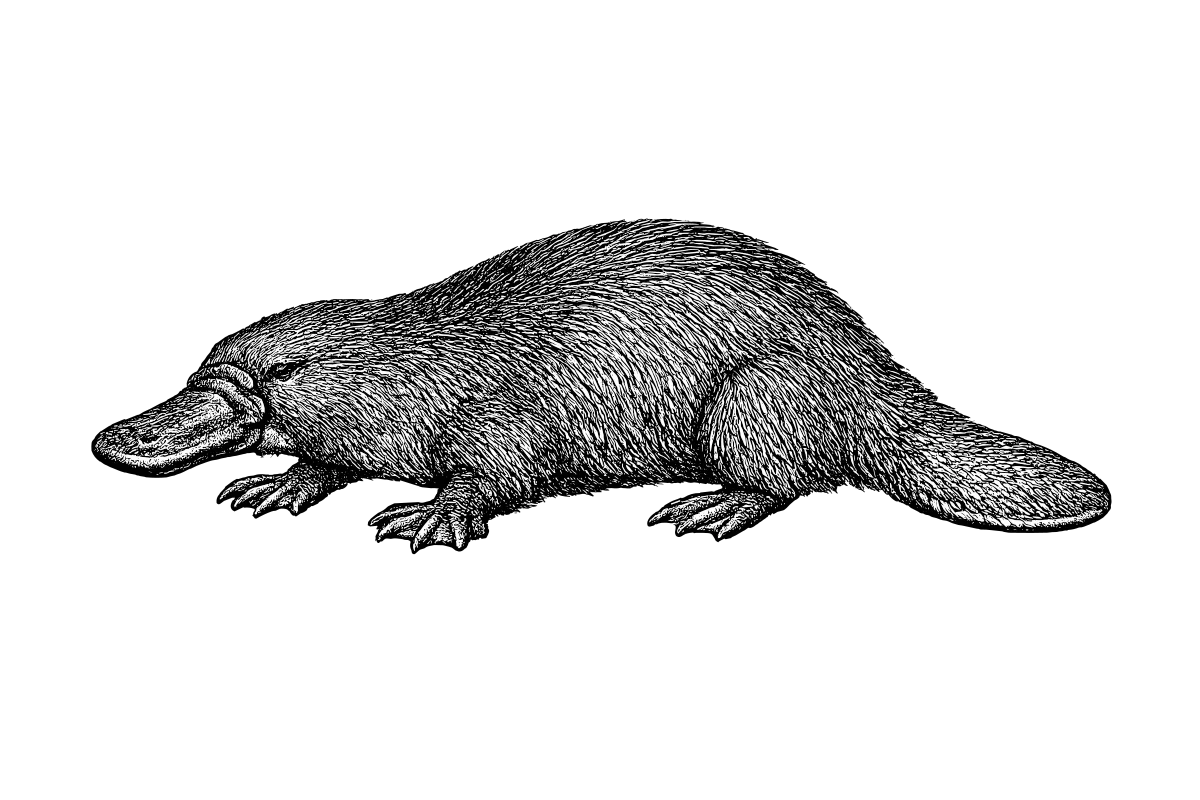
Platypus
Ornithorhynchus anatinus
A mammal that lays eggs, detects prey by electric field, has a duck's bill and a beaver's tail, and delivers venom from a spur on its hind leg. When the first specimen reached Britain in 1799, naturalists assumed it was a hoax stitched together from several animals.
Browse the Woodcut Wild shop →Habitat
Platypuses live in freshwater rivers, streams, and lakes along the eastern edge of Australia and in Tasmania. They need clean water with earthen banks for burrowing and abundant bottom-dwelling invertebrates to feed on.
Behavior
The platypus is a monotreme — one of only five surviving species of egg-laying mammals. It forages underwater with its eyes, ears, and nostrils closed, finding prey entirely by detecting the faint electric fields of muscle activity through receptors in its bill, a sense almost unknown elsewhere among mammals. It feeds on insect larvae, worms, and shellfish, storing them in cheek pouches to eat at the surface. Males bear a venomous spur on each hind ankle, used in competition, that can cause excruciating pain in humans.
Marginalia
- The platypus hunts with its eyes, ears, and nose shut, navigating entirely by electroreception — sensing the electrical signals of prey muscle through thousands of receptors in its bill.
- It is one of only five egg-laying mammal species (the others are the four echidnas); females incubate eggs and then nurse the young, but have no nipples — milk seeps through patches of skin.
- Male platypuses are venomous — a spur on each hind leg delivers venom potent enough to incapacitate a dog and cause humans weeks of pain unrelieved by morphine.
- Platypus fur glows biofluorescent green-blue under ultraviolet light, a property discovered only in 2020 and of completely unknown purpose.
Common questions
Do platypuses have a stomach?
Barely — they have no true stomach at all. The esophagus connects almost directly to the intestine, with no acid-producing stomach sac in between. Several monotremes and a number of fish have lost the organ independently, probably because a diet of soft invertebrates ground up with grit never needed it.
What is a baby platypus called?
There is no official term, though 'puggle' is widely used and borrowed from baby echidnas. A female lays one to three small leathery eggs in a burrow, curls around them for about ten days, and then nurses the blind, hairless young for months as milk seeps through her skin. The young are weaned underground and rarely seen.
How long do platypuses live?
Longer than their size suggests — commonly around a dozen years in the wild, and into their twenties in captivity. For a small mammal that is unusually long-lived, in keeping with the slow, low-energy pace of the monotremes.
What eats a platypus?
Snakes, large native fish, goannas, and birds of prey take them, and introduced foxes and dogs have added pressure since European settlement. Drowning in unattended fishing nets and yabby traps is now one of the largest single killers — a platypus surfaces to breathe every couple of minutes and cannot escape a submerged trap.
Can you keep a platypus as a pet?
No. They are protected in Australia, are not exported, and have never been kept successfully outside a handful of specialized Australian facilities. They need cold, clean running water, eat their own body weight in live invertebrates over a few days, and the males are venomous — a combination that rules out any private keeping.