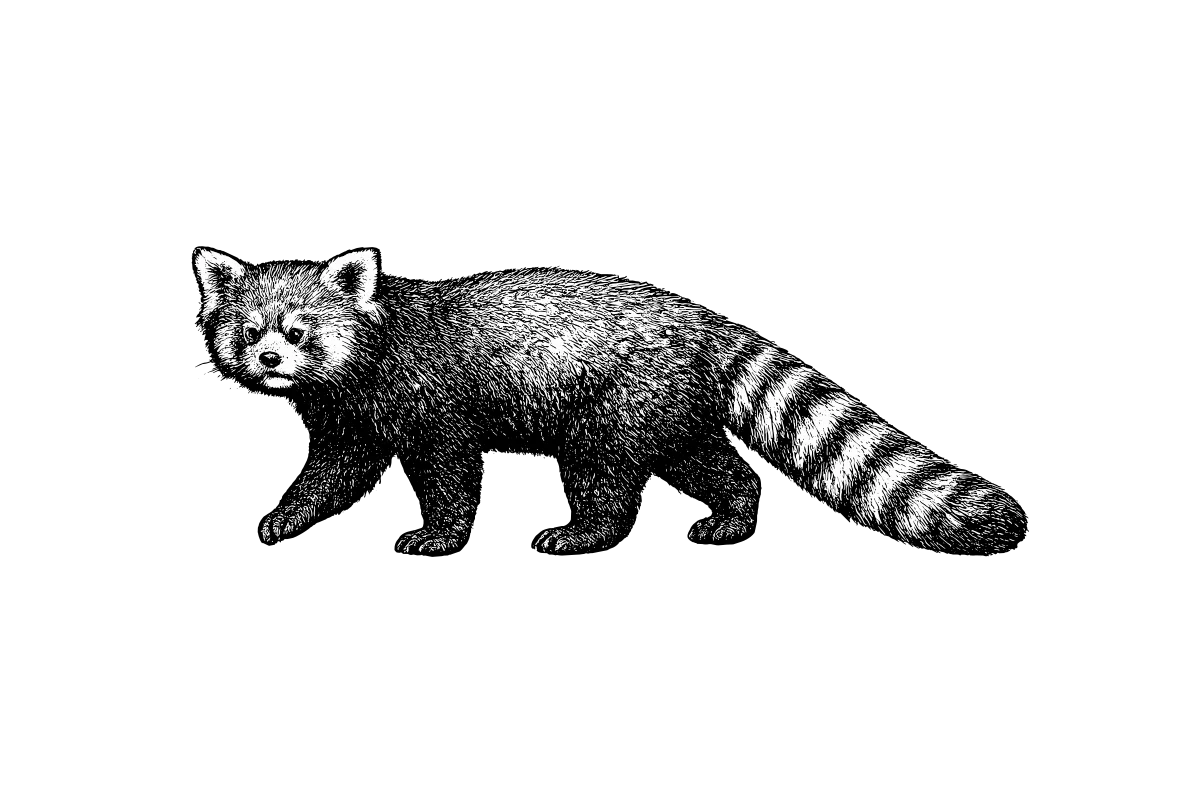
Red Panda
Ailurus fulgens
Not a bear, not a raccoon — the red panda is the only living member of its family, a russet-orange tree dweller that eats bamboo with the same false thumb as the giant panda. An unrelated case of evolution arriving at the same solution.
Browse the Woodcut Wild shop →Habitat
Red pandas live in the temperate bamboo forests of the eastern Himalayas — Nepal, northern Myanmar, Bhutan, parts of India, and south-central China. They prefer cool montane forest between 7,000 and 13,000 feet, with dense bamboo understory and reliable rainfall.
Behavior
Red pandas are largely solitary, mostly crepuscular, and almost entirely arboreal. They spend their days curled in tree forks and feed at dawn and dusk on bamboo leaves and shoots, supplemented with fruit, eggs, and the occasional small bird or rodent. They communicate with a distinctive twitter call, scent-mark with anal glands and footpads, and use their bushy tail for balance and warmth — wrapped around themselves as a blanket in cold weather.
Marginalia
- The red panda was scientifically described in 1825 — nearly 50 years before the giant panda.
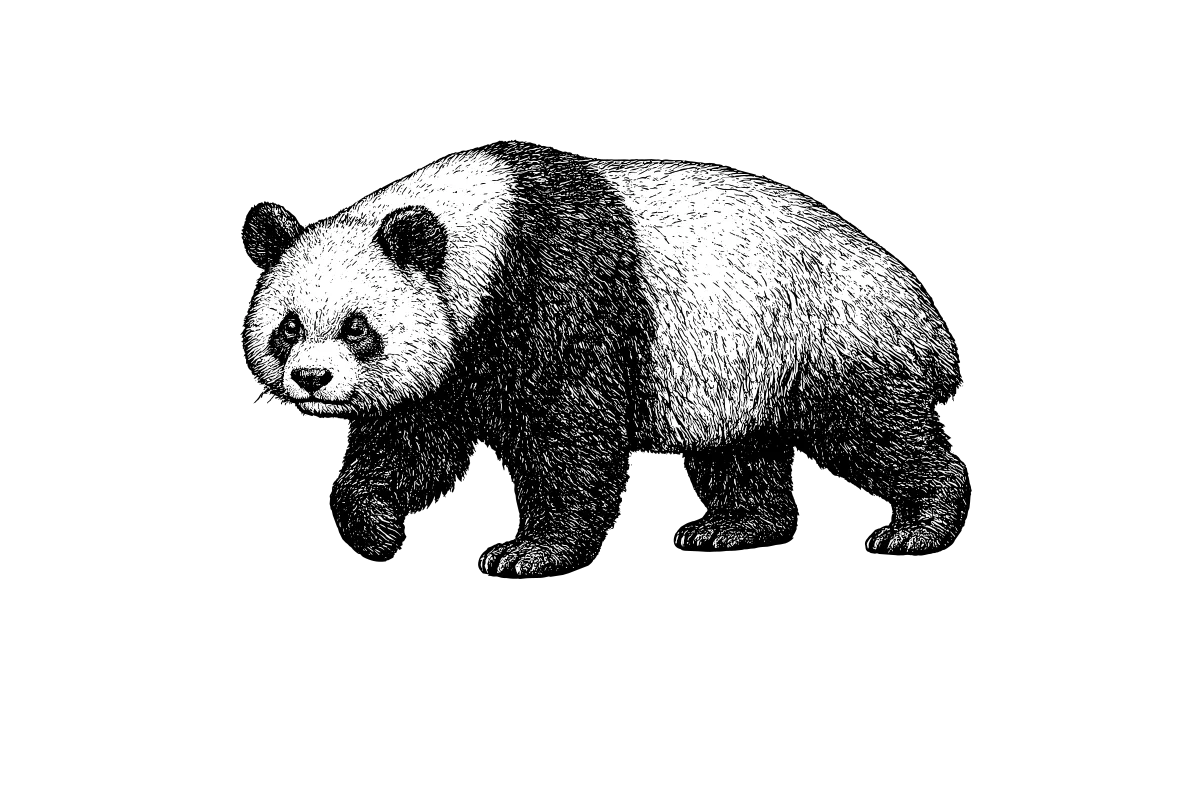
- Its false thumb, used for gripping bamboo, evolved independently from the giant panda's. A clear example of convergent evolution.
- The Mozilla Firefox logo is often misidentified as a fox; it's actually a stylized red panda.
- Fewer than 10,000 are estimated to remain in the wild, with habitat loss as the primary driver of decline.
Kin & neighbors
Common questions
How long do red pandas live?
Around eight to ten years in the wild, and into the mid-teens under human care, where the record approaches twenty. The bamboo diet is so poor in calories that a wild red panda spends much of its life on a tight energy budget, which leaves little margin when food or habitat runs short.
What is the difference between a red panda and a raccoon?
They are not close relatives despite the shared face and ringed tail. The raccoon is a New World carnivore of the family Procyonidae; the red panda is the sole survivor of its own family, the Ailuridae, and lives only in Asian mountain forests. The resemblance is a coincidence of pattern, not kinship — and the red panda is a near-vegetarian, while the raccoon eats anything.
What does a baby red panda look like?
Born buff-gray, blind, and helpless, with the russet adult coat coming in over the first months. A mother gives birth to one to four cubs in a tree-hollow or rock-den nest she lines with leaves and moss, and the cubs stay hidden with her for about three months before they begin to climb on their own.
Can you keep a red panda as a pet?
No — it is illegal nearly everywhere and would be cruel where it is not. Red pandas are an endangered species protected by international trade law, require a constant supply of fresh bamboo and cold mountain temperatures, and stress badly outside specialized care. The ones you see are in accredited zoos and conservation breeding programs.
What eats a red panda?
Snow leopards and martens are the main natural predators, and birds of prey can take the cubs. In the trees a red panda is hard to reach, but its slowness on the ground leaves it exposed — and across its range, free-roaming domestic dogs and poaching now kill more than any wild hunter.