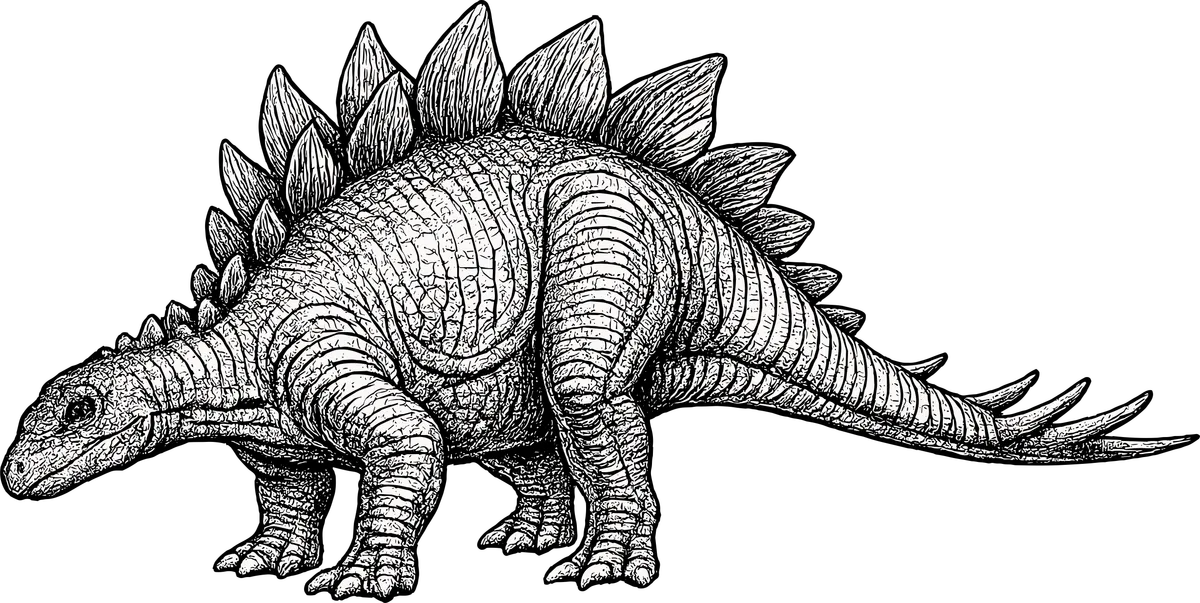
Stegosaurus
Stegosaurus stenops
Thirty feet of armored herbivore, with a double row of bony plates running down its back and four spikes on the tail. The most distinctive silhouette of the Jurassic — and one whose plates remain among the most-debated structures in vertebrate paleontology.
Browse the Woodcut Wild shop →Habitat
Stegosaurus inhabited the riverine floodplains, open forests, and seasonally arid uplands of the Morrison Formation — the latest Jurassic environment that preserved much of the western United States. The country was warm, semi-arid, with monsoon rains feeding broad meandering rivers; the dominant vegetation was cycads, conifers, ginkgoes, and tree ferns. Stegosaurus shared this landscape with Allosaurus (its primary predator), Apatosaurus, Diplodocus, Brachiosaurus, and Camptosaurus.
Behavior
Stegosaurus was a low-browsing herbivore that cropped vegetation with a small, narrow beak and processed it with weak cheek teeth — a digestive system that likely relied heavily on gut fermentation. The tail spikes, collectively named the thagomizer (after a 1982 Gary Larson cartoon that paleontologists subsequently adopted as the formal term), were a working defensive weapon: puncture wounds matching Stegosaurus thagomizer spacing and morphology have been recovered in Allosaurus tail vertebrae, proving Stegosaurus successfully defended itself in life. The famous back plates, arranged in a double offset row down the spine, remain debated. Current consensus favors a combination of species recognition, intraspecific display, and possibly thermoregulation — though the plates' internal vascular structure can be reconstructed both ways, and the question is unresolved.
Marginalia
- Stegosaurus lived 84 million years before Tyrannosaurus rex. The temporal distance between these two famous dinosaurs is larger than the distance between Tyrannosaurus and us.
- The Stegosaurus brain weighed about 2.5 ounces — roughly the size of a lime, in a 7-ton animal. This led to a long-standing 19th-century theory of a 'second brain' in the hip — actually now known to be an enlargement of the spinal cord that probably stored glycogen, similar to a structure found in modern birds.
- The term 'thagomizer' for the tail-spike weapon was invented by cartoonist Gary Larson in a 1982 Far Side panel ('Now this end is called the thagomizer, after the late Thag Simmons'). Paleontologists adopted the term semi-formally; it now appears in peer-reviewed papers.
- Stegosaurus was named in 1877 by paleontologist Othniel Charles Marsh during the Bone Wars — the decades-long feud between Marsh and Edward Drinker Cope that produced over 130 named dinosaur species and effectively founded the field of American paleontology.
- Stegosaurus is the state fossil of Colorado, where the most complete specimens have been recovered from the Morrison Formation outcrops north and west of Denver.
Kin & neighbors
Common questions
How many plates did a Stegosaurus have?
Around seventeen to twenty-two, in a staggered double row that did not pair off across the spine — each plate sat in its own pocket of skin rather than fusing to the skeleton, which is why their exact arrangement took a century to settle. The largest, over the hips, stood more than two feet tall; they tapered to small plates at the neck and tail.
How fast could a Stegosaurus move?
Slowly. Its short, pillar-like forelimbs and bulk put its top speed at a walk of a few miles per hour — there was no running in this animal. Stegosaurus did not outpace a predator; it stood its ground and swung the spiked tail, which is exactly the defense the fossil wounds confirm it used.
Could Stegosaurus rear up on its hind legs?
Possibly, for short bursts to reach higher plants. The hind limbs were far longer and heavier than the front, the hips were massively built, and the stiff tail could have acted as a third leg of a tripod — the same body plan that lets a kangaroo or a ground sloth prop up. It was not a habitual stance, but the anatomy allows it.
How do we know what Stegosaurus looked like?
From skeletons, and one extraordinary piece of luck. Dozens of partial specimens give the bones, and a single fossil from Wyoming nicknamed 'Sophie' is about ninety percent complete — but the clincher was a Stegosaurus found with a fossilized skin impression and a throat patch of small bony studs, showing armor the bare skeleton never hinted at.
Did Stegosaurus live in herds?
The evidence is thin and points more toward a solitary life than the big herds of its long-necked neighbors. A few sites preserve several individuals together, and bonebeds of close relatives exist, but nothing like the mass nesting grounds known for other plant-eaters. The display function argued for the plates would, however, only matter to an animal that regularly met its own kind.