Stegosaurus
Stegosaurus stenops
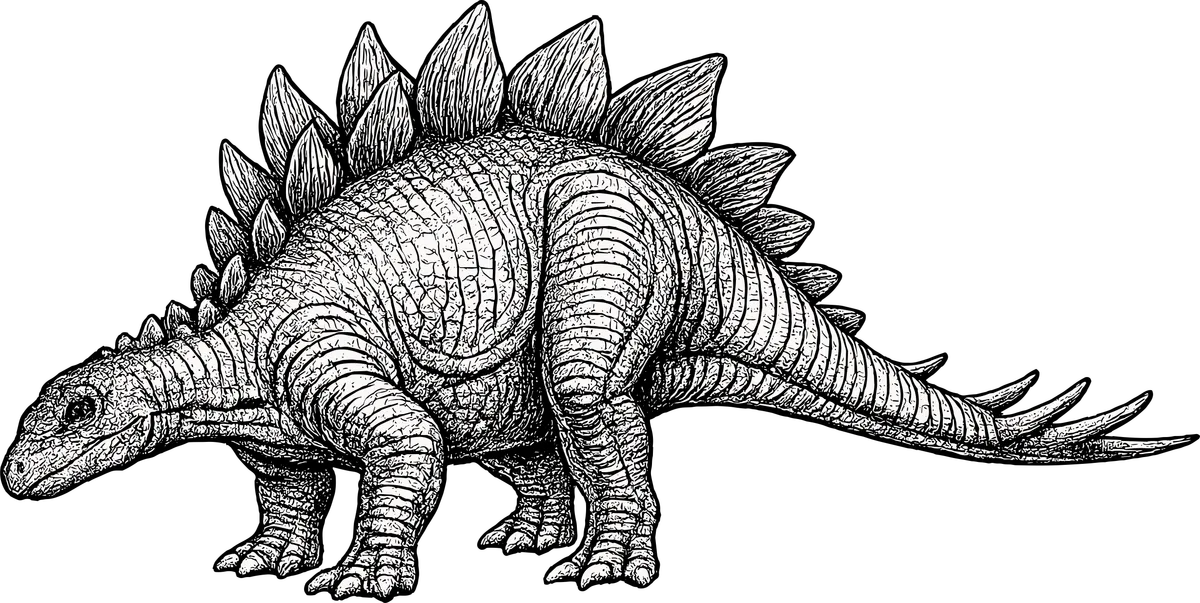
Thirty feet of armored herbivore, with a double row of bony plates running down its back and four spikes on the tail. The most distinctive silhouette of the Jurassic — and one whose plates remain among the most-debated structures in vertebrate paleontology.
Browse the Woodcut Wild shop →Habitat
Stegosaurus inhabited the riverine floodplains, open forests, and seasonally arid uplands of the Morrison Formation — the latest Jurassic environment that preserved much of the western United States. The country was warm, semi-arid, with monsoon rains feeding broad meandering rivers; the dominant vegetation was cycads, conifers, ginkgoes, and tree ferns. Stegosaurus shared this landscape with Allosaurus (its primary predator), Apatosaurus, Diplodocus, Brachiosaurus, and Camptosaurus.
Behavior
Stegosaurus was a low-browsing herbivore that cropped vegetation with a small, narrow beak and processed it with weak cheek teeth — a digestive system that likely relied heavily on gut fermentation. The tail spikes, collectively named the thagomizer (after a 1982 Gary Larson cartoon that paleontologists subsequently adopted as the formal term), were a working defensive weapon: puncture wounds matching Stegosaurus thagomizer spacing and morphology have been recovered in Allosaurus tail vertebrae, proving Stegosaurus successfully defended itself in life. The famous back plates, arranged in a double offset row down the spine, remain debated. Current consensus favors a combination of species recognition, intraspecific display, and possibly thermoregulation — though the plates' internal vascular structure can be reconstructed both ways, and the question is unresolved.
Marginalia
- Stegosaurus lived 84 million years before Tyrannosaurus rex. The temporal distance between these two famous dinosaurs is larger than the distance between Tyrannosaurus and us.
- The Stegosaurus brain weighed about 2.5 ounces — roughly the size of a lime, in a 7-ton animal. This led to a long-standing 19th-century theory of a 'second brain' in the hip — actually now known to be an enlargement of the spinal cord that probably stored glycogen, similar to a structure found in modern birds.
- The term 'thagomizer' for the tail-spike weapon was invented by cartoonist Gary Larson in a 1982 Far Side panel ('Now this end is called the thagomizer, after the late Thag Simmons'). Paleontologists adopted the term semi-formally; it now appears in peer-reviewed papers.
- Stegosaurus was named in 1877 by paleontologist Othniel Charles Marsh during the Bone Wars — the decades-long feud between Marsh and Edward Drinker Cope that produced over 130 named dinosaur species and effectively founded the field of American paleontology.
- Stegosaurus is the state fossil of Colorado, where the most complete specimens have been recovered from the Morrison Formation outcrops north and west of Denver.