Velociraptor
Velociraptor mongoliensis
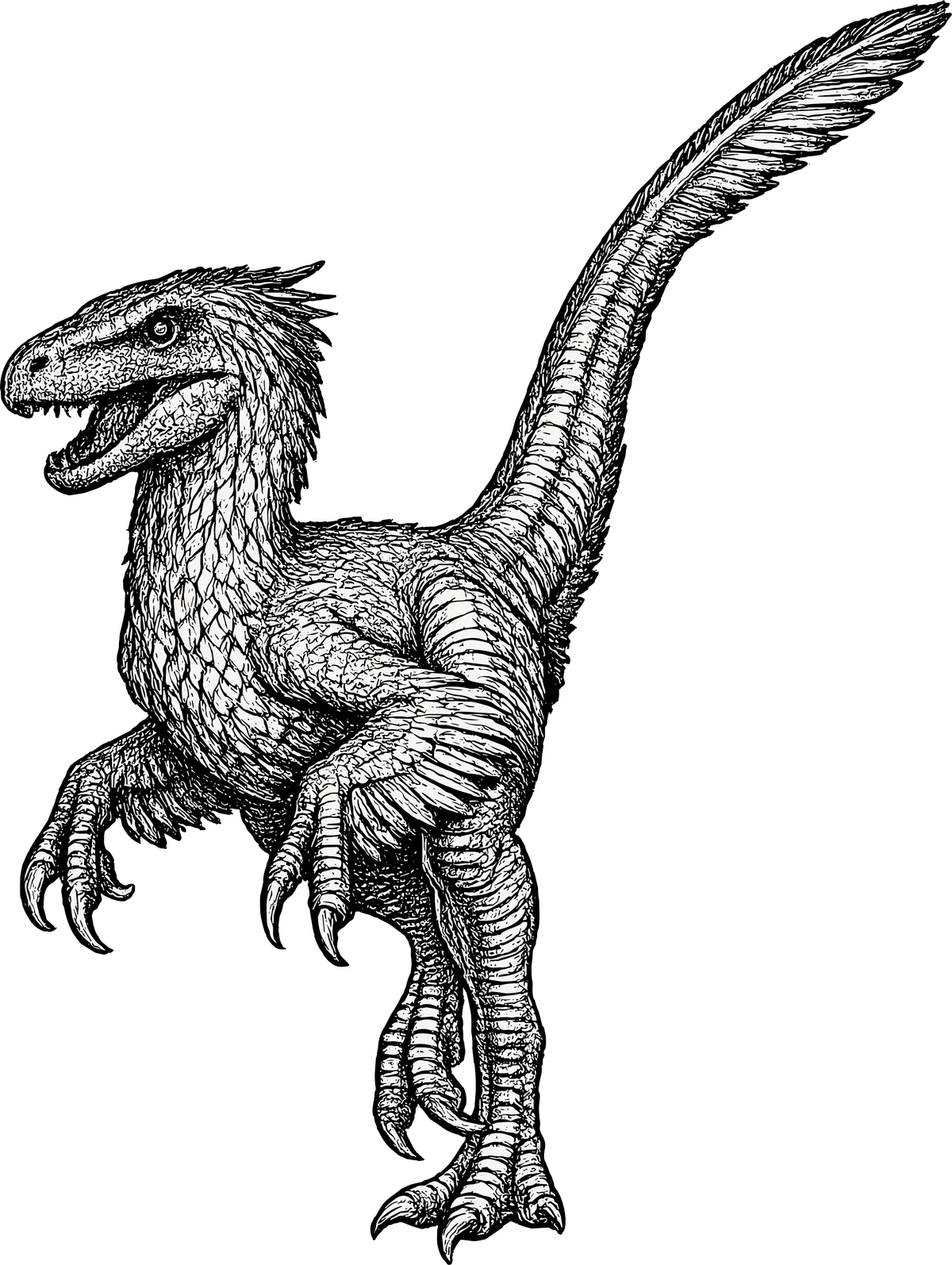
A feathered, turkey-sized dromaeosaur of Late Cretaceous Mongolia, armed with a single retractable sickle claw on each foot. Almost nothing like the wolf-sized monster of Jurassic Park — but a remarkable animal in its own right.
Browse the Woodcut Wild shop →Habitat
Velociraptor inhabited the warm, semi-arid floodplains and dune fields of what is now the Gobi Desert in Mongolia and adjacent regions of northern China and far-eastern Russia, during the late Campanian Cretaceous (~75–71 million years ago). The environment was seasonally dry with episodic torrential rains, and the famous fossil preservation of the Djadochta and Ukhaa Tolgod formations records animals that were rapidly buried by collapsing sand dunes — a process that has preserved Velociraptor skeletons in life poses, including the spectacular Fighting Dinosaurs specimen of a Velociraptor and Protoceratops locked in mid-combat at the moment of burial.
Behavior
Velociraptor was a small, swift, bipedal predator — at most six feet long head-to-tail-tip and weighing about 30 pounds, roughly the size of a coyote. The signature weapon was the second-toe sickle claw, held off the ground when walking and used in attack — recent biomechanical studies favor a 'raptor prey restraint' model in which the claw pinned struggling prey while the dinosaur fed, similar to how a modern hawk uses its talons. Definitive evidence of feathers — quill knobs along the forearm bones — was recovered in 2007, confirming the species was fully feathered, likely brightly patterned, and possibly capable of stabilizing leaps with wing-like forelimbs. Velociraptor probably hunted small lizards, mammals, hatchling dinosaurs, and juvenile or weakened larger prey. Despite Jurassic Park's pack-hunting raptors, fossil and behavioral evidence for organized pack hunting in dromaeosaurids is weak; current consensus leans toward solitary or loose-association hunting.
Marginalia
- The 'Velociraptor' of Jurassic Park is not Velociraptor. Michael Crichton borrowed the name for his novel because it sounded more dramatic, but the movie's wolf-sized raptors are anatomically closer to Deinonychus antirrhopus, a larger North American cousin. Real Velociraptor was about the size of a wild turkey.
- Velociraptor was fully feathered. Quill knobs (anchor points for flight-style feathers) on a Velociraptor forearm bone were confirmed in 2007 — direct fossil evidence that ends a long-running debate. The animal probably looked more like a long-tailed, sickle-clawed bird of prey than the scaly movie monster.
- The Fighting Dinosaurs specimen — a Velociraptor and Protoceratops fossilized in mid-combat, with the raptor's sickle claw embedded in the Protoceratops's throat and the Protoceratops's beak clamping the raptor's arm — is one of the most famous fossils in the world. The pair was buried alive in a collapsing sand dune ~75 million years ago and discovered in 1971.
- The sickle claw was previously thought to be a 'disemboweling' weapon. Modern biomechanical analyses suggest it was used more like a hawk's talon — to grip and pin struggling prey while the dinosaur held position with its body weight and ate.
- The genus name Velociraptor means 'swift thief' in Latin. The species name mongoliensis simply marks where it was first found. The genus contains a single species and was named in 1924 by Henry Fairfield Osborn at the American Museum of Natural History.