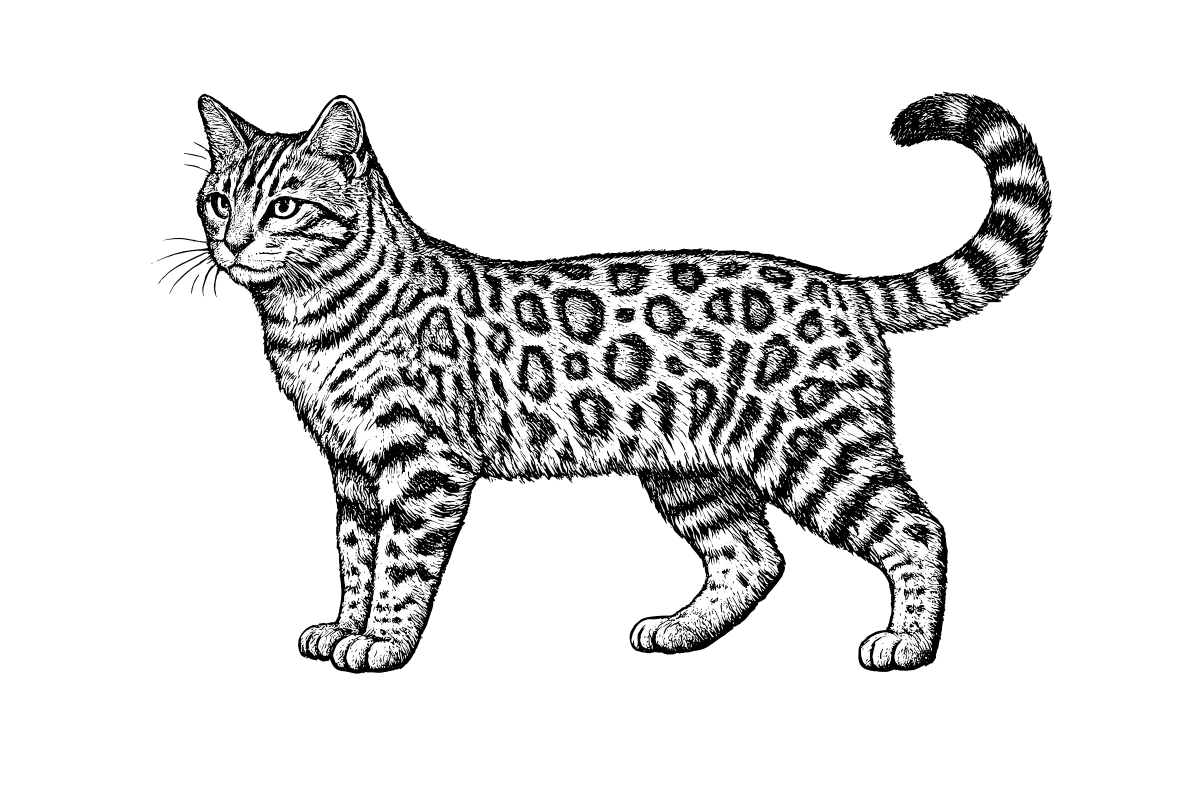
Bengal
United States, 1960s–1980s (developed by Jean Mill)
A domestic cat with a wild cat in its recent pedigree. The Bengal was created by deliberately crossing Asian leopard cats — a small wild Asian species — with domestic shorthairs, and selecting forward generations until the temperament settled while the coat retained its wild patterning.
Browse the Woodcut Wild shop →Origin & history
The breed traces to the work of Jean Sugden Mill, who in the 1960s crossed an Asian leopard cat (Prionailurus bengalensis) with a domestic shorthair to study a possible genetic link between the leopard cat and feline leukemia resistance. Mill resumed the program seriously in the 1980s using Asian leopard cats imported by Dr. Willard Centerwall as part of his FIV-resistance research. The breed standard was accepted by TICA in 1986. Modern Bengals are considered fully domestic at four generations removed from the wild ancestor (F4); earlier-generation cats (F1–F3) are still legally restricted in many U.S. states as 'hybrid wild cats.' The CFA did not accept the breed until 2018, citing concerns about the wild ancestry.
Temperament & behavior
Bengals are unusually active for a domestic cat and retain several behavioral traits from the wild parent. They are strongly drawn to running water — many Bengals will play in a sink or shower spray, and some learn to operate faucets. They are vocal in a low chirruping and growling way distinct from typical domestic-cat vocalizations. They climb obsessively, get bored quickly, and are routinely cited as the breed most likely to cause damage to a home. Many shelters maintain breed-specific surrender notes for Bengals because owners underestimate the activity level.
Marginalia
- The 'glitter' coat — an iridescent shimmer on the guard hairs — is a Bengal-specific trait that does not appear in any other breed and is selected for in show standards.
- Bengals are one of the few domestic cat breeds in which true rosettes (as opposed to simple spots) occur — inherited directly from the leopard cat parent.
- F1 Bengals (one generation from a wild leopard cat) are considered wild animals in many jurisdictions and require special permits to own; even an F4 Bengal cannot be legally owned in New York City.
- The breed's name comes not from Bengal, India but from the Asian leopard cat's scientific name, Prionailurus bengalensis.
Common questions
Do Bengals shed, and how much grooming do they need?
Less than most cats, and the grooming need is minimal. The short pelt-like coat sheds lightly and rarely mats, so a weekly once-over with a rubber brush is plenty. Grooming is the one easy part of Bengal ownership; the hard part is everything they do while awake.
Are Bengals good with kids and other pets?
Generally yes, provided the household matches their energy. Bengals tolerate confident children and play hard with active dogs, and they often do well paired with another high-drive cat that can keep up. Timid pets and quiet households tend to find them exhausting rather than charming.
What health problems are Bengals prone to?
Two are well documented. The breed carries elevated risk of hypertrophic cardiomyopathy, the most common feline heart disease, and of progressive retinal atrophy, an inherited eye condition that gradually erodes vision. Responsible breeders screen for the PRA mutation and echocardiogram the parents before pairing cats.
Are Bengals affectionate, and do they like to be held?
On their own terms, and rarely in a lap. A Bengal shows affection through proximity and participation — it wants to be wherever you are, supervising and joining in — but most resent being scooped up and held still. The bond is real; it just runs through play and pursuit rather than cuddling.
Are Bengals good for first-time owners?
Rarely. A Bengal is a high-output animal that needs hours of daily interaction, vertical space, and puzzle-feeding to stay out of trouble, and a novice owner usually underestimates all three. They are a better second or third cat — for someone who already knows what an under-stimulated cat will do to a couch.