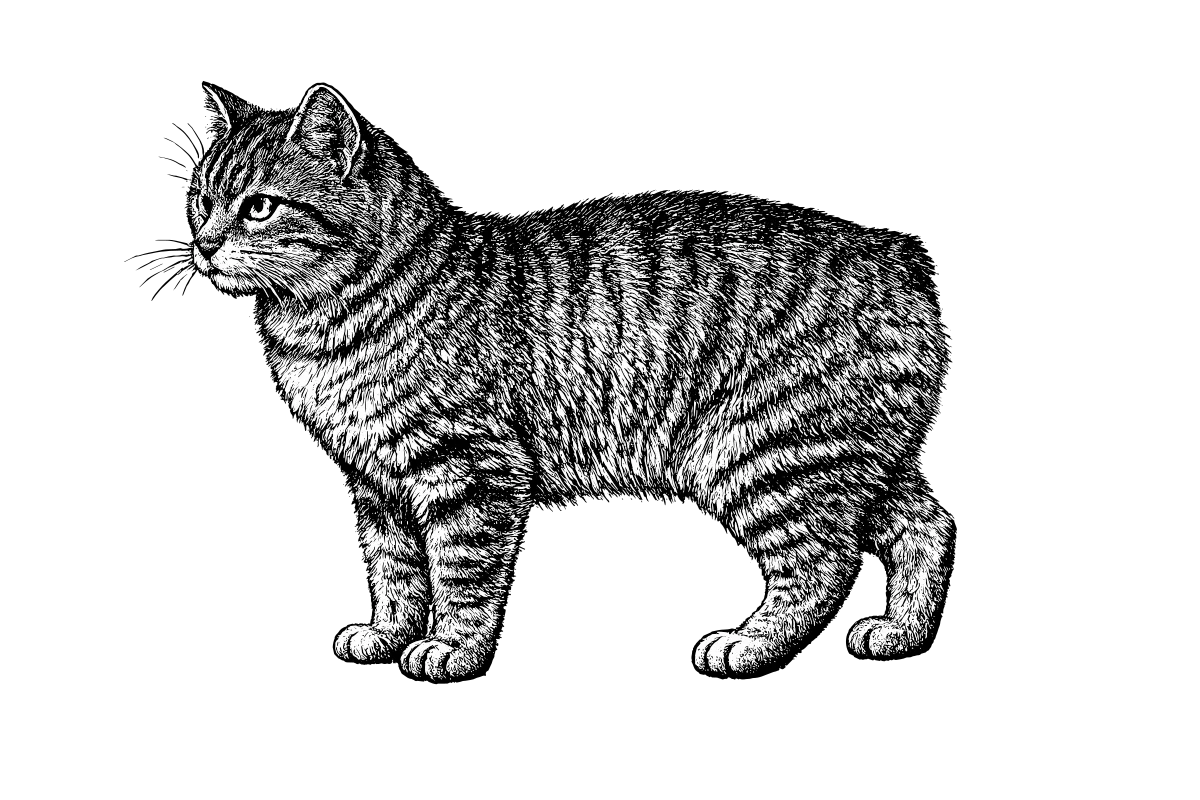
Manx
Isle of Man, several centuries (a naturally-occurring island population)
A taillessness mutation that fixed itself in a small island cat population on the Isle of Man and has been a stable breed for at least 250 years. The Manx is one of the only domestic cat breeds defined by what it lacks — and depending on the specific expression of the gene, what it lacks ranges from the whole tail to nearly nothing.
Browse the Woodcut Wild shop →Origin & history
Tailless cats have been documented on the Isle of Man since at least the late 18th century, and folk explanations for the trait run the full range — that they descend from cats whose tails were severed when boarding Noah's Ark, that they are crossbreeds with rabbits ('cabbits'), that they survived a shipwreck of the Spanish Armada in 1588. The actual cause is a single dominant mutation that disrupts spinal column development; on a small isolated island the gene reached high frequency through founder effects and inbreeding. The breed was one of the first to be formally recognized by the CFA in 1906. The Manx genome project sequenced the responsible gene in 2013.
Temperament & behavior
Manx cats are unusually placid and prone to bonding strongly with a single household — the breed is often described as 'dog-like' in this respect. They are powerful jumpers despite the missing tail (cats use their tails for balance, but Manxes compensate with stronger hindquarters and an unusually upright posture). The defining medical concern is 'Manx syndrome': the same gene that produces taillessness can also cause spinal cord defects, particularly when two tailless Manxes are bred together. Responsible breeders cross tailless Manxes only with tailed ones to suppress the homozygous condition, which is invariably fatal.
Marginalia
- Tail expression in Manxes is graded into four categories: rumpy (no tail), rumpy-riser (a small bump), stumpy (a short partial tail), and longy (a near-normal tail). Only rumpies and rumpy-risers can win in CFA show classes.
- The Manx is the official cat of the Isle of Man and has been depicted on Manx coinage and postage stamps.
- The longhaired variant is registered as a separate breed (the Cymric) in some registries but as a Manx variant in others — there is no genetic difference.
- Manx kittens are sometimes called 'stubbins' in older breed literature.
Common questions
Do Manx shed, and how much grooming do they need?
The shorthaired Manx sheds moderately and needs only weekly brushing, but the coat is a dense double layer that blows out seasonally and rewards more frequent combing during those weeks. The longhaired Cymric carries the same double coat at full length and needs brushing two or three times a week to stay free of mats.
Are Manx good with kids and other pets?
Yes on both counts. The even, placid temperament tolerates respectful children well, and the breed's dog-like sociability means Manxes often get on with actual dogs better than with aloof cats. They tend to choose one favorite person but extend easy tolerance to the rest of the household.
What health problems are Manx prone to?
One serious, breed-defining concern: 'Manx syndrome.' The same dominant gene that shortens the tail can also shorten the spine too far, causing spinal cord, bladder, and bowel defects — most severe when two tailless cats are bred together. It usually shows within the first months of life, which is why ethical breeders pair tailless Manxes only with tailed cats and place kittens late.
Are Manx affectionate, and do they like to be held?
Devoted rather than clingy, and steady about being handled. A Manx bonds hard to one household and likes to stay in the same room and follow you around, but it is a calm, undemonstrative loyalty more than constant lap-sitting. Most tolerate being picked up without fuss; they simply prefer being a quiet shadow nearby to being carried.
Should I worry about a Manx's litter box habits?
Sometimes, and it is worth asking the breeder. Because the same gene shortens the spine, a minority of Manxes have weak bowel or bladder control linked to the tailless trait, and the rumpless rear can need occasional cleaning. A healthy, well-bred Manx uses the box normally, which is exactly why the line's history matters — and why reputable breeders hold kittens until at least four months to confirm the kitten is sound before placing it.