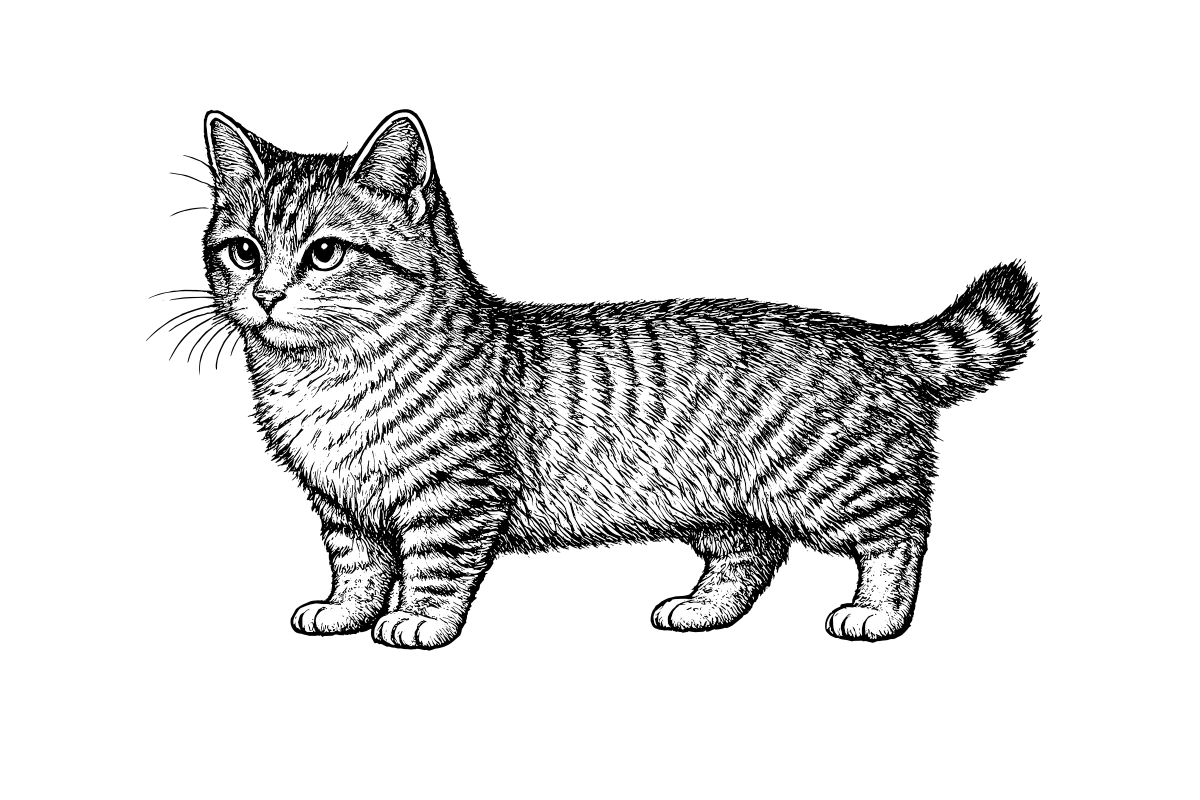
Munchkin
Rayville, Louisiana, 1983
The corgi of cats. A naturally-occurring genetic mutation produces extremely short legs on an otherwise normal cat — the same achondroplasia-style trait that gives the Dachshund and Pembroke Welsh Corgi their characteristic builds, here applied to a domestic shorthair.
Browse the Woodcut Wild shop →Origin & history
The breed traces to a single cat: a pregnant short-legged stray named Blackberry, found under a truck in Rayville, Louisiana in 1983 by Sandra Hochenedel. Half of Blackberry's kittens inherited the short-leg trait. Hochenedel and breeder Kay LaFrance developed the line, and the breed was first presented at a TICA show in 1991, where it was controversial enough that one of the judges resigned in protest. TICA accepted the Munchkin into its new-breed development program in 1994 and granted full championship status in 2003. The CFA still does not recognize the breed; the GCCF (UK) explicitly refuses to register it on welfare grounds. Despite this, the Munchkin has become one of the most commercially successful new cat breeds of the past forty years and is the foundation for several derived breeds (Dwelf, Bambino, Skookum).
Temperament & behavior
Munchkins behave like normal domestic shorthairs in nearly every respect — they run, climb, jump (with effort), play, and hunt with the same intensity as any other cat. The short legs are achondroplastic, not pathological in motion; the cats are unaware of being unusual. They are notably extroverted and social, and have a documented breed tendency to hoard small shiny objects, a trait sometimes called 'the Magpie tendency.' Welfare concerns center on possible spinal and joint issues at higher rates than typical cats, though long-term studies on this are sparse and inconclusive.
Marginalia
- The short-leg gene is heterozygous lethal — Munchkin × Munchkin pairings produce embryos that don't survive, so all Munchkins are produced by crossing a Munchkin with a standard-leg cat.
- The current Guinness record holder for shortest living domestic cat — Lilieput, an American Munchkin — stood 5.25 inches tall at the shoulder.
- The breed name comes directly from the Munchkin people of L. Frank Baum's Wizard of Oz.
- The short-leg mutation occurs naturally in feral cat populations and has been documented sporadically since the 1940s — the 'Stalingrad kangaroo cats' of WWII Russia were a wartime example, all of whom died before the breed was formalized.
Common questions
Do Munchkins shed, and how much grooming do they need?
About like any domestic shorthair — moderate shedding and a weekly brush. The catch is reach: short legs make it harder for a Munchkin to twist around and groom its own back and rear, so the longhaired variety in particular benefits from an owner combing the spots the cat cannot. Otherwise the coat is low-effort.
Are Munchkins good with kids and other pets?
Yes — the outgoing, confident temperament suits a busy household. Munchkins tend to greet children, play with dogs, and slot in with resident cats without much fuss. Their low center of gravity also makes them less inclined to bolt to high hiding spots when the house gets loud.
What health problems are Munchkins prone to?
Generally healthy, with the spine and joints worth watching. The short-leg gene is a localized cartilage trait, not a whole-body disease, so most Munchkins are sound — but the breed lacks the long-term studies older breeds have, and the obvious concern is the same one short-legged dogs face: extra stress on the back and joints over time. Buy from a breeder who outcrosses to standard-leg cats and screens the parents.
Are Munchkins affectionate, and do they like to be held?
Reliably so, and yes to being held. They are people-oriented and enjoy being picked up, and they tend to stay close and involved rather than aloof. The breed's confidence means they seek out attention rather than waiting to be coaxed — a Munchkin is more likely to climb into a lap than wait for an invitation.
Can Munchkins jump and use stairs?
Most can, just lower and with a running start. A Munchkin will climb stairs and hop onto a couch, but a tall bed or counter is often out of reach, so owners add pet steps or ramps to favorite perches. It is a practical accommodation more than a sign of distress.