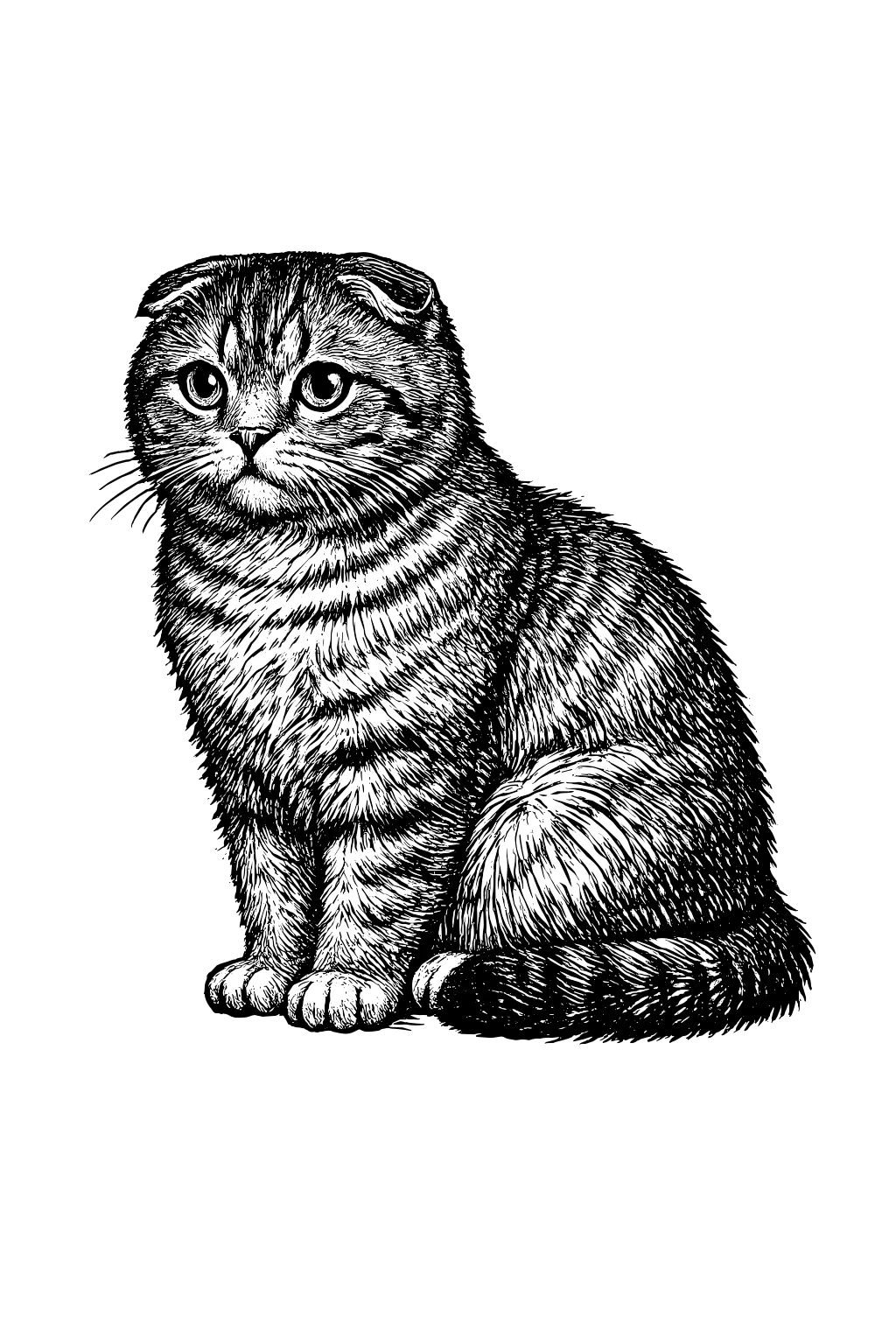
Scottish Fold
Perthshire, Scotland, 1961
The folded ears are the breed. A single autosomal-dominant gene mutation causes the cartilage in the ear to fold forward and down, giving the cat its characteristic owl-like or 'pancake-faced' appearance. The same gene also causes painful skeletal abnormalities throughout the cat's body — which is why several major veterinary bodies and registries have called for the breed to be phased out.
Browse the Woodcut Wild shop →Origin & history
The breed traces to a single white barn cat named Susie, born on a farm in Perthshire, Scotland in 1961, whose ears bent forward in an unusual fold. A neighboring farmer, William Ross, recognized the trait and began a breeding program with one of Susie's kittens. The breed was registered with the Scottish governing body and exported to the United States in 1971; the CFA accepted it for championship status in 1978. The GCCF (UK) refused to recognize the breed in 1971 — a position it has maintained on welfare grounds — and the British Veterinary Association formally recommends against breeding Scottish Folds. The breed's most famous owners — including Taylor Swift, who has been criticized publicly by animal welfare groups for popularizing the breed — have made the Scottish Fold one of the most commercially valuable cat breeds despite the welfare controversy.
Temperament & behavior
Scottish Folds are unusually placid and tolerant — the breed is often described as the most laid-back of the modern domestic cats. They are quieter than most breeds and form deep attachments to their household, and the famous 'Buddha pose' (sitting upright on the haunches with the front paws resting on the belly) is a Scottish Fold signature, possibly because the position relieves joint discomfort. The defining medical reality is osteochondrodysplasia: the same gene that folds the ears causes progressive cartilage and bone deformity throughout the cat's body, particularly in the limbs and tail. ALL Scottish Folds — including straight-eared 'Scottish Shorthair' carriers — have some degree of this skeletal disease, and most experience joint pain by middle age.
Marginalia
- The folded-ear trait is heterozygous-dominant; two Folds bred together produce homozygous offspring with severe skeletal deformity. Responsible breeders cross Folds only with straight-eared cats.
- All Scottish Folds are born with straight ears. The fold develops at three to four weeks of age — those that fold are 'Folds,' those that don't are sold as 'Scottish Shorthairs' and still carry one copy of the gene.
- Susie, the foundation cat of the entire breed, also had a curiously thick tail — a sign of the cartilage disease that wasn't understood at the time.
- Taylor Swift owns three Scottish Folds (Meredith, Olivia, Benjamin) and is the single largest contributor to the breed's modern popularity in the United States.
Common questions
Do Scottish Folds shed, and how much grooming do they need?
Moderately, and the coat is the easy part. A weekly brush keeps the short coat tidy; the longhaired Highland Fold needs combing two or three times a week to prevent mats. The ears need more attention than the fur — check them weekly, because the forward fold restricts airflow into the canal and wax builds up faster than in an open-eared cat. Wipe the visible part with a vet-approved cleaner; never probe deep into the fold.
Are Scottish Folds good with kids and other pets?
Generally very good. The calm, tolerant temperament handles gentle children and coexists peacefully with cats and dogs, and the breed rarely picks fights. They prefer steady company to a chaotic, rough-handling household, but they are among the more adaptable cats socially.
What health problems are Scottish Folds prone to?
One, and it is inherent to the breed: osteochondrodysplasia. The same gene that folds the ears causes progressive cartilage and bone deformity throughout the body, particularly the limbs and tail, and every Fold carries some degree of it — there is no healthy version of the fold. Most develop joint pain by middle age. It is the reason several veterinary bodies recommend against breeding the cat at all.
Are Scottish Folds affectionate, and do they like to be held?
Yes, in a quiet, undemanding way. Folds form deep attachments and like to stay near their people, settling on a lap or beside you rather than performing for attention, and most accept gentle handling calmly. Be careful lifting one, though — given the joint disease, support the body fully and avoid pressure on the legs and spine.
What daily care helps a Scottish Fold's joints?
Soft surfaces and low jumps. Because the breed lives with cartilage and joint disease, owners ease the load with padded beds, ramps or steps to favorite perches, a low-sided litter box, and warmth, which seems to relieve stiffness. Watch for a cat that hesitates to jump, walks stiffly, or stops grooming its lower body — those are signs to see the vet.