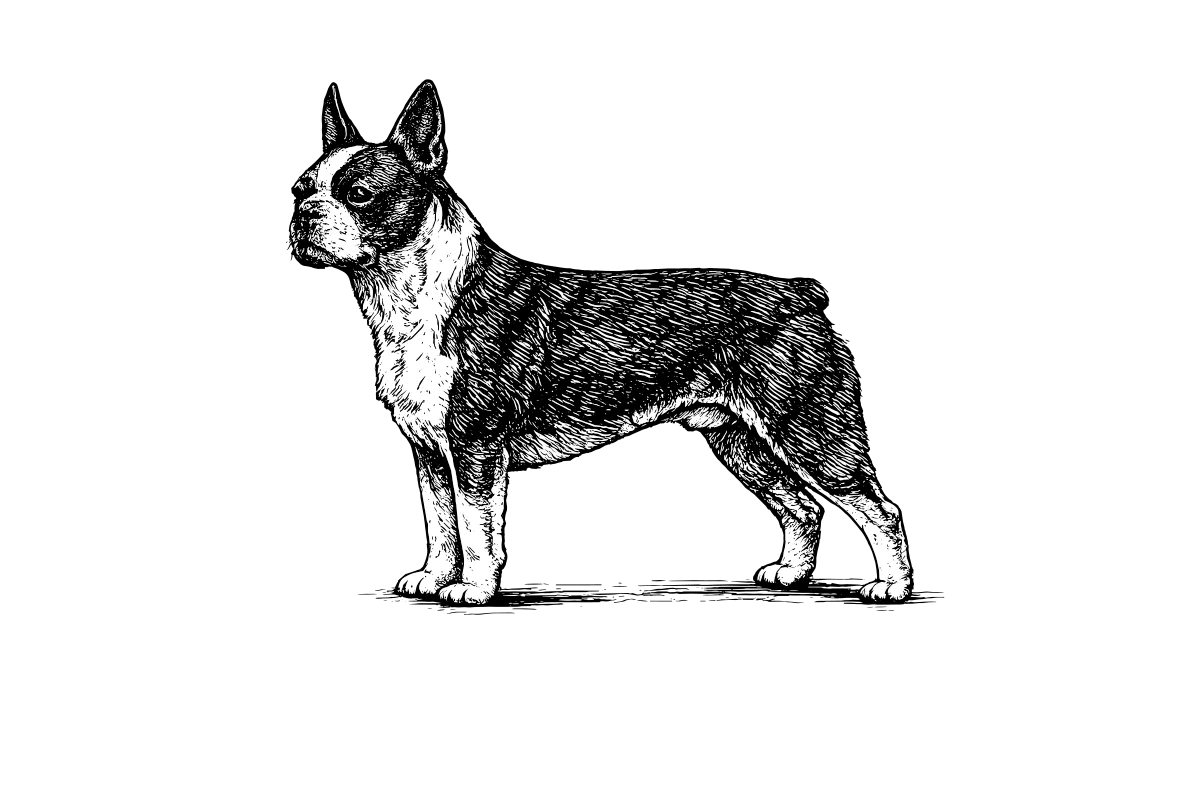
Boston Terrier
Non-Sporting group · Boston, Massachusetts, late 19th century
The American Gentleman. One of the first breeds developed entirely in the United States, derived from English Bulldog–terrier crosses originally bred for fighting, then redirected within a generation into a small companion dog with a dinner-jacket coat pattern.
Browse the Woodcut Wild shop →Origin & history
The breed traces to a single dog: Judge, a Bulldog-and-white-English-Terrier cross imported to Boston in 1865. Judge was bred down through subsequent generations with smaller females, and by the 1890s a recognizably modern Boston Terrier had emerged — smaller, flatter-faced, and bred entirely away from the fighting pit. The Boston Terrier became the first non-sporting breed developed in the United States to gain AKC recognition (1893) and was for decades the most popular breed in the country. The breed is the official dog of the Commonwealth of Massachusetts and the mascot of Boston University.
Temperament & behavior
Boston Terriers are quieter than most small dogs — they rarely bark without cause and tend to be measured around strangers. The breed is sensitive to tone and will sulk after being scolded. The flattened skull produces some of the same brachycephalic respiratory issues as the French Bulldog, though usually less severely; eyes are also vulnerable due to the shallow sockets. They are notoriously gassy, a consequence of swallowed air from the flat face.
Originally bred for
Pit fighting, briefly — then companionship, almost immediately.
Marginalia
- The 'tuxedo' marking is not optional in the breed standard — a solid-color Boston Terrier is disqualified from conformation.
- Bostons were known as 'Round Heads' or 'Bull Terriers' until 1891, when the American Bull Terrier Club voted to rename the breed after the city that developed it.
- Helen Keller's Boston Terrier, Sir Thomas, was reportedly the first of the breed widely photographed and helped popularize the breed nationally.
- Despite the name, the breed has no behavioral or genetic connection to working terriers — by the 1880s the breeders had already pulled most of the terrier ancestry back out.
Related breeds
Common questions
Do Boston Terriers shed?
Lightly. The short, fine single-layer coat sheds modestly year-round and needs little more than a weekly wipe with a rubber curry brush. They are about as low-maintenance as a coat gets, though the facial folds need occasional cleaning to stay dry.
Are Boston Terriers good with kids and other pets?
Generally very good with both. The breed is sturdy enough for gentle older children and was bred for sociability rather than guarding or hunting, so it tends to get along with other dogs and cats. Supervise play with toddlers, mostly to protect the dog's prominent eyes.
What health problems are Boston Terriers prone to?
Mostly eyes and breathing. The shallow eye sockets make them prone to corneal ulcers, cataracts, and injury, and the flat face brings milder brachycephalic airway issues than the Frenchie — real but usually less severe. Patellar luxation and deafness also appear in the breed; responsible breeders test hearing and eyes.
How much exercise do Boston Terriers need?
Modest — a couple of short daily walks and some play indoors. They have bursts of energy but tire quickly, and the flat face limits sustained or hot-weather exertion. Overdoing it risks overheating rather than building fitness.
Are Boston Terriers good for first-time owners?
Yes — one of the easier breeds to start with. They are small, quiet by small-dog standards, eager to please, and content with modest exercise, so they forgive a novice's mistakes. The main thing to learn is heat management and routine cleaning of the facial folds and eyes.