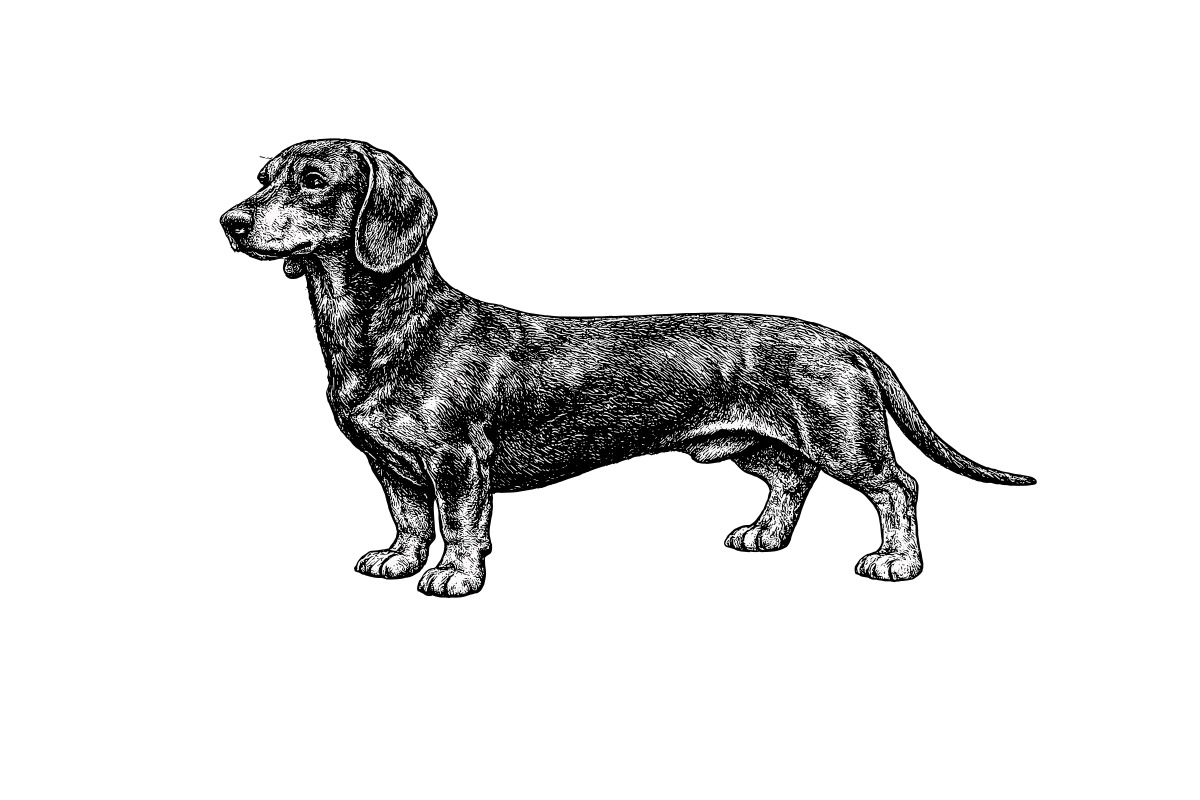
Dachshund
Hound group · Germany, 16th–17th century
A small hound built specifically to enter the burrow of a fifty-pound badger and fight it in the dark. The unmistakable silhouette — long body, deep chest, paddle-like front feet — is not a quirk of breeding but a complete functional specification for going underground after something that bites.
Browse the Woodcut Wild shop →Origin & history
The breed name is literal: 'Dachs' (badger) plus 'Hund' (dog). The earliest references appear in German hunting manuscripts in the 1500s, and the modern type was largely fixed by the late 19th century. The original Standard Dachshund was bred to corner European badgers underground; Miniature Dachshunds were later developed to pursue rabbits and other smaller burrowing animals. The breed nearly disappeared from English-speaking countries during the First World War due to anti-German sentiment, and was rebranded as the 'Badger Dog' in some kennel clubs to survive.
Temperament & behavior
Dachshunds are built for working alone underground, which produces a temperament unlike most modern companion breeds — independent, vocal, and entirely willing to escalate a conflict. They bark with disproportionate volume for their size, ignore commands they consider unreasonable, and remain capable hunters of small game well into old age. Their long spine is also their primary medical liability: roughly one in four develops intervertebral disc disease, and jumping from furniture is a meaningful risk.
Originally bred for
Following European badgers into their setts and engaging them underground.
Marginalia
- The body is engineered for digging and underground work: short, powerful legs; an elongated rib cage to house large lungs; loose skin that won't tear when scraped against burrow walls.
- The wirehaired variety was created in the late 1800s by crossing smooth Dachshunds with terriers, which is why wirehairs often have a more terrier-like temperament.
- Picasso owned a Dachshund named Lump who appears in over fifty of his works.
- Dachshunds were the first official mascot of the modern Olympic Games — Waldi, a longhaired Dachshund, represented the 1972 Munich Olympics.
Common questions
Do Dachshunds shed?
Yes, with the amount depending on the coat. Smooths shed lightly and steadily; longhairs shed more and need regular brushing to avoid mats; wirehairs shed least but require periodic hand-stripping of the coat. None is hypoallergenic.
Are Dachshunds good with kids and other pets?
Better with older, gentle children than with toddlers. The breed tolerates respectful handling but is not endlessly patient, and rough or careless lifting is both unwelcome and physically risky given the fragile spine. They bond closely with their own family but can be snappy when startled or mishandled, and the hunting drive means small pets like rabbits or rodents are not safe companions.
What health problems are Dachshunds prone to?
The back, above all. The long spine and short legs make the breed highly prone to intervertebral disc disease, which can cause pain or paralysis; roughly a quarter are affected over a lifetime. They are also prone to obesity, which compounds the spinal risk, and to patellar luxation and progressive retinal atrophy. Keeping the dog lean is the single most protective thing an owner can do.
How much exercise do Dachshunds need?
Moderate — a couple of brisk daily walks and some play satisfy most. Keeping the dog lean matters more than the mileage, since excess weight strains the long back. Avoid jumping and stair-running, which are the real spinal risks, not lack of exercise.
How do you protect a Dachshund's back?
Keep it lean, and keep it off the furniture. The long spine and short legs make intervertebral disc disease the breed's defining hazard, so the standard advice is to limit jumping on and off couches and beds, restrict stair use, and support the body with one hand under the chest and one under the rear whenever you lift. Ramps and steps to favored perches are a common, sensible accommodation.