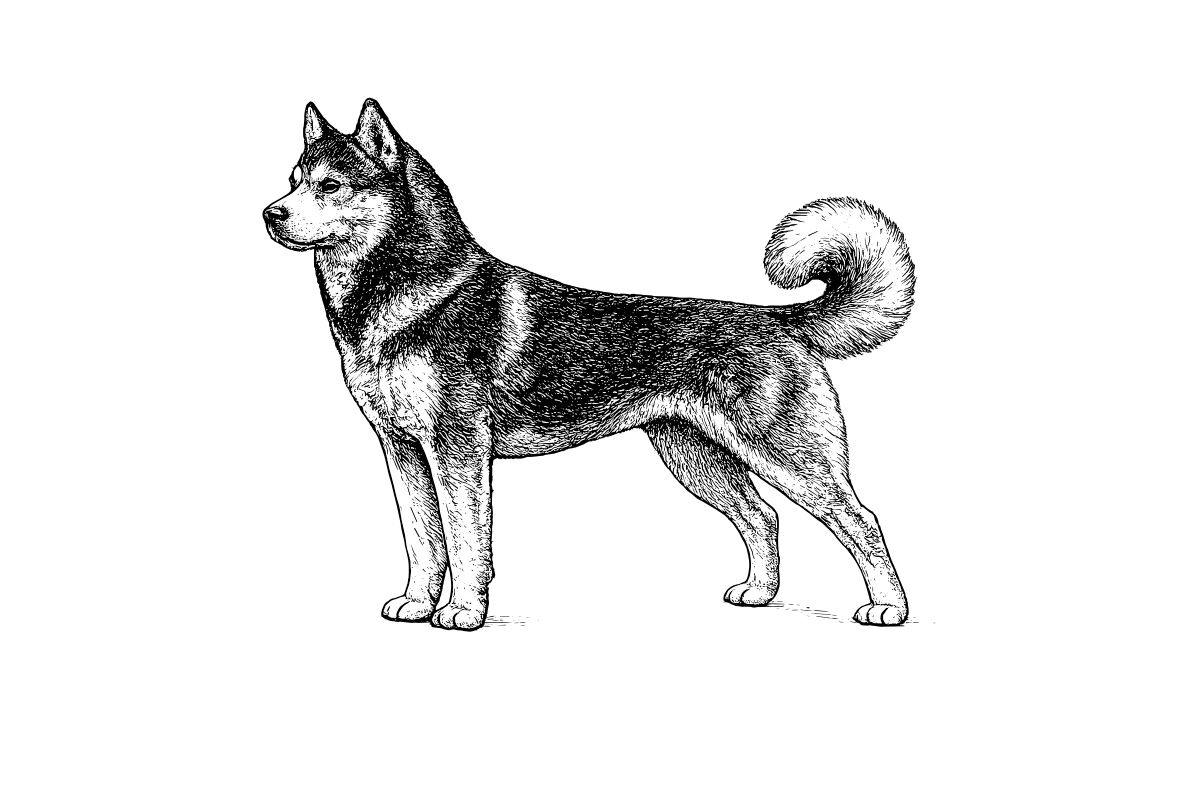
Siberian Husky
Working group · Northeastern Siberia (Chukchi people), several thousand years ago
A working sled dog from the Bering Strait, bred by the Chukchi people for endurance and economy of motion at extreme cold. The Husky was never intended to be obedient, only to keep running — a temperament that remains in every modern Husky born to a heated suburban home.
Browse the Woodcut Wild shop →Origin & history
The Siberian Husky is one of the few dog breeds that derives directly and continuously from an aboriginal working population. The Chukchi people of northeastern Siberia developed the breed over several thousand years as a long-distance hauler — light, efficient, and able to live on minimal food in extreme cold. Huskies entered North America in 1908 when fur trader William Goosak imported a team to Nome, Alaska to compete in the All-Alaska Sweepstakes sled race. The breed's reputation was sealed by the 1925 serum run to Nome, when relay teams of Huskies and other sled dogs carried diphtheria antitoxin 674 miles across the Alaskan interior in -50°F weather to halt an outbreak. The lead dog of the final leg, Balto, has a statue in Central Park.
Temperament & behavior
Huskies are unusually disinterested in human approval. They are sociable but not biddable — most will not reliably return when called, do not naturally guard, and cannot be trusted off-leash. They were bred to run, and given any opportunity will leave. They are also among the most vocal dog breeds, producing howls, talking sounds, and the so-called 'wooing' chatter unique to the breed. They shed continuously and the spring/fall coat blow produces volumes of undercoat that resemble small animals on the floor.
Originally bred for
Pulling light loads across long distances over Arctic terrain in temperatures down to -75°F.
Marginalia
- Huskies can have heterochromia — one blue and one brown eye, or split-color eyes within a single iris — at much higher rates than most breeds.
- The breed metabolizes fat differently from most dogs; working teams in the 1925 serum run survived on diets that were over 60 percent fat.
- Balto, the famous lead dog of the serum run, was actually a backup driver's dog — Togo, the lead dog of the longest and most dangerous leg, received less recognition during his lifetime.
- The breed is one of the most-surrendered to shelters in the United States because owners chronically underestimate the exercise and confinement requirements.
Common questions
Do Siberian Huskies shed?
Heavily, and year-round. The dense double coat sheds steadily the whole year and then blows out completely twice a year, depositing volumes of undercoat that owners describe as small animals on the floor. Daily brushing during a coat blow stays ahead of the worst of it but never stops it, and the breed is emphatically not hypoallergenic — few dogs put more hair and dander into a home.
Are Siberian Huskies good with kids and other pets?
Good with children, often poor with small animals. Huskies are friendly, pack-oriented, and not territorial, so they tend to be tolerant and playful with kids — though the independence means they will not guard or supervise the way some breeds do, and their strength can knock a small child flat in pure exuberance. The harder issue is prey drive: a working sled dog was expected to find its own food, and many huskies will chase and harm cats, rabbits, and small dogs on instinct. The drive does not reliably train out.
What health problems are Siberian Huskies prone to?
Fewer than most breeds their size, which is part of the appeal — the aboriginal working background kept the gene pool relatively sound. The notable predispositions are ocular: huskies are prone to juvenile cataracts, corneal dystrophy, and progressive retinal atrophy. Hip dysplasia occurs but at lower rates than many large breeds, and a well-bred husky often reaches the upper end of its lifespan.
How much exercise do Siberian Huskies need?
An enormous amount — this is the single most underestimated thing about the breed. A husky was bred to run dozens of miles a day and is not satisfied by a walk or a yard; it needs hard, sustained daily exertion, and ideally a job that involves running or pulling. A husky denied that outlet becomes destructive, vocal, and inventive, and chronic under-exercise is why the breed fills shelters.
Are Siberian Huskies hard to keep contained?
Notoriously so — they are among the most accomplished escape artists in dogdom. A husky will dig under a fence, climb a six-foot one, slip a collar, and bolt through an open door, and once loose it simply runs, often for miles, because the instinct to keep moving overrides any recall. Secure fencing with a dug-in base, a leash at all times outside an enclosed yard, and no off-leash trust are non-negotiable with this breed.