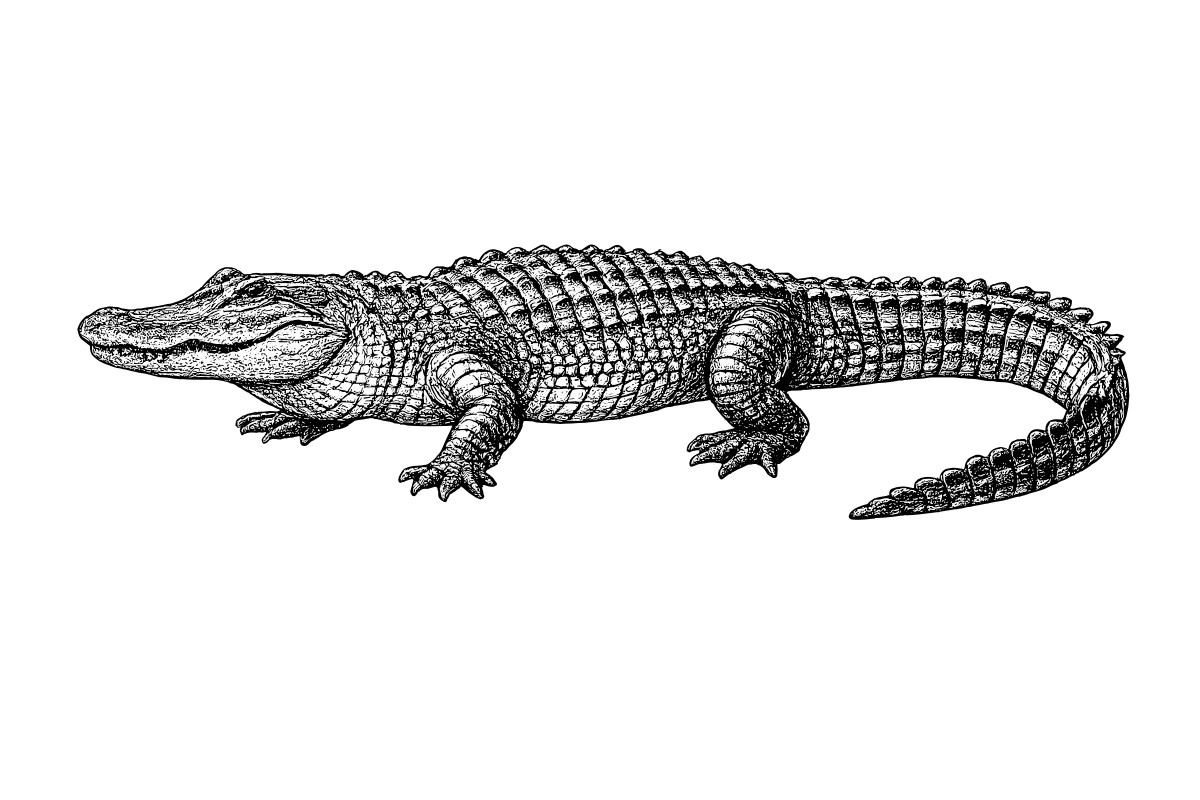
American Alligator
Alligator mississippiensis
A living archosaur — closer kin to birds and dinosaurs than to lizards — and one of conservation's clearest victories. Hunted to the brink by the 1960s, the American alligator recovered so completely that it was delisted within two decades, and now numbers in the millions.
Browse the Woodcut Wild shop →Habitat
American alligators live in the freshwater wetlands of the southeastern United States — swamps, marshes, rivers, and lakes. They are a keystone species of these systems, and in dry seasons they dig 'gator holes' that hold water and become refuges for fish, turtles, and birds.
Behavior
Alligators are ambush predators, lying motionless at the surface and exploding upward to seize prey in a bite that exerts some of the strongest force ever measured in a living animal. They are ectotherms, basking to regulate temperature, and can go months without eating. Mothers are unusually attentive for reptiles — they build and guard nest mounds, carry hatchlings to water in their jaws, and protect the young for up to a year. Their deep bellowing 'roar,' felt as much as heard, carries across the wetland in spring.
Marginalia
- Nest temperature determines sex — warmer nests produce males, cooler ones females, with no sex chromosomes involved at all.
- The American alligator is a conservation success story: listed as endangered in 1967, it recovered so fully that it was removed from the endangered list in 1987.
- Alligators are members of the archosaurs and are more closely related to birds and extinct dinosaurs than to any lizard or snake.
- They survive freezing weather by 'snorkeling' — holding the tip of the snout above the surface as ice forms around them, then waiting, immobile, for the thaw.
Kin & neighbors
Common questions
What is the difference between an alligator and a crocodile?
Look at the snout and the teeth. An alligator has a broad, rounded, U-shaped snout and, with its mouth closed, shows only the upper teeth — the lower ones tuck into pits in the jaw. A crocodile has a narrower V-shaped snout and a toothy grin in which the fourth lower tooth juts up over the lip. Alligators are also darker, prefer fresh water, and are far less aggressive. In the United States they overlap only at the southern tip of Florida, the one place on earth both animals live side by side.
How long do alligators live?
Commonly 30 to 50 years in the wild, and longer in captivity — a famous individual at a Belgrade zoo reportedly passed 80. Like most reptiles they keep growing slowly throughout life, so the truly large old males represent decades of steady growth.
How fast can an alligator run?
Faster than people expect over a short distance — roughly 30 mph in a brief burst on land. But they tire almost immediately and cannot sustain it; an alligator runs to reach water, not to chase down prey across open ground. The folk advice to flee in a zigzag is unnecessary. A straight line away is fine.
What do alligators eat?
Whatever is available and catchable. Young alligators take insects, snails, frogs, and small fish; adults move on to fish, turtles, birds, snakes, and mammals up to the size of a deer or wild hog. They swallow small prey whole and use a 'death roll' to tear chunks from anything too large to gulp.
Do alligators attack humans?
Rarely, and far less often than crocodiles. Serious bites in the United States average only a handful a year despite millions of alligators living near millions of people. Almost every attack traces to an animal that has been fed by people and lost its fear, or to someone entering the water at dusk or dawn when alligators hunt.