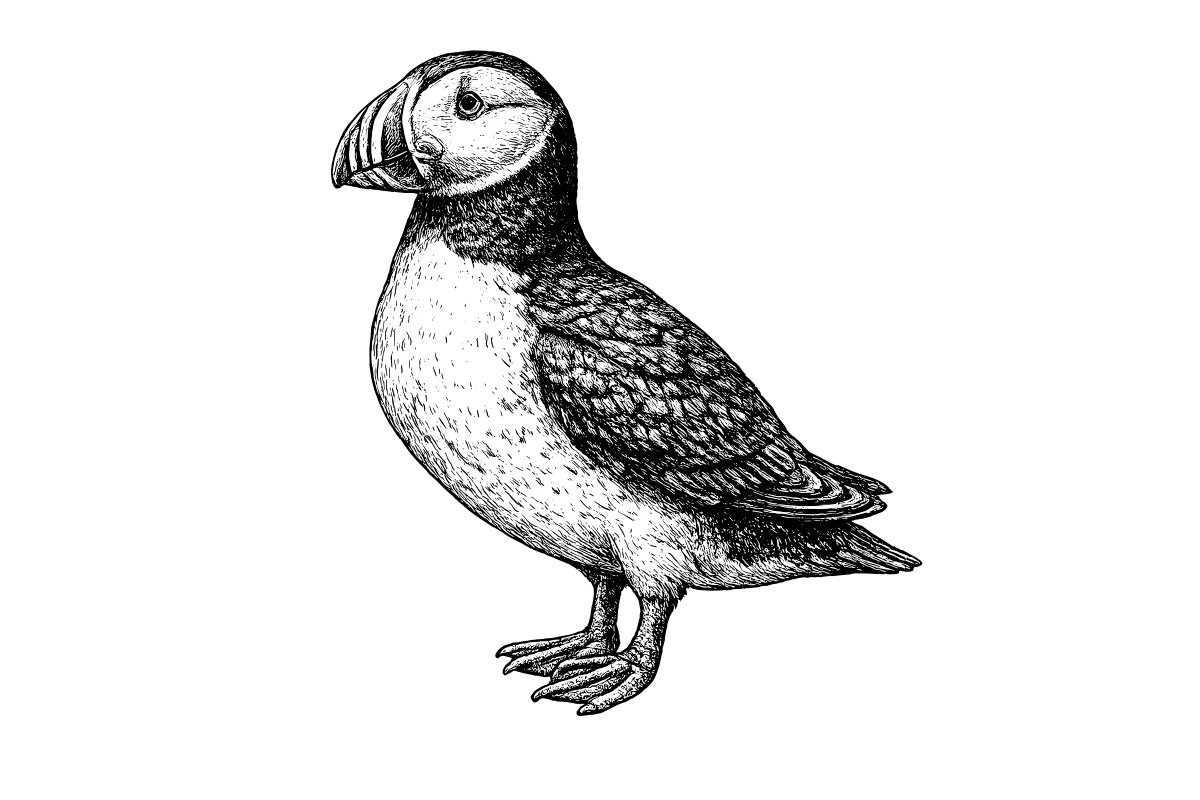
Atlantic Puffin
Fratercula arctica
A small black-and-white North Atlantic seabird with a comically large, technicolor bill — but only in summer. The famous orange-and-blue beak is a seasonal mating ornament; in winter the colorful plates fall off and the puffin's face dulls down to a quiet grey.
Browse the Woodcut Wild shop →Habitat
Atlantic puffins breed on cold-water cliffs and islands across the North Atlantic — Iceland, the British Isles, Norway, the Faroes, Greenland, Newfoundland, and Maine. They nest in burrows dug into soft soil at the cliff top, usually within a few yards of other puffin pairs. Outside the breeding season they live entirely at sea, scattered across the open North Atlantic and rarely seen from land.
Behavior
Puffins are pursuit divers, using stubby wings to fly underwater and a steering tail to chase sand eels, herring, hake, and capelin to depths of 200 feet. Adults can hold roughly ten small fish crosswise in the bill on a single trip back to the burrow, lined up alternately head-tail-head-tail and held in place by backward-pointing barbs on the tongue and palate. Pairs are monogamous across many years and return to the same burrow each spring; both parents incubate a single egg and share the work of feeding the chick (a 'puffling') until it fledges, alone at night, by jumping off the cliff into the sea.
Marginalia
- A puffin's bill can hold around ten small fish lined up crosswise — the record stood at 62 fish in a single beakful — held in place by backward-pointing spines on the tongue and the roof of the mouth.
- Puffins are long-lived — 20 to 25 years is common, with banded individuals over 35 — and pair bonds last for most of an adult life, with the same male and female returning to the same burrow every spring.
- The puffling fledges alone, at night, by jumping from the cliff into the sea; the parents are not present, and the young bird must figure out flight and hunting on its own.
- Puffins fluoresce under ultraviolet light along the bill ridge and feet — invisible to humans but presumably part of the visual signal between birds.
Kin & neighbors

Common questions
Why are puffin beaks colorful only in summer?
Because the color is a display, not part of the working bill. The orange-and-blue outer plates grow over the bill each spring as the breeding season approaches, intensify in color (the orange may even fluoresce under UV light to other puffins), and then shed in late summer once the chick has fledged. In winter the puffin's bill is a smaller, duller grey and the face is sooty rather than white — at sea in February a puffin barely looks like the same species.
Are puffins related to penguins?
No. Puffins are in the auk family Alcidae and are most closely related to murres, guillemots, and razorbills — all Northern Hemisphere flying seabirds that hunt by diving. Penguins are Southern Hemisphere relatives of tube-nosed seabirds and gave up flight entirely. The resemblance is convergent: a body shape good for swimming underwater pushes both groups toward the same upright, black-and-white silhouette.
Where can you see puffins in the United States?
Almost exclusively along the coast of Maine, where a multi-decade restoration project led by Project Puffin has reestablished colonies on Eastern Egg Rock, Seal Island, Matinicus Rock, and a few other small offshore islands. The species was nearly extirpated from the US by 19th-century hunting; the modern colonies are the result of translocating chicks from Newfoundland and tricking returning adults to land with decoys and recorded calls. Boat tours run from late spring through summer.
Are Atlantic puffins endangered?
Listed Vulnerable globally, with the Icelandic and Norwegian colonies — which together hold most of the world's puffins — in steep decline. The cause is shifting food supply: warming seas push the sand eels and small fish that puffins depend on out of range of the colonies, and chicks starve in their burrows. The American colonies are smaller but in better shape; the long-term trajectory for the species depends on what the North Atlantic does next.
Can puffins fly?
Yes, fast and tiringly. The same short, dense wings that work as flippers underwater are barely large enough to keep a puffin airborne — they have to beat them about 400 times a minute, and the flight is fast (around 55 mph) and ragged. Takeoff from water requires a long running launch across the surface; landing is a controlled crash. The bird is a much more capable swimmer than flier.