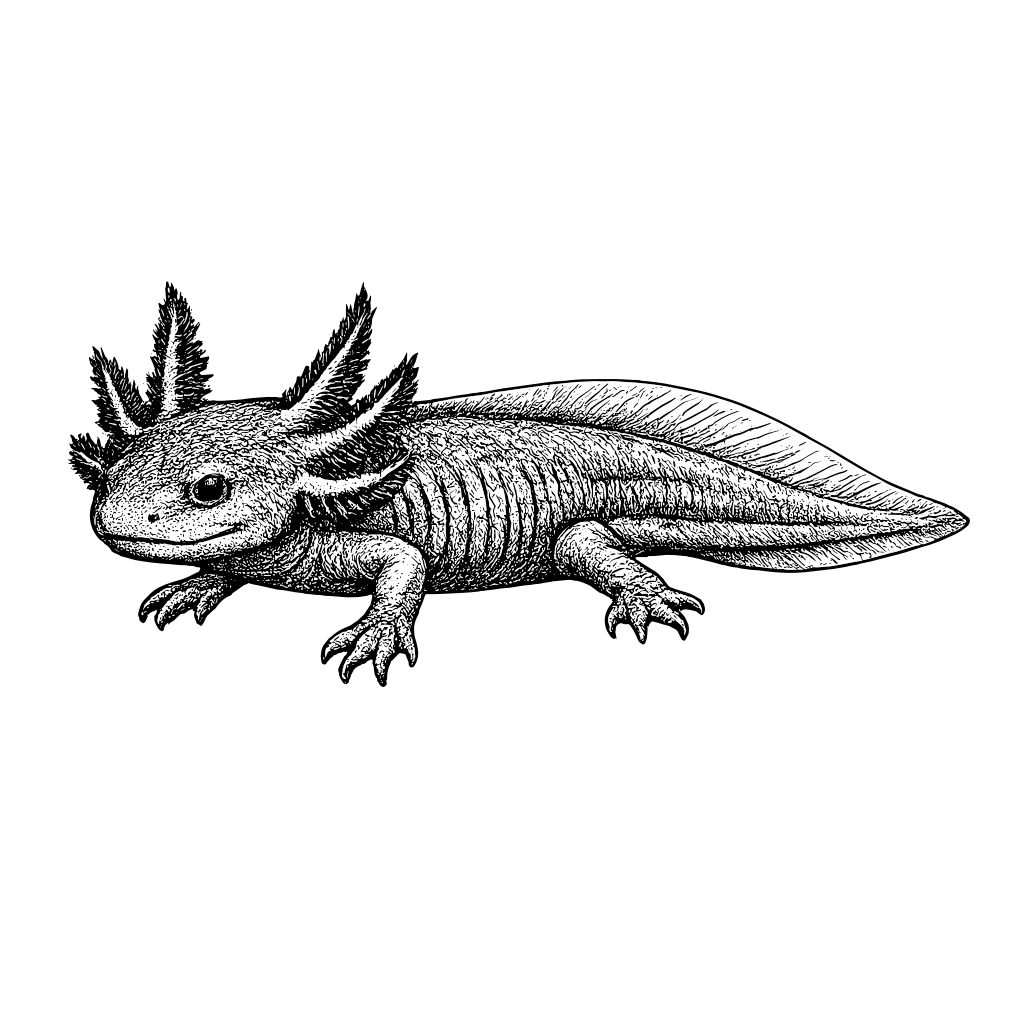
Axolotl
Ambystoma mexicanum
A salamander that never grows up. The axolotl stays in its larval form for its entire life — gills, fins, and underwater living — and as a side effect can regrow limbs, tail, spinal cord, parts of the heart and brain, and almost anything else it loses.
Browse the Woodcut Wild shop →Habitat
In the wild the axolotl is endemic to a single lake system in central Mexico — Lake Xochimilco and the canals around it, the last remnants of the great lakes that once filled the basin of Mexico City. Pollution, drainage, and introduced tilapia and carp have driven the wild population to a few hundred individuals at most. The species survives almost entirely in laboratories, pet trade, and aquariums.
Behavior
Axolotls hunt small prey — worms, insect larvae, small fish, tadpoles, and each other when crowded — by suction-feeding, opening the mouth abruptly and pulling water and food in together. They breed in cool water in late winter, with the male depositing spermatophores that the female picks up internally. Embryos can produce as many as a thousand eggs in a single clutch.
Marginalia
- An adult axolotl can regrow a limb, including bone, muscle, nerves, and skin, in roughly 60 to 90 days, with the new limb anatomically perfect.
- All the common pet axolotl color morphs — leucistic, golden albino, white albino — trace back to mutations bred from a single lab population, not from the wild.
- The Aztecs ate axolotls; sources describe a tamale wrapped around one, and the animal remained a traditional food in Mexico City into the 20th century.
- Axolotls can accept transplanted limbs — even heads — from other axolotls and integrate them, which has made them indispensable to developmental biology labs.
Kin & neighbors
Common questions
What does 'axolotl' mean?
It comes from Nahuatl and translates roughly as 'water dog' or 'water monster' — though the deeper sense is wrapped up in Aztec mythology. The god Xolotl, twin of Quetzalcoatl and patron of twins, monsters, and transformation, was said to have hidden himself in the lakes as a salamander to escape sacrifice. The axolotl, perpetually larval and refusing to change, is Xolotl made flesh.
Why don't axolotls metamorphose like other salamanders?
They have evolved out of it. Most salamanders go through metamorphosis driven by a surge of thyroid hormone — gills shrink, lungs finish forming, the animal moves to land. Axolotls produce little of that hormone and have receptors that respond weakly, so the larval form holds. Inject one with thyroid hormone in a lab and it does metamorphose, transforming into a stubbier, land-bound salamander that loses most of its regenerative ability and dies young.
Can axolotls really regrow limbs?
Yes, and not just limbs — tails, jaws, spinal cord segments, parts of the heart, and pieces of the brain regrow cleanly, without scar tissue, in a few months. The cells around the wound revert to a stem-cell-like state and rebuild the missing structure in correct anatomical order. Most of what science knows about vertebrate regeneration has come from cutting bits off axolotls and watching them grow back.
Are axolotls good pets?
They can be, for a patient owner with cold, clean water. Axolotls need a tank kept around 60–68°F (a chiller is often necessary), fine-grained or bare-bottomed substrate so they don't impact their gut, and only soft tank mates or none — anything that nips will bite their gills off. The cartoonish pink axolotl most pet owners know is the leucistic morph from a single 19th-century laboratory stock and looks nothing like the dark-grey wild type.
Are wild axolotls extinct?
Almost. Surveys of Xochimilco in the last decade have struggled to find any in some years and turned up only a handful in others, against an estimated wild population in the low hundreds. The species persists in vast numbers in captivity, but the wild animal — in the only lake system it has ever lived in — is genuinely on the brink.