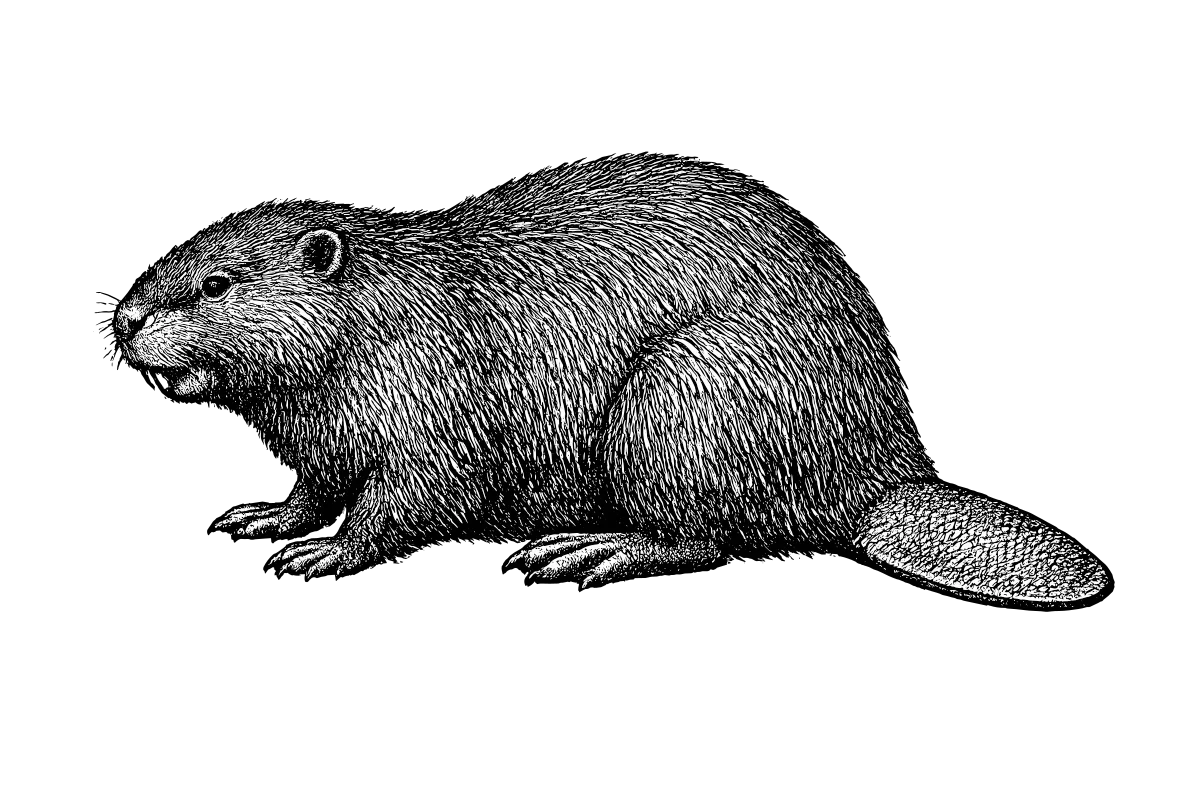
North American Beaver
Castor canadensis
The animal that builds its own habitat. The beaver is a keystone species — by felling trees and damming streams it creates wetlands that hundreds of other species depend on, reshaping watersheds so thoroughly that its near-extermination measurably changed the hydrology of a continent.
Browse the Woodcut Wild shop →Habitat
Beavers live along streams, rivers, and lakes across North America, in any forested or shrubby watercourse with trees to cut and water deep enough to protect a lodge entrance. Where the water is too shallow, they make it deeper — by building a dam.
Behavior
Beavers are nocturnal engineers. They fell trees with self-sharpening, iron-reinforced incisors, build dams to create deep ponds, and construct lodges with underwater entrances for safety. The sound of running water triggers the dam-building instinct directly — a beaver will build against a recording of a stream. They mate for life and live in family colonies, and the ponds they create become wetlands supporting fish, amphibians, waterfowl, and moose.
Marginalia
- Beaver incisors are orange because the enamel is reinforced with iron, making them hard enough to chew through hardwood and self-sharpening as the softer back of the tooth wears faster than the front.
- The continental fur trade was driven almost entirely by beaver — felt hats made from beaver underfur drove European exploration of North America, and the animal was nearly wiped out by 1900.
- Beaver dams reduce downstream flooding, raise water tables, filter sediment, and create habitat so valuable that beavers are now deliberately reintroduced as a low-cost watershed-restoration tool.
- The largest beaver dam ever found, in Alberta, is over half a mile long and visible from space.
Kin & neighbors
Common questions
Do beavers eat fish?
No — beavers are strict vegetarians, which surprises people who picture them living in ponds full of fish. They eat the bark, twigs, and inner cambium of trees like aspen, willow, and birch in winter, and switch to leaves, roots, and aquatic plants in summer. The trees they fell are food and building material, not bait.
Why do beavers slap their tails on the water?
It is an alarm. A beaver that senses danger smacks its broad flat tail down hard, producing a loud crack that warns the whole colony and sends them diving for the safety of deep water. The tail also works as a rudder when swimming, a prop when sitting upright to gnaw, and a fat store for winter.
How long do beavers live?
Around 10 to 12 years in the wild, occasionally into their late teens. They are slow to mature and raise small litters of kits each spring, with the young staying in the family lodge for about two years before heading off to claim territory of their own.
What is castoreum?
A pungent secretion beavers produce from glands near the tail and use to scent-mark territory. For centuries it was harvested as a base for perfumes and, oddly, as a vanilla-like food flavoring; the practice is now rare and the quantities once used in food were tiny. Its musky, leathery smell is part of how a beaver advertises ownership of a stretch of stream.
Are beavers dangerous?
Almost never, but not quite never. A beaver's first response to a person is to flee or tail-slap and dive. Cornered or rabid animals are the exception — those big iron-hard incisors can inflict a serious bite, and there have been rare attacks on swimmers and dogs. Give one room and it wants nothing to do with you.