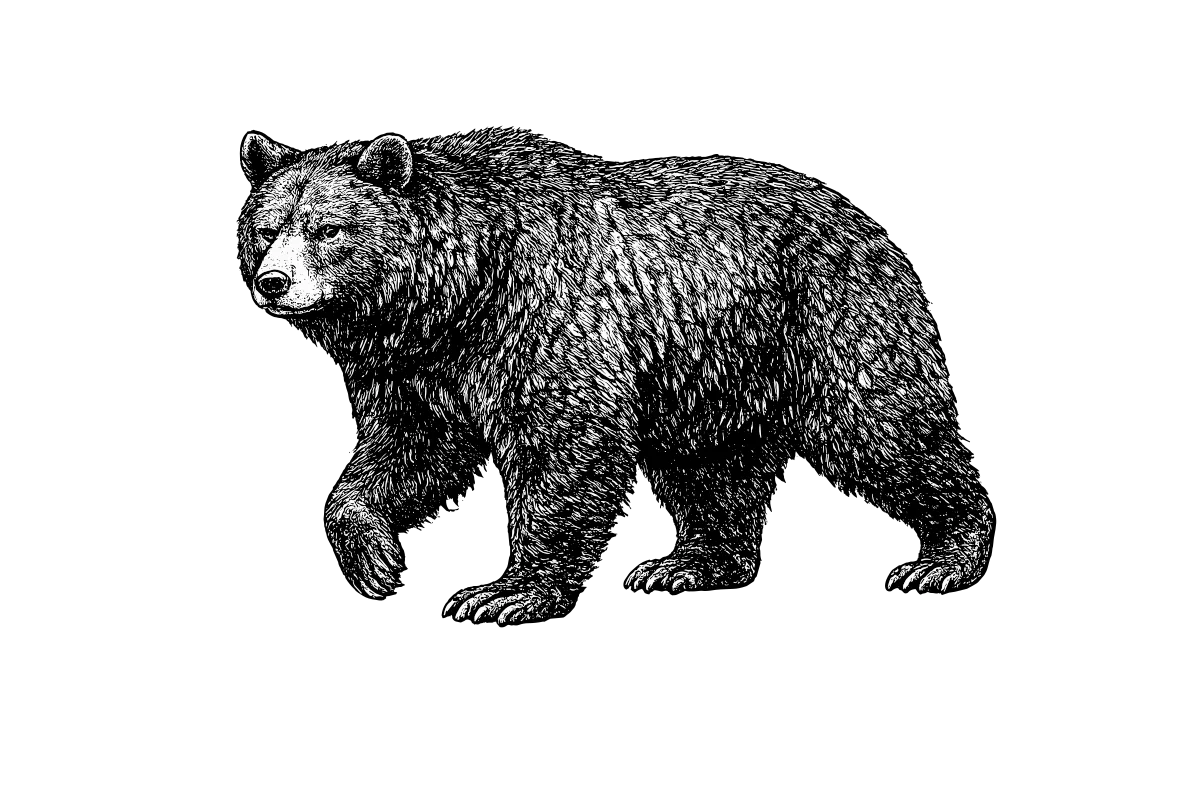
American Black Bear
Ursus americanus
The most numerous bear in the world and the one most people actually encounter. The American black bear is a forest generalist that has expanded its range while the grizzly contracted — partly by being smaller, more arboreal, and far less inclined to fight.
Browse the Woodcut Wild shop →Habitat
Black bears are forest animals, occupying woodland across most of North America from the boreal forest to the mountains of Mexico. They favor dense cover with a mix of mast-producing trees, berries, and wetlands, and have adapted readily to the forest edges around human settlement.
Behavior
Black bears are omnivores whose diet is mostly vegetation — berries, nuts, roots, insects — supplemented opportunistically with carrion and the occasional fawn. Unlike grizzlies, their first instinct under threat is to flee or climb rather than fight, which is why black bear attacks are rare relative to encounters. They enter a winter dormancy (not true hibernation) during which females give birth and nurse while asleep.
Marginalia
- Despite the name, black bears come in brown, cinnamon, blond, blue-gray ('glacier bear'), and even white ('spirit bear,' a rare white morph of a British Columbia subspecies that is not albino).
- Black bears are excellent climbers their whole lives — a key difference from grizzlies, which lose most climbing ability as adults — and short claws curved for grip rather than digging.
- During winter dormancy a black bear does not eat, drink, urinate, or defecate for up to seven months, recycling waste into protein, a metabolic feat researchers study for human kidney medicine.
- A black bear's sense of smell is about seven times more acute than a bloodhound's and can detect food from over a mile away.
Kin & neighbors
Common questions
What should you do if you encounter a black bear?
Stand your ground and make yourself look big and loud — the opposite of the advice for grizzlies. Speak firmly, wave your arms, back away slowly, and never run, which can trigger a chase. If a black bear actually attacks, you fight back; playing dead is for grizzlies. Most encounters end with the bear leaving on its own.
How can you tell a black bear from a grizzly?
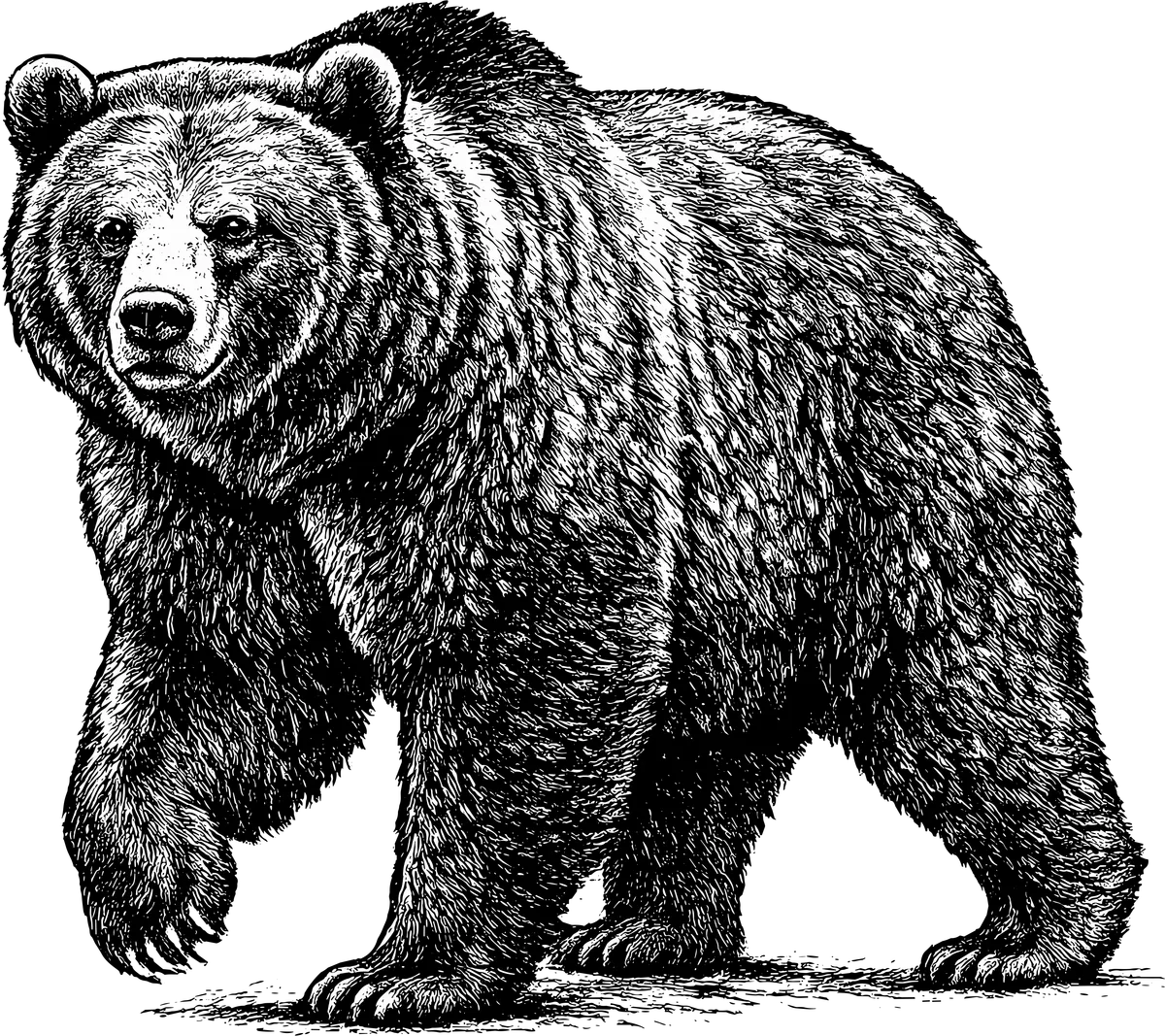
Not by color — both come in shades of brown. Look at the shoulders and face. A grizzly has a high muscular shoulder hump, a dished concave face, and long pale claws; a black bear has no hump, a straight 'Roman' nose profile, and shorter dark claws. Where their ranges overlap in the northern Rockies, the shoulder hump is the most reliable tell at a distance.
How long do black bears live?
Often 20 years or more in the wild, and some marked individuals have passed 30. The leading cause of death is people — hunting and vehicle collisions — rather than old age or other predators.
What does a baby black bear look like?
Tiny. Cubs are born in midwinter weighing under a pound, blind and nearly hairless, while the mother sleeps through her dormancy. They nurse and grow in the den, emerge in spring as fuzzy black balls of perhaps five pounds, and stay with the sow for about a year and a half learning what to eat and where.
How fast can a black bear run?
Around 30 mph — fast enough that no human can outrun one, which is exactly why running is the wrong response to an encounter. They are also powerful swimmers and, unlike adult grizzlies, expert tree-climbers their whole lives.