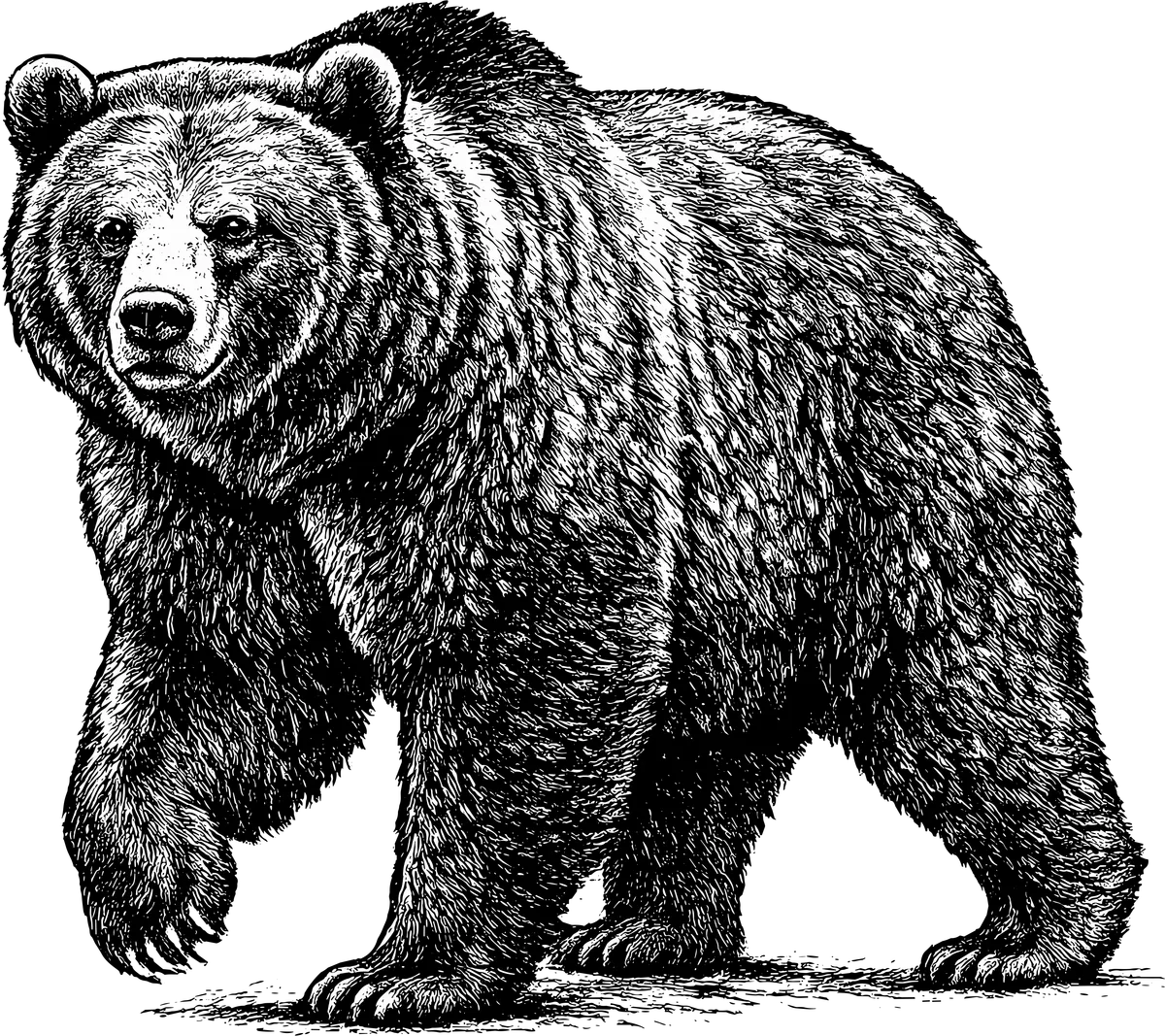
Grizzly Bear
Ursus arctos horribilis
A shoulder hump like a boulder under fur. The grizzly is the North American subspecies of the brown bear — a slow-walking, fast-charging keystone of the western wild.
Browse the Woodcut Wild shop →Habitat
Grizzlies range across high meadows, river valleys, coastal estuaries, and subalpine forests. They follow seasonal food: roots and shoots in spring, salmon runs in summer, berries and whitebark pine in fall. A single bear's home range can cover hundreds of square miles.
Behavior
Despite their size, grizzlies are surprisingly fast — capable of 35 mph in short bursts — and excellent swimmers. They are omnivores, feeding on roots, tubers, berries, insects, fish, and ungulates. Adults are usually solitary outside of mother-cub groups and the seasonal salmon-river gatherings in Alaska.
Marginalia
- The shoulder hump is pure muscle that powers their digging — they can move boulders and excavate deep dens.
- A grizzly's sense of smell is roughly seven times stronger than a bloodhound's.
- Cubs spend two to three years with their mother before being chased off to establish their own range.
- During hibernation, grizzlies don't urinate or defecate for up to six months and emerge with most of their muscle mass intact.
Kin & neighbors
Common questions
What is the difference between a grizzly bear and a black bear?
Not color — both come in shades from blond to near-black. The reliable tells are the grizzly's pronounced shoulder hump, its dished, concave facial profile, and its long front claws. Black bears have a straight 'Roman' nose, no hump, and shorter curved claws built for climbing trees, which adult grizzlies largely cannot do.
What should you do if you encounter a grizzly bear?
Do not run, and do not climb a tree — you cannot outrun or outclimb one. Speak calmly, back away slowly, and make yourself look large. If a grizzly actually makes contact in a surprise encounter, the standard advice is to play dead: lie face-down, cover your neck, and stay still until it leaves. Bear spray, deployed at close range, is more reliably effective than a firearm.
How long do grizzly bears live?
Around 20 to 25 years in the wild, and longer in captivity. Females typically don't breed until five or older and raise cubs slowly, which makes grizzly populations very slow to recover from losses — one reason the contiguous-U.S. bears remain protected.
Do grizzly bears eat humans?
Very rarely, and almost never as deliberate prey. Most grizzly attacks are defensive — a startled bear, a mother with cubs, or a bear guarding a carcass. Predatory attacks on people are exceptional events, far outnumbered by the bears that simply avoid humans entirely.
What is the difference between a grizzly bear and a brown bear?
They are the same species. 'Brown bear' is the global name for Ursus arctos; 'grizzly' refers specifically to the inland North American subspecies. The huge coastal brown bears of Alaska — fattened on salmon — are the same animal as the grizzly, just better fed.