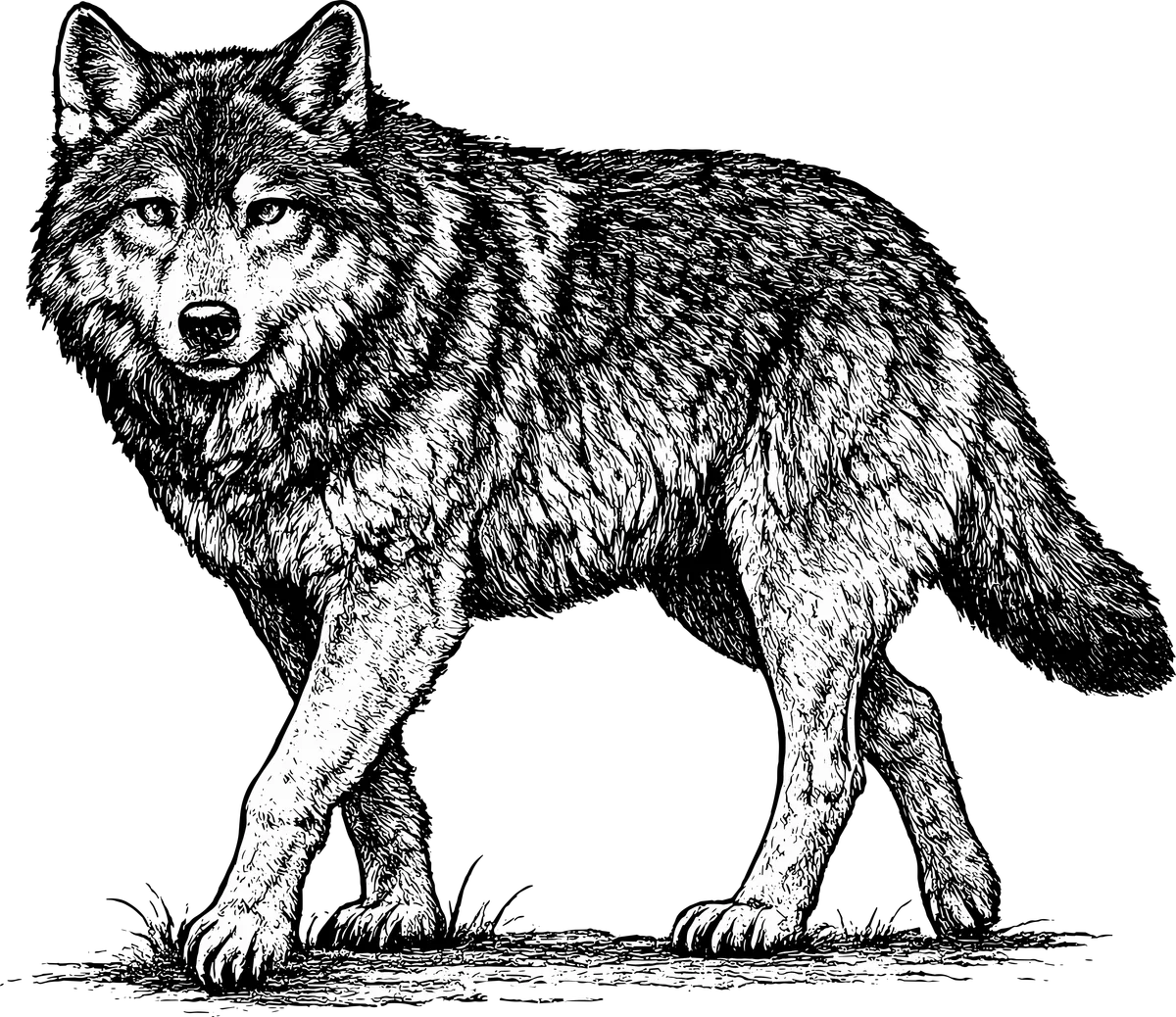
Gray Wolf
Canis lupus
A social, intelligent, long-distance hunter built around the pack. The gray wolf is the largest member of the dog family and the ancestor of every domestic dog.
Browse the Woodcut Wild shop →Habitat
Gray wolves are adaptable — they live in arctic tundra, boreal forest, temperate woodlands, mountain ranges, and high prairie. The single constant is large prey and enough space to roam.
Behavior
Wolves hunt cooperatively, primarily large ungulates: elk, deer, moose, caribou, and bison. A pack is usually a single breeding pair and their offspring of one or two years. Howling coordinates pack members, advertises territory, and reunites scattered animals after a hunt.
Marginalia
- A wolf's bite force is roughly 400 psi — about twice that of a large domestic dog.
- Yellowstone's 1995 reintroduction triggered measurable changes in river paths as elk browsing patterns shifted.
- Wolves can travel 30 miles or more in a single day when hunting.
- Pack hierarchy is largely about parentage and age, not perpetual fighting — the "alpha wolf" model from captive studies has been largely discarded by field biologists.
Kin & neighbors
Common questions
What is the difference between a wolf and a coyote?
Size, mostly, then the details. A gray wolf is roughly twice a coyote's weight, with a broad blocky muzzle, short rounded ears, and a low straight-tailed trot; a coyote is slight, narrow-faced, big-eared, and carries its tail down when running. Wolves hunt large prey in packs and avoid people; coyotes work alone or in pairs, eat almost anything, and thrive in cities. The two interbreed where ranges overlap, producing the larger eastern 'coywolf'.
Are wolves dangerous to humans?
Very rarely. Healthy wild wolves avoid people, and documented fatal attacks in North America are vanishingly few — you are at far greater risk from a domestic dog. The real exceptions are wolves habituated to human food and animals carrying rabies, both of which strip away the natural wariness that normally keeps wolves and people apart.
How long do wolves live?
Six to eight years in the wild, occasionally into the teens. Life is short and hard — wolves die from injuries inflicted by large prey, starvation when hunts fail, disease, and conflict with rival packs and people. Captive wolves with food and veterinary care routinely reach fifteen or more, which says how much the wild costs them.
Can you keep a wolf as a pet?
Legally fraught and practically a bad idea. A pure wolf is a wild animal that does not domesticate within a lifetime — it needs enormous space, never loses its prey drive, and bonds poorly to humans the way a dog does. Wolfdog hybrids are widely owned and widely surrendered; their behavior is unpredictable, and many jurisdictions ban or tightly regulate keeping either.
What does it mean to see a wolf?
Across most northern cultures, loyalty, family, and the wild itself. The wolf stands for the pack and its bonds in Native American and Norse tradition alike — Rome was founded, in legend, by twins a she-wolf nursed. The folk image of the lone, menacing wolf is largely a European fairy-tale invention layered over an animal whose defining trait is its devotion to kin.