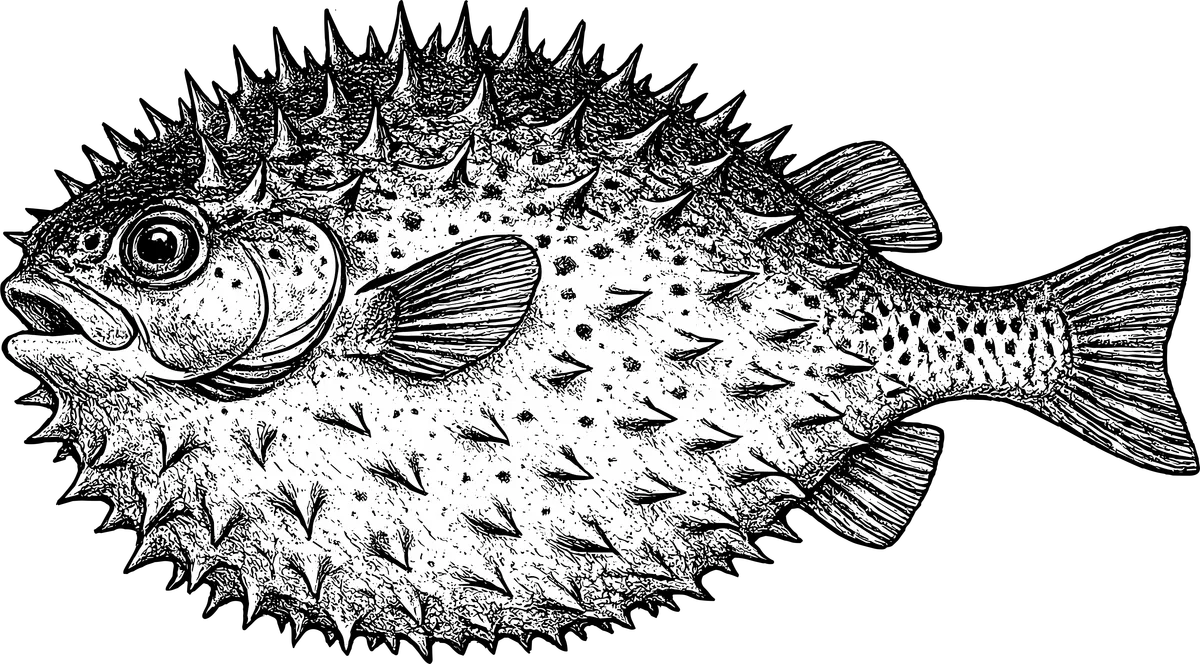
Blowfish
Tetraodontidae
Also called the pufferfish, fugu, swellfish, or sea squab — a small armored fish that gulps water into a specialized stomach to inflate into a spiny ball, and carries enough tetrodotoxin in its tissues to kill thirty people.
Browse the Woodcut Wild shop →Habitat
Pufferfish inhabit warm and temperate coastal waters worldwide — coral reefs, seagrass beds, mangroves, estuaries — and a handful of species (the freshwater puffers of the Amazon, Congo, and Southeast Asian rivers) have moved entirely into freshwater. Most live near structure on shallow bottoms where they can ambush small invertebrates and crustaceans.
Behavior
Blowfish are slow, deliberate swimmers with extraordinary independently-mobile eyes. When threatened, the fish gulps seawater into a highly elastic stomach diverticulum, inflating its body into a roughly spherical, spine-bristling shape three times its normal volume — too large for most predators to swallow and too well-armored to crush. The defense is metabolically expensive, and a blowfish that inflates too often will weaken. The animal's secondary defense is chemical: tetrodotoxin, a sodium-channel-blocking neurotoxin roughly 1,200 times more lethal than cyanide, concentrated in the liver, ovaries, and skin. The toxin is not produced by the fish itself but acquired from bacteria in their prey.
Marginalia
- Tetrodotoxin (TTX), the toxin in puffer tissues, is roughly 1,200 times more deadly than cyanide. A single puffer can contain enough to kill 30 people, and there is no antidote — only supportive care while the toxin clears (24–48 hours).
- Fugu — pufferfish sashimi — is a Japanese delicacy that requires three years of training and a licensed permit to prepare. Roughly 5 fugu-related deaths occur in Japan each year, almost always from unlicensed home preparation.
- The family name Tetraodontidae means 'four teeth' — pufferfish have fused upper and lower beak-like dental plates split into two halves each, used to crack open mollusks and crustaceans.
- Pufferfish acquire their toxin from gut bacteria in the prey they eat. Captive-raised puffers fed sterile diets are non-toxic — a fact that has spawned a small Japanese aquaculture industry producing safe fugu.
- Male pufferfish of certain species construct elaborate two-meter-wide geometric patterns on the seafloor sand using only their fins — the most intricate courtship structures known in the animal kingdom. The patterns took marine biologists years to attribute to such a small fish.
Kin & neighbors
Common questions
Can you keep a pufferfish as a pet?
Yes, and the small freshwater species are a niche aquarium favorite — the pea-sized dwarf puffer especially. They are personable, watch their keepers, and recognize feeding time, but they are demanding: most need live or hard-shelled food to keep their ever-growing beak worn down, many are aggressive fin-nippers best kept alone, and they should never be deliberately provoked into puffing.
Can a pufferfish kill you by touching it?
Not by a brief touch of intact skin — the danger is swallowing the toxin, not contact. That said, the skin and slime of many species do carry tetrodotoxin, so handling one and then touching your mouth or an open cut is a genuinely bad idea, and the toxin survives cooking. Poisonings come almost entirely from eating improperly prepared fish, never from a casual touch.
How long do pufferfish live?
Roughly 8 to 10 years for many species, with some of the larger ones living longer. Lifespan varies widely across the 120-odd species in the family, and captive aquarium puffers given the right diet and water often reach the upper end of their range.
What eats a pufferfish?
Few things willingly. The inflation and the toxin together make most predators give up, but sharks and some large rays appear largely immune to the poison and will eat them, and tiger sharks in particular are known to swallow puffers whole. Seabirds and other fish that grab a juvenile sometimes pay for it with their lives.
Why do pufferfish puff up out of water?
Because being lifted out is exactly the kind of threat the reflex evolved for, and a netted or hooked puffer will often gulp air instead of water and balloon up. It is hard on the fish — air is difficult to expel, and a puffer left inflated out of water can be injured or die — so an angler who lands one should return it gently and let it deflate in the water.