Blowfish
Tetraodontidae
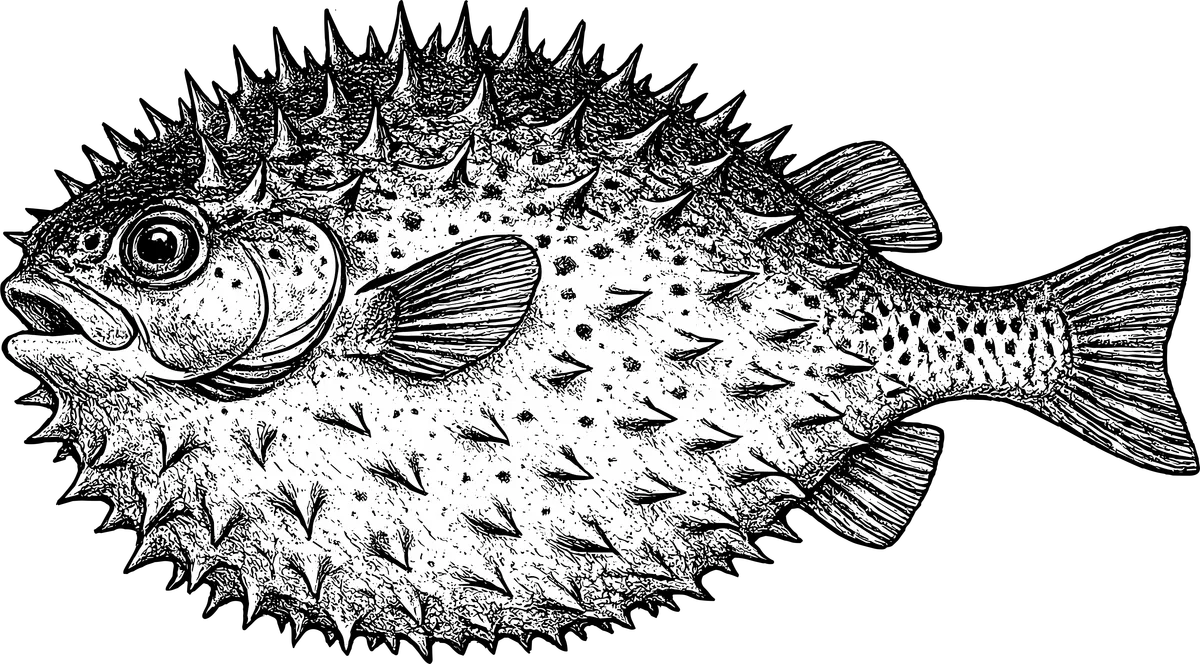
Also called the pufferfish, fugu, swellfish, or sea squab — a small armored fish that gulps water into a specialized stomach to inflate into a spiny ball, and carries enough tetrodotoxin in its tissues to kill thirty people.
Browse the Woodcut Wild shop →Habitat
Pufferfish inhabit warm and temperate coastal waters worldwide — coral reefs, seagrass beds, mangroves, estuaries — and a handful of species (the freshwater puffers of the Amazon, Congo, and Southeast Asian rivers) have moved entirely into freshwater. Most live near structure on shallow bottoms where they can ambush small invertebrates and crustaceans.
Behavior
Blowfish are slow, deliberate swimmers with extraordinary independently-mobile eyes. When threatened, the fish gulps seawater into a highly elastic stomach diverticulum, inflating its body into a roughly spherical, spine-bristling shape three times its normal volume — too large for most predators to swallow and too well-armored to crush. The defense is metabolically expensive, and a blowfish that inflates too often will weaken. The animal's secondary defense is chemical: tetrodotoxin, a sodium-channel-blocking neurotoxin roughly 1,200 times more lethal than cyanide, concentrated in the liver, ovaries, and skin. The toxin is not produced by the fish itself but acquired from bacteria in their prey.
Marginalia
- Tetrodotoxin (TTX), the toxin in puffer tissues, is roughly 1,200 times more deadly than cyanide. A single puffer can contain enough to kill 30 people, and there is no antidote — only supportive care while the toxin clears (24–48 hours).
- Fugu — pufferfish sashimi — is a Japanese delicacy that requires three years of training and a licensed permit to prepare. Roughly 5 fugu-related deaths occur in Japan each year, almost always from unlicensed home preparation.
- The family name Tetraodontidae means 'four teeth' — pufferfish have fused upper and lower beak-like dental plates split into two halves each, used to crack open mollusks and crustaceans.
- Pufferfish acquire their toxin from gut bacteria in the prey they eat. Captive-raised puffers fed sterile diets are non-toxic — a fact that has spawned a small Japanese aquaculture industry producing safe fugu.
- Male pufferfish of certain species construct elaborate two-meter-wide geometric patterns on the seafloor sand using only their fins — the most intricate courtship structures known in the animal kingdom. The patterns took marine biologists years to attribute to such a small fish.