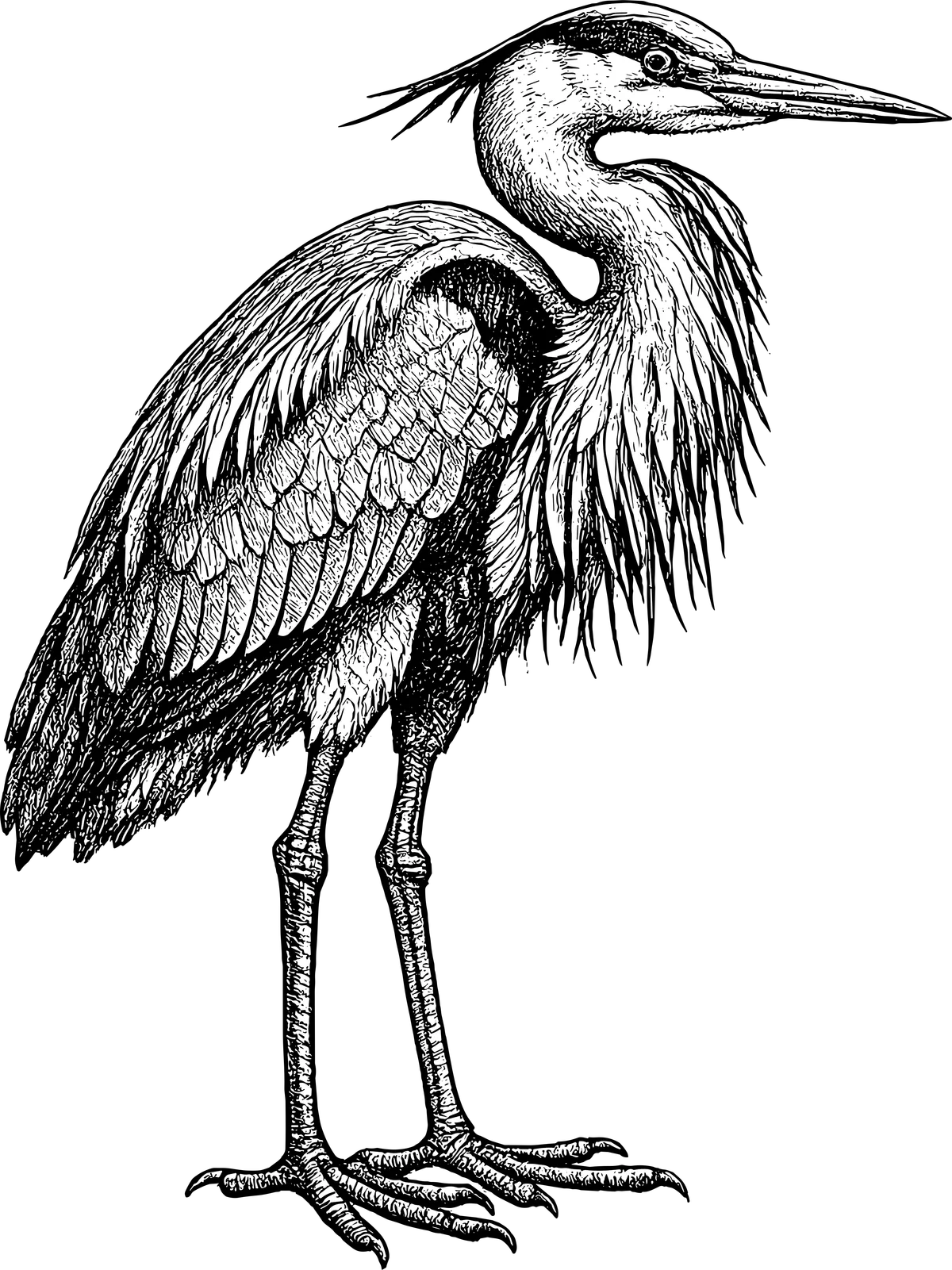
Great Blue Heron
Ardea herodias
The tall grey sentinel of every American marsh and trout stream. The largest heron in North America and a patient, lethally precise ambush hunter.
Browse the Woodcut Wild shop →Habitat
Great blue herons hunt almost anywhere there's shallow water and small prey: freshwater marshes, river edges, beaver ponds, tidal flats, mangroves, ditches, and the shorelines of large lakes. They nest colonially in tall trees — heronries — sometimes a hundred nests in a single grove of cottonwoods or sycamores.
Behavior
Herons hunt by stillness. A motionless bird stands belly-deep in slow water, neck folded into a tight S, then strikes in a blur — a dagger bill driven through fish, frog, snake, vole, or duckling. They are mostly silent except for a deep guttural croak when flushed. In flight they fold the neck back against the shoulders, distinguishing them from cranes, which fly with necks extended. Pairs perform elaborate courtship displays on the nest: bill clapping, stick presentations, and the slow erection of long plumes from the back and breast.
Marginalia
- Despite a wingspan over six feet, an adult great blue weighs only about five pounds — hollow bones and feathered economy.
- They can swallow fish almost as wide as their own necks, and have been known to choke trying.
- The all-white morph found in southern Florida and the Caribbean was once considered a separate species — the Great White Heron.
- Specialized feathers on the breast crumble into a fine powder that herons use to clean fish slime and oil from their plumage.
- A great blue's strike from neck-folded to fish-impaled takes about a tenth of a second.
Kin & neighbors
Common questions
What does it mean when you see a great blue heron?
Across a lot of folklore the heron stands for patience, stillness, and self-reliance — a fair reading of an animal that hunts by standing motionless for an hour. Various traditions also tie it to good fortune and to determination. None of it is the bird's concern, but the symbolism is consistent and old, and it follows the heron onto plenty of tattoos and totems.
What is the difference between a heron and a crane?
Watch them fly. A heron tucks its neck back into a tight S against the shoulders; a crane flies with the neck stretched straight out. On the ground a crane is a bulkier, drier-country bird that struts and dances in flocks, while the heron is a solitary water-hunter. They are not even close relatives, despite the similar long-legged silhouette.
What is the difference between a great blue heron and an egret?
Mostly color and size. Egrets are typically smaller and pure white with black or yellow legs, hunting the same shallows. The great blue is grey-blue and the largest North American heron — though to complicate things, a white form of the great blue lives in south Florida and can be mistaken for the great egret. Bill and leg color usually sort them out.
Are great blue herons dangerous?
Not to people, with one caveat: that dagger bill is built to spear fish and is aimed instinctively at the eyes when the bird feels cornered. Wildlife handlers treat an injured heron with real caution for exactly that reason. In the wild a heron's only interest is fleeing you, so the risk is essentially zero unless you grab one.
How long do great blue herons live?
Often around 15 years, with a banded wild bird recorded past 24. As with most large birds the first year is the killer — a majority of young herons don't survive it — but an adult that learns to hunt well and dodge eagles can last well over a decade.