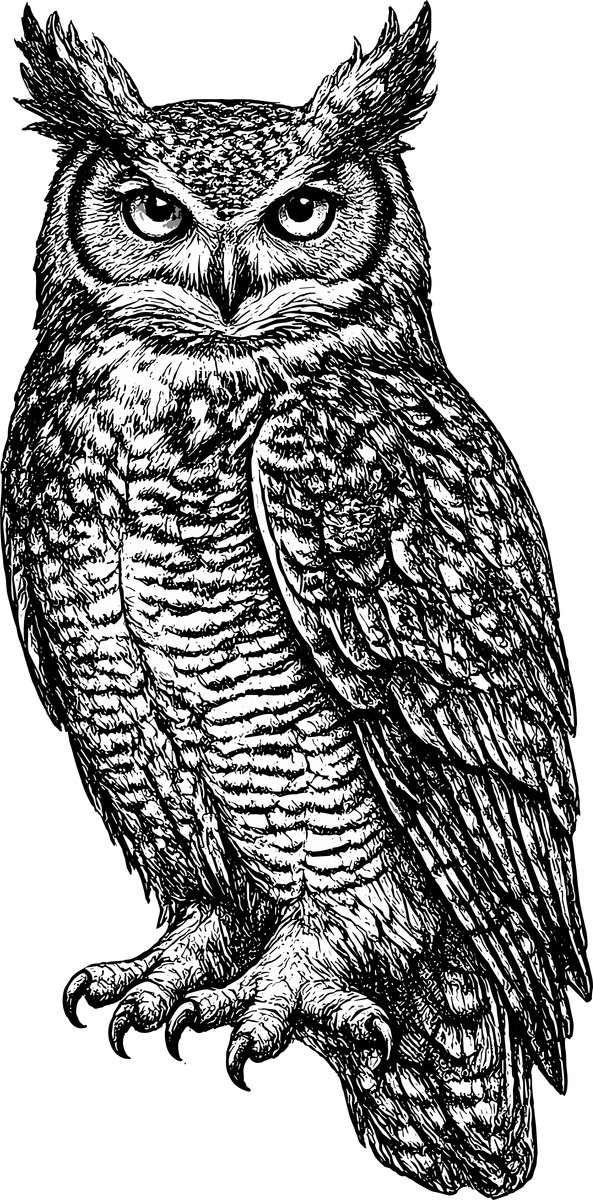
Great Horned Owl
Bubo virginianus
The tiger of the night sky. A heavy, ear-tufted owl with a four-foot wingspan and a grip strong enough to crush a rabbit's skull.
Browse the Woodcut Wild shop →Habitat
Great horned owls thrive in nearly every habitat in the Americas — old-growth forest, suburban parks, desert canyons, prairie shelterbelts. They roost in dense conifers by day and hunt from low perches at night.
Behavior
They are versatile, fearless predators that will take prey from beetles to skunks to other raptors — they are the only consistent predator of skunks in North America. Pairs call in late winter, with the male's deeper hoot and the female's higher answer forming a duet that carries through cold air.
Marginalia
- Their grip strength is roughly 500 psi — enough to sever a spine.
- They can rotate their heads 270 degrees in either direction.
- The ear tufts are not ears at all; they are display feathers used for communication and camouflage.
- They often steal nests from red-tailed hawks rather than build their own.
Kin & neighbors
Common questions
What does it mean when you hear an owl hooting at night?
Across many cultures the owl is an omen — variously of death, wisdom, or hidden knowledge, depending on whose folklore you are reading. Greek tradition tied it to Athena and wisdom; a lot of other traditions read a calling owl as a warning. To the owl it means none of this. The deep stuttering hoots you hear in late winter are a mated pair claiming territory and tightening the bond before nesting.
Can owls see in complete darkness?
No — nothing can see with zero light, owls included. What they have is eyesight tuned for very low light, with huge forward-facing eyes packed with rod cells, plus hearing so precise they can strike prey by sound alone. On a truly black night the great horned owl is hunting with its ears as much as its eyes.
Do great horned owls migrate?
No, they hold their territory year-round. A pair stays put through the hardest winter, which is exactly why they nest so early — courting in December and January and laying eggs while snow is still on the ground, so the young have the whole spring glut of prey to grow on.
How long do great horned owls live?
Often 10 to 15 years in the wild, and far longer in captivity, where birds have passed 30 and even 50. Most wild deaths are human-related — vehicle strikes, electrocution on power lines, and poisoning from rodents that ate bait — rather than anything in nature, since a grown great horned owl has almost no predators.
Can you keep a great horned owl as a pet?
No, and it is illegal. In the United States they are protected under the Migratory Bird Treaty Act, so possessing one without a federal permit is a crime. Beyond the law, they are powerful wild predators with a grip that can break bone and no interest in domestication; the only people who legally handle them are licensed rehabilitators and falconers.