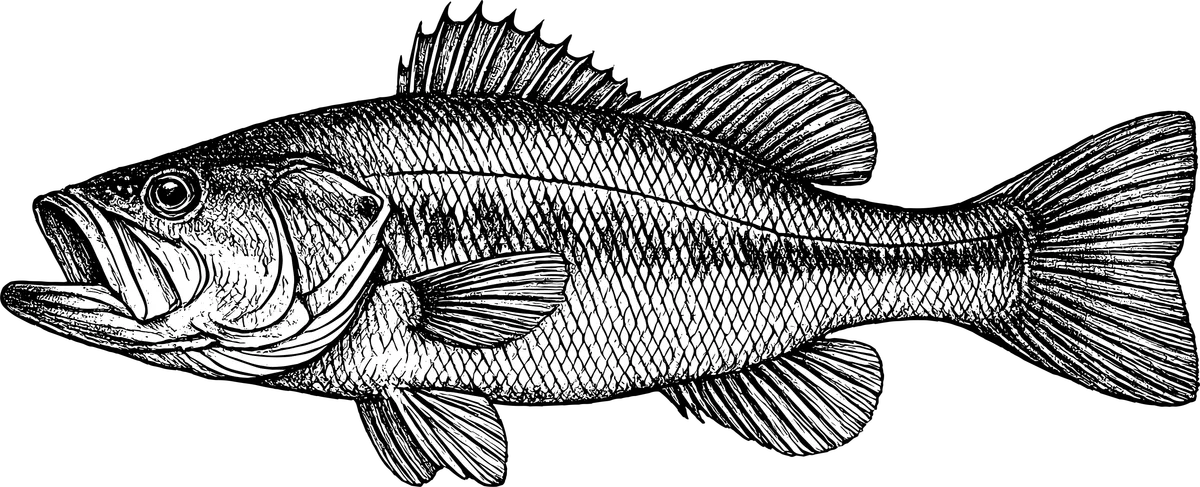
Largemouth Bass
Micropterus salmoides
The most-pursued freshwater game fish in North America. A green, ambush-built sunfish with a jaw that hinges past the eye and an appetite for almost anything that fits inside it.
Browse the Woodcut Wild shop →Habitat
Largemouth thrive in warm, weedy freshwater: ponds, slow rivers, reservoirs, oxbows, and the shallow margins of large lakes. They want cover — lily pads, fallen timber, weed beds, dock pilings — and water warm enough to keep them active most of the year. Native to the eastern and central United States, they have been introduced as a sport fish across every continent except Antarctica.
Behavior
Largemouth are ambush hunters. They sit motionless against structure and strike outward in a short, explosive lunge, expanding the bucket-sized mouth to vacuum prey in with the water. They eat anything that fits — minnows, crayfish, frogs, snakes, smaller bass, even ducklings. In spring, males clear fan-shaped nests in shallow gravel and guard the eggs and fry aggressively, charging anything that approaches. Largemouth are temperature-sensitive: a single degree of water-temp change can flip them from feeding to dormant.
Marginalia
- Despite the name, largemouth bass are not true bass — they're the largest member of the sunfish family, alongside bluegill and crappie.
- The world-record largemouth (22 lb 4 oz) was caught in Montgomery Lake, Georgia in 1932 and tied in 2009 from Lake Biwa, Japan — the only major freshwater record to stand that long.
- A largemouth's mouth opens to roughly the diameter of a tennis ball — wide enough to engulf prey almost half its own length.
- Bass fishing supports a multi-billion-dollar industry in the U.S. alone, with professional tournament circuits, dedicated boat designs, and a tackle industry built around a single species.
- Largemouth can live 15+ years in the right water but most heavily-fished populations turn over much faster.
Kin & neighbors
Common questions
How do you catch largemouth bass?
Throw something near cover and make it look alive. Because largemouth ambush from structure, the productive water is the edge of weed beds, fallen timber, docks, and lily pads. Plastic worms, jigs, crankbaits, spinnerbaits, and topwater frogs all work; the unifying principle is presenting the lure tight to cover and working it past a waiting fish.
What is the difference between largemouth and smallmouth bass?
Look at the mouth and the water. On a largemouth the upper jaw hinges past the eye; on a smallmouth it stops under the eye. Largemouth prefer warm, weedy, still water and run greener with a dark lateral stripe; smallmouth favor cooler, clearer, rockier rivers and lakes, run bronze with vertical bars, and pound-for-pound fight harder.
Are largemouth bass good to eat?
Edible, but not prized. The flesh is white and mild but can taste muddy from warm, weedy water, and as the continent's premier sport fish most bass are released rather than kept. Anglers who do eat them tend to take fish from cooler, cleaner water and release the big breeders.
What is the best time of day and temperature to fish for bass?
Early morning and evening, in water from the high 60s to mid 70s Fahrenheit. Largemouth feed hardest in low light and warm-but-not-hot water; midday sun pushes them deep or under cover, and a sharp cold front can shut them down for a day. Spring, around the spawn, brings them shallow and aggressive.
Do largemouth bass have teeth, and can they bite you?
Yes to teeth, no to real harm. A largemouth's mouth is lined with small, sandpapery teeth for gripping prey, not slicing — hence the angler's 'bass thumb,' the roughened skin from lipping fish all day. They have no defensive interest in people and cannot do meaningful damage to a hand.