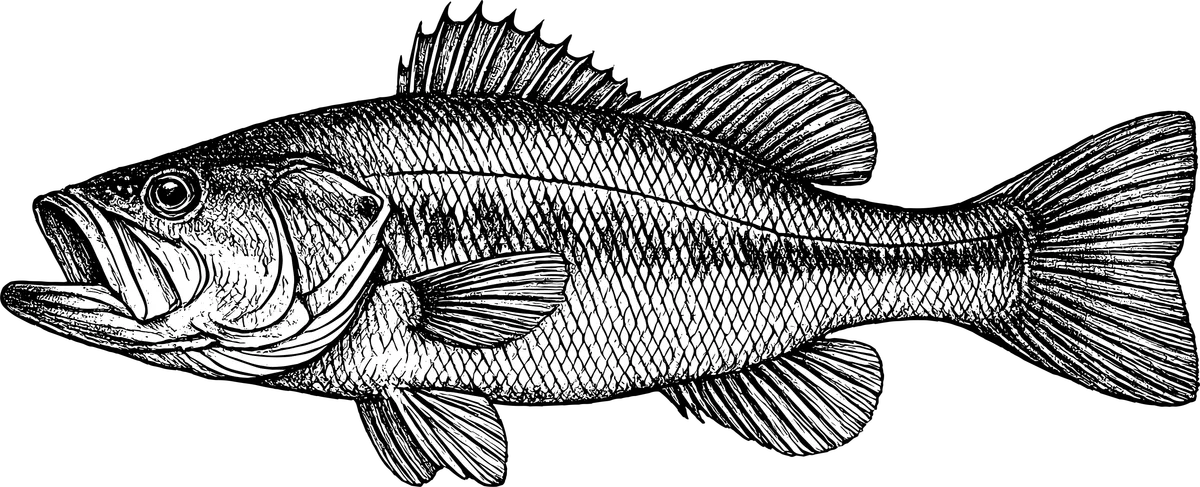
Largemouth Bass
Micropterus salmoides
The most-pursued freshwater game fish in North America. A green, ambush-built sunfish with a jaw that hinges past the eye and an appetite for almost anything that fits inside it.
Browse the Woodcut Wild shop →Habitat
Largemouth thrive in warm, weedy freshwater: ponds, slow rivers, reservoirs, oxbows, and the shallow margins of large lakes. They want cover — lily pads, fallen timber, weed beds, dock pilings — and water warm enough to keep them active most of the year. Native to the eastern and central United States, they have been introduced as a sport fish across every continent except Antarctica.
Behavior
Largemouth are ambush hunters. They sit motionless against structure and strike outward in a short, explosive lunge, expanding the bucket-sized mouth to vacuum prey in with the water. They eat anything that fits — minnows, crayfish, frogs, snakes, smaller bass, even ducklings. In spring, males clear fan-shaped nests in shallow gravel and guard the eggs and fry aggressively, charging anything that approaches. Largemouth are temperature-sensitive: a single degree of water-temp change can flip them from feeding to dormant.
Marginalia
- Despite the name, largemouth bass are not true bass — they're the largest member of the sunfish family, alongside bluegill and crappie.
- The world-record largemouth (22 lb 4 oz) was caught in Montgomery Lake, Georgia in 1932 and tied in 2009 from Lake Biwa, Japan — the only major freshwater record to stand that long.
- A largemouth's mouth opens to roughly the diameter of a tennis ball — wide enough to engulf prey almost half its own length.
- Bass fishing supports a multi-billion-dollar industry in the U.S. alone, with professional tournament circuits, dedicated boat designs, and a tackle industry built around a single species.
- Largemouth can live 15+ years in the right water but most heavily-fished populations turn over much faster.