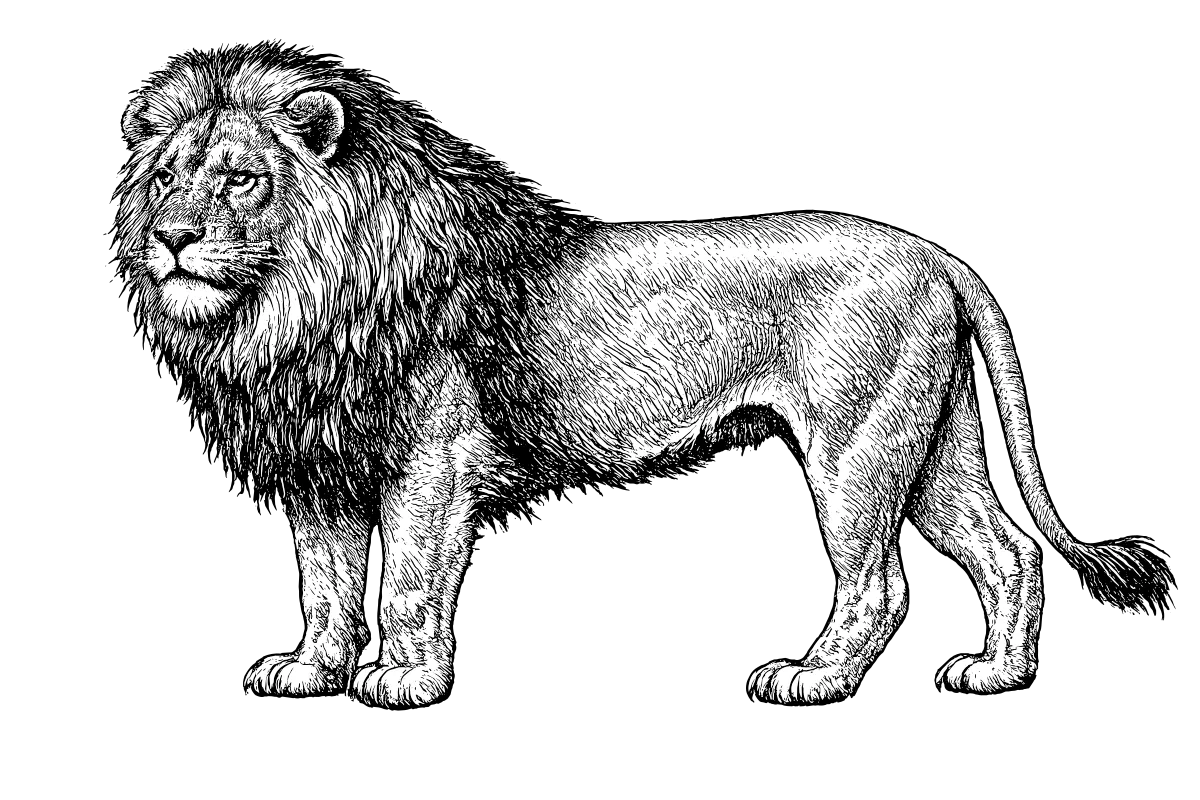
Lion
Panthera leo
The only truly social cat. Lions live in prides and hunt in coordinated groups — a behavioral strategy unique among the world's thirty-odd cat species, and the reason a single lion is a less complete animal than a pride.
Browse the Woodcut Wild shop →Habitat
Lions occupy savanna, open woodland, and scrub across sub-Saharan Africa, with a single remnant population of Asiatic lions in the Gir Forest of India. They avoid dense rainforest and the deep desert, favoring grassland with enough cover to stalk and enough prey to feed a pride.
Behavior
The pride is the defining unit — typically related females, their cubs, and a coalition of one to several males who hold tenure for a few years before being displaced. Females do most of the hunting, often in coordinated drives; males defend territory and the pride against rival coalitions. Incoming males commonly kill the cubs of their predecessors, bringing the females back into estrus. Lions sleep or rest up to twenty hours a day.
Marginalia
- A lion's roar can be heard up to five miles away and is produced by a specialized, squared-off vocal fold structure that lets the cat roar at high volume with relatively little effort.
- The mane is a signal of fitness — darker, fuller manes correlate with higher testosterone, better nutrition, and more success holding a pride, but also with greater heat stress.
- Asiatic lions are a genetically distinct subspecies down to a few hundred individuals, all descended from a population that nearly hit zero in the early 20th century.
- Lions are the only cats with a tufted tail, and the tuft conceals a small horny 'spur' at the tip whose function is unknown.
Kin & neighbors

Common questions
What is the difference between a lion and a tiger?
Beyond the obvious — the lion's mane and tawny coat versus the tiger's stripes — the deepest difference is social. Lions are the only cats that live in groups; tigers are solitary. Tigers are also the larger of the two on average, and where the two have been kept together their ranges historically barely overlapped: lions on open savanna, tigers in dense forest.
What do lions eat?
Large hoofed animals, mostly. Zebra, wildebeest, buffalo, and various antelope make up the bulk of a pride's kills, taken in coordinated drives. Lions are also unapologetic scavengers and will drive hyenas or cheetahs off a fresh carcass rather than hunt — easier calories are still calories.
How long do lions live?
Around 10 to 14 years in the wild; females generally longer than males. A male's life is shaped by tenure — once he loses control of a pride to a younger coalition, usually in his prime, his survival prospects fall sharply. Captive lions can reach their late teens or beyond.
What does a lion symbolize?
Royalty, courage, and authority across nearly every culture that has lived alongside one. The lion anchors heraldry, scripture, and the thrones of empires from Babylon to Britain, and as a zodiac sign and 'king of beasts' it has carried the idea of sovereign strength for thousands of years — despite, awkwardly, the females doing most of the hunting.
Can lions climb trees?
They can, though most do so clumsily. A few famous populations — notably in Uganda's Ishasha sector and Tanzania's Lake Manyara — habitually lounge draped over branches, probably to catch a breeze and escape biting flies on the ground. Elsewhere lions are firmly ground animals and leave the tree-lounging to leopards.