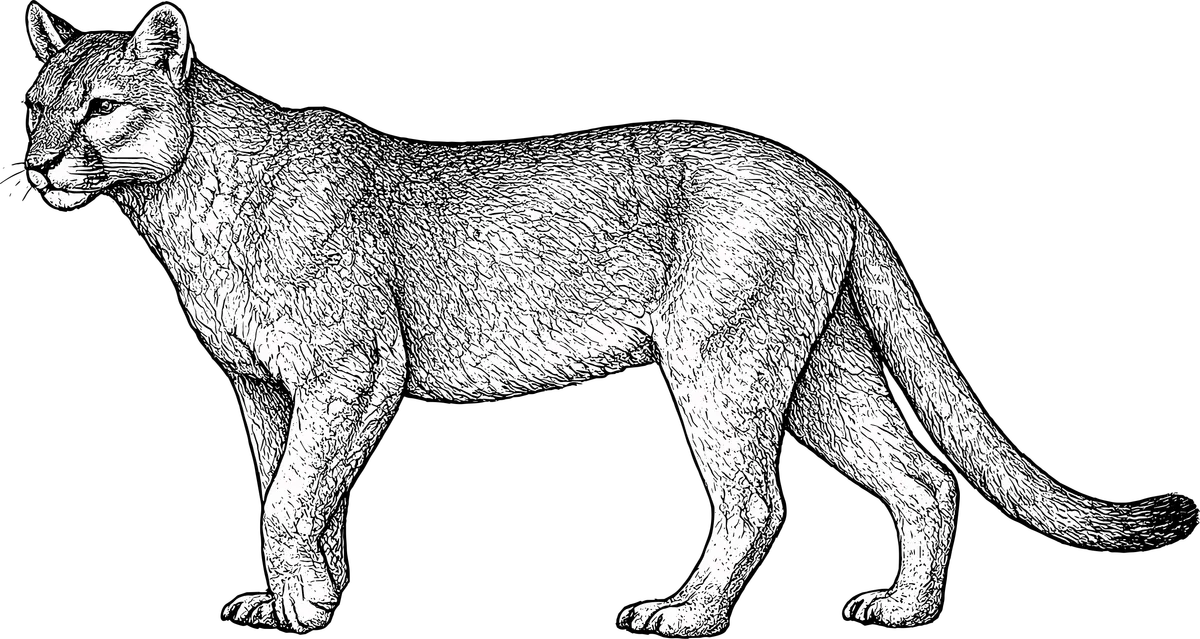
Mountain Lion
Puma concolor
The most widely distributed wild mammal in the Western Hemisphere — and the quietest large predator on the continent. Also called the cougar, puma, panther, and catamount. One animal, more common names than any other in North America.
Browse the Woodcut Wild shop →Habitat
Mountain lions live across an extraordinary range of habitats — coastal redwood forest, high alpine meadow, desert canyon country, Florida swamp, Andean cloud forest, Patagonian steppe. They need large home ranges (a single male's territory can exceed 200 square miles), abundant deer or other large prey, and enough cover to stalk from. They are absent only from the high Arctic and the most heavily developed agricultural lowlands.
Behavior
Mountain lions are solitary, nocturnal-to-crepuscular ambush hunters. They stalk to within twenty or thirty feet of a deer or elk, accelerate in a short explosive rush, and kill with a precise neck bite. A single deer feeds an adult for a week; cougars cache uneaten carcasses under leaves and snow and return to feed over multiple nights. The species cannot roar — the larynx and hyoid structure differ from true big cats — but produces a distinctive 'scream' during the mating season that gave the animal its 'catamount' name and, historically, frightened settlers into believing the woods held something supernatural.
Marginalia
- The mountain lion holds the Guinness record for most names for a single species — over 40 documented English common names alone (mountain lion, cougar, puma, panther, catamount, painter, mountain screamer, ghost cat, deer tiger, and more).
- Mountain lions can leap 18 feet vertically from a standstill and 40 feet horizontally — a vertical capability that has been measured against a mock cliff face by biologists studying their prey selection.
- Despite their size, mountain lions purr instead of roaring. They are anatomically more closely related to domestic cats than to true big cats (lions, tigers, leopards, jaguars).
- The Florida panther — the last remaining wild cougar population east of the Mississippi — was reduced to fewer than 30 individuals in the 1990s. A controversial genetic-rescue program introduced eight Texas cougars in 1995; the population has since rebuilt to about 200, though habitat loss and vehicle collisions remain critical pressures.
- Mountain lions are responsible for fewer than one human fatality per year on average across all of North America. Statistically, deer kill more people than mountain lions do — primarily through vehicle collisions.
Kin & neighbors
Common questions
What do you do if you see a mountain lion?
Stand your ground and make yourself look big. Do not run — running triggers the chase response in a stalking predator. Face the animal, raise your arms or open your jacket, speak firmly, and back away slowly while keeping eye contact. Pick up small children. If a lion attacks, fight back; people who resist are far more likely to be released than those who play dead.
How long do mountain lions live?
Eight to thirteen years in the wild, occasionally longer. Captive animals have reached their early twenties. Wild lifespans are cut short mostly by humans, by injury during the hunt, and by territorial fights between males, which kill a meaningful share of young dispersing cats.
What is the difference between a mountain lion and a bobcat?
Mainly size and tail. A mountain lion is a large, uniformly tan cat with a long, heavy tail nearly a third of its length; a bobcat is house-cat-plus, spotted and barred, with a stubby 'bobbed' tail a few inches long. An adult cougar outweighs a bobcat roughly ten to one.
What does it mean to see a mountain lion in Native American culture?
It generally signified leadership, patience, and quiet power. Across many Indigenous nations of the Americas the cougar was a respected hunter-symbol rather than an omen of dread; the Hopi and Zuni carved it as a guardian of the north, and Inca and pre-Inca cultures of the Andes treated the puma as a sacred emblem — the old city of Cusco was laid out in its shape.
Do mountain lions attack dogs?
Yes, and dogs are a common draw near the edges of cougar country. A lion will take a loose or leashed dog as prey, and the scent and noise of pets can pull one closer to homes. In rural areas they also take goats, sheep, and the occasional calf, which is the usual source of conflict with ranchers.