Narwhal
Monodon monoceros
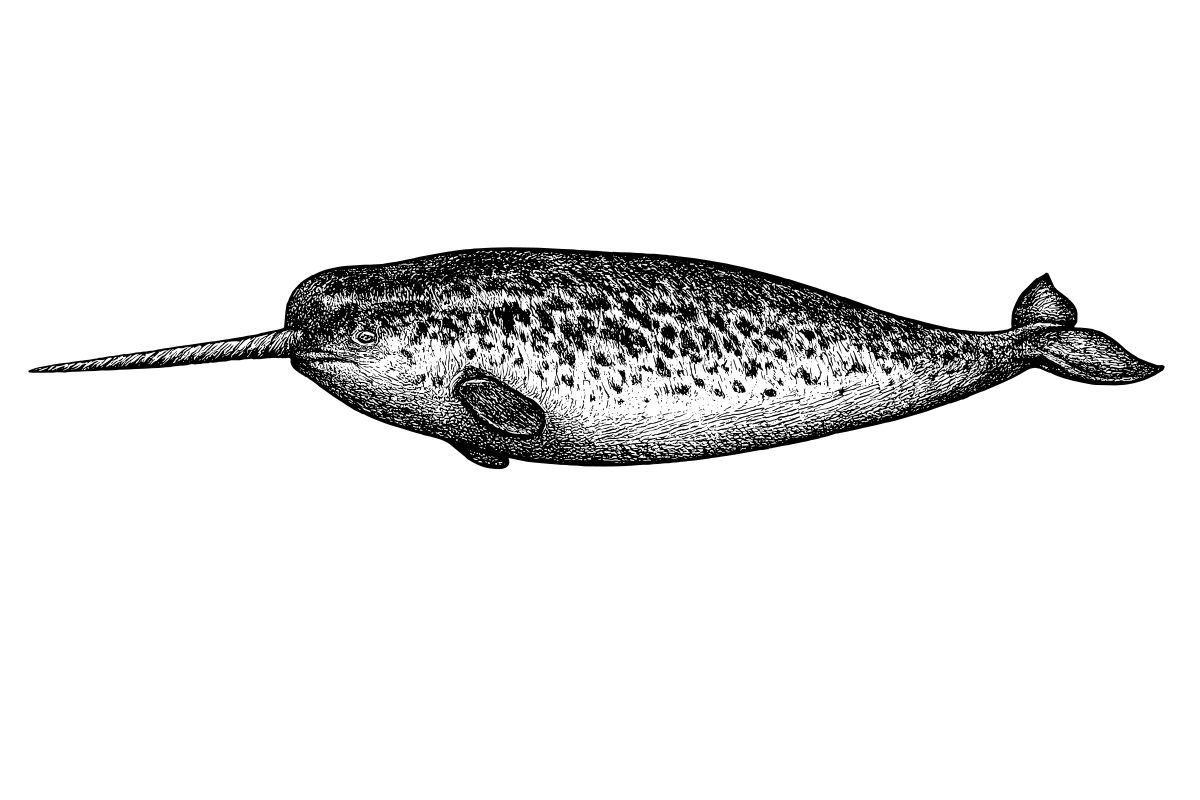
The unicorn of the sea. A small Arctic whale with a single spiraled tusk — actually an elongated canine tooth — that can grow longer than a tall man. Lives under sea ice, hunts squid in total darkness, and barely tolerates change.
Browse the Woodcut Wild shop →Habitat
Narwhals live exclusively in the Arctic — primarily in the deep fjords and offshore waters around Greenland, Canada's eastern Arctic, and Svalbard. They make extraordinary deep dives (over 5,000 feet) and spend much of the year under or alongside the sea ice.
Behavior
Narwhals travel in pods of 5 to 20, occasionally aggregating into superpods of hundreds during summer migrations. They feed largely on Greenland halibut, Arctic cod, and squid, hunting in the lightless winter under thick ice. The tusk, present primarily in males, is now understood to be a sensory organ — it contains millions of nerve endings that may help detect water salinity, temperature, and pressure changes. Tusks are also used in 'tusking' displays between males.
Marginalia
- The narwhal tusk is a left canine tooth that grows through the upper lip in a counter-clockwise spiral. About 15% of females also grow one.
- Narwhals can hold their breath for over 25 minutes — among the longest of any marine mammal.
- They are critically dependent on sea ice for shelter and feeding. Climate change makes them one of the most climate-vulnerable whales.
- Their closest relative is the beluga whale; the two have been documented producing hybrid offspring called 'narlugas.'