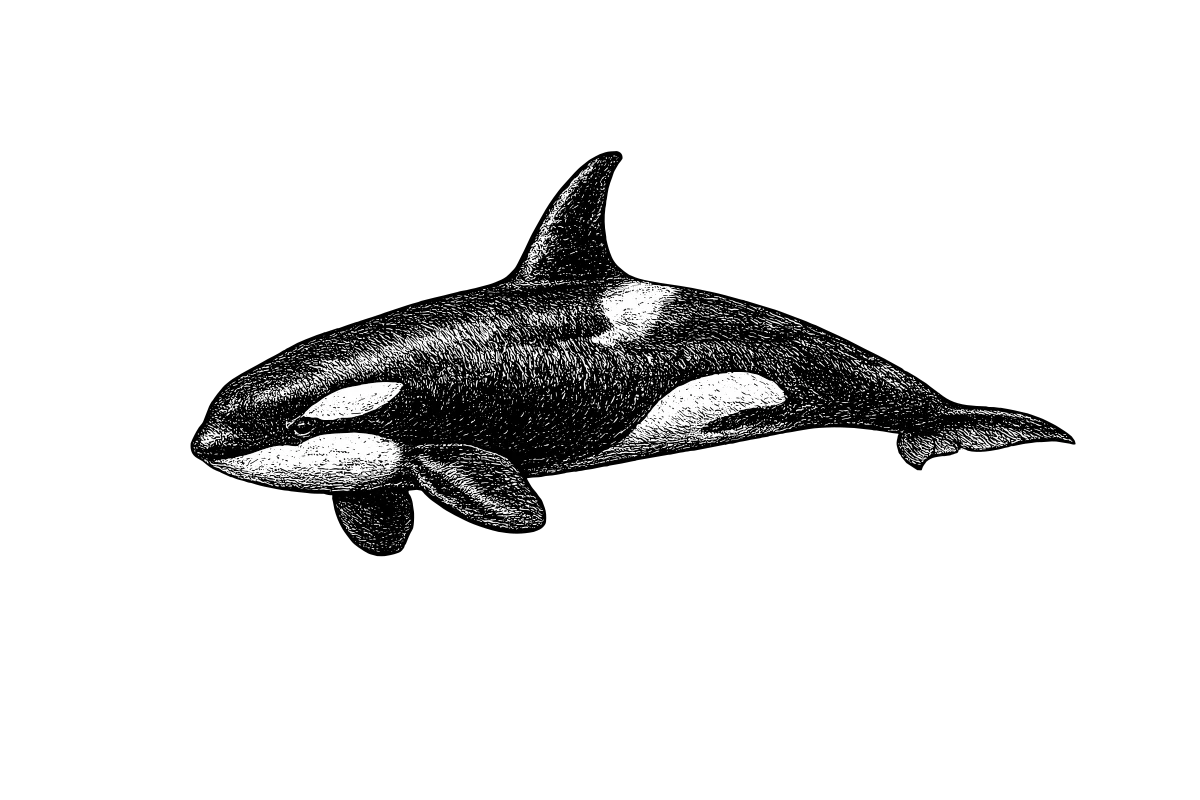
Orca
Orcinus orca
The ocean's apex predator — bigger than great whites, smarter than most mammals on earth, and divided into distinct cultures that hunt different prey and refuse to interbreed. A killer whale is a dolphin, just enormous.
Browse the Woodcut Wild shop →Habitat
Orcas live in every ocean on the planet, from the polar ice to the tropics — among the most widely distributed mammals on earth. Different populations occupy distinct ecological niches: Pacific Northwest residents specialize in salmon; transients hunt marine mammals; offshore ecotypes prey on sharks; Antarctic types target seals from ice floes.
Behavior
Orcas live in stable matrilineal pods — the matriarch's family stays with her for life. Each pod has its own dialect of calls, hunting techniques, and prey preferences, passed down across generations. Researchers describe this as culture in the proper sense: traits inherited socially rather than genetically. They hunt cooperatively, sometimes with extraordinary sophistication — beaching themselves intentionally to grab seals, generating waves to wash prey off ice floes, drowning whales by holding them underwater.
Marginalia
- Orcas have the second-largest brain of any animal — and the most folded cerebral cortex relative to body size of any mammal.
- Different ecotypes haven't interbred for hundreds of thousands of years; they may be functionally separate species.
- An orca named Granny was estimated at over 100 years old when she was last seen in 2016.
- Despite the name 'killer whale,' there is no recorded fatal attack on a human by a wild orca.
Kin & neighbors
Common questions
Why do orcas' dorsal fins flop over in captivity?
Because a captive tank cannot support the fin. In the wild the tall dorsal fin is held upright by water pressure during constant swimming and deep diving; a tank-bound orca swims slow circles at the surface, the unsupported cartilage warms and bends in the sun and air, and the fin collapses. It is seen in nearly every captive adult male and almost never in the wild.
Do orcas eat great white sharks?
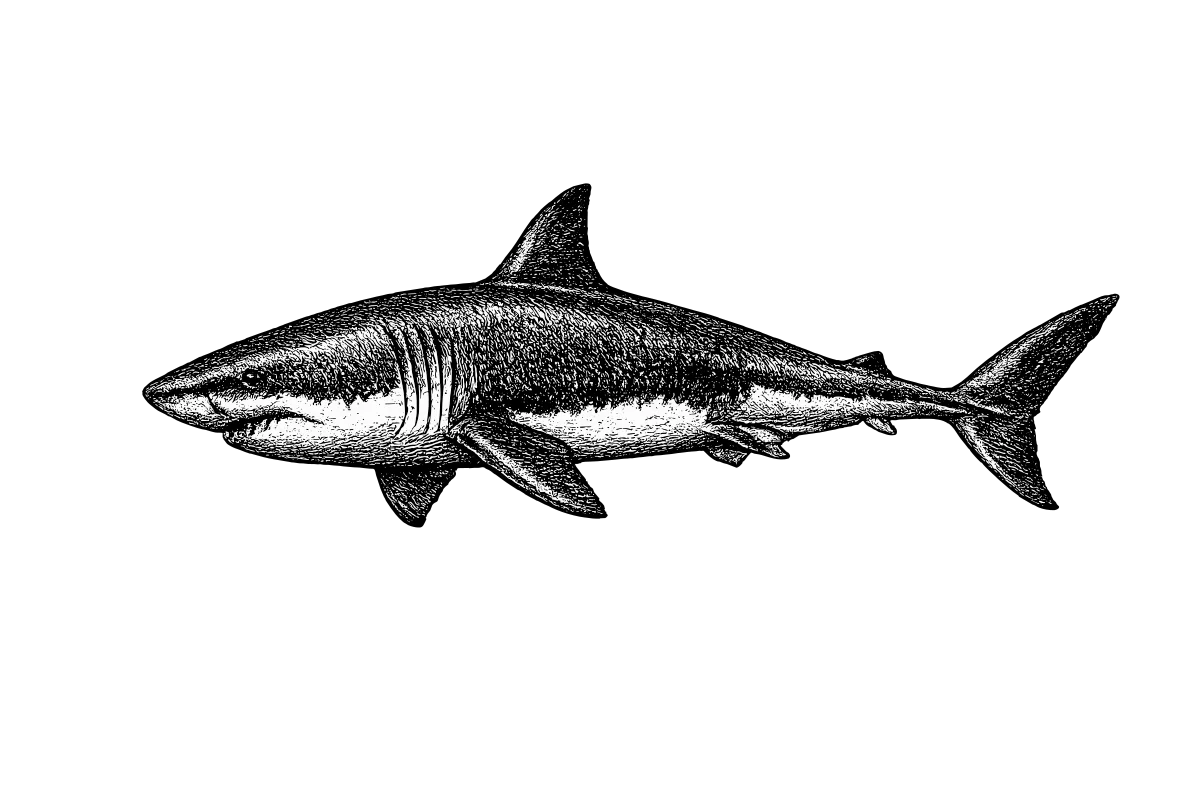
Yes, and selectively. Orcas have been documented killing great whites and eating only the liver — an oil-rich organ the size of a small car's fuel tank — leaving the rest. The hunting is so effective that in parts of South Africa the mere arrival of a pair of shark-eating orcas has driven great whites out of their own coastline for months.
Has a wild orca ever attacked a human?
There is no record of a wild orca killing a person, which is striking for an animal that routinely kills other large predators. The handful of dangerous incidents involving people have all happened in captivity. The recent run of orcas ramming boats off Iberia is property damage, not predation — the animals target the rudder and leave the crew alone.
What does a baby orca look like?
Orange where the adult is white. Newborn calves are about eight feet long and the pale patches that turn crisp white in adults start out a peachy orange, an effect of thin blubber over warm blood that fades in the first year. A calf nurses for over a year and stays with its mother's pod for life.
What is the difference between an orca and a pilot whale?
Both are oversized dolphins, but the orca is far larger and boldly marked black-and-white, while a pilot whale is uniformly dark with a bulbous, rounded forehead and no white eyepatch. Pilot whales travel in much larger, looser groups and feed mainly on squid; an orca is the only one of the two that hunts other marine mammals.