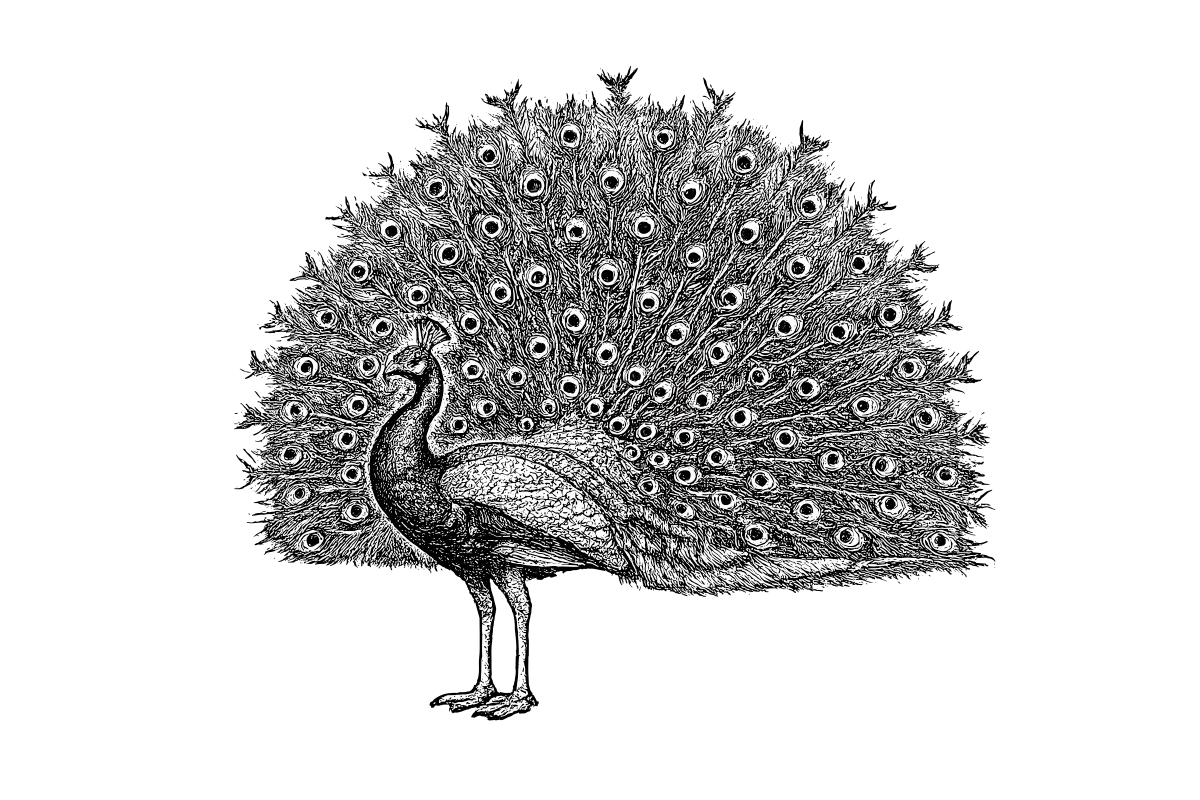
Peacock
Pavo cristatus
A four-foot-tall ground-dwelling pheasant that grew a six-foot train of iridescent display feathers and built an entire courtship ritual around shaking them. The colors are not paint — they are structural, refracted off microscopic feather lattices — and the train regrows from scratch every year.
Browse the Woodcut Wild shop →Habitat
The Indian peafowl is native to the open forests, grasslands, and farmland edges of the Indian subcontinent and Sri Lanka, and lives wild in scattered feral populations elsewhere from California to New Zealand. They roost in tall trees at night, descend at dawn to forage on the ground, and rarely stray far from a reliable water source.
Behavior
Peafowl are omnivorous ground foragers, scratching for seeds, grains, insects, small reptiles, and even small snakes. Males display the train in front of females in a spread fan vibrated at 25 Hz, a tremor that makes the eyespots shimmer while the long ribs around them rattle audibly. Females ('peahens') choose mates based on train symmetry and eyespot density, then incubate a clutch of 3 to 8 eggs alone in a ground scrape and raise the chicks without further help from the male. The male's loud, far-carrying contact call is a single drawn-out 'may-AW' that is, in person, surprisingly unmusical.
Marginalia
- The iridescent blues and greens are structural — produced by light refracting off microscopic crystalline lattices in the feather barbules — not pigment. Crush a peacock feather and the color disappears.
- Males drop the entire train every year after the breeding season and regrow it from scratch over the next several months; juveniles do not develop a full train until age three.
- The eyespots' shimmer during display is driven by tail muscles vibrating the feathers at 25 Hz — fast enough that the eyespots appear to float while the surrounding feathers blur.
- Three peafowl species exist: the familiar Indian (*Pavo cristatus*), the larger and more endangered green peafowl (*Pavo muticus*) of Southeast Asia, and the dark Congo peafowl (*Afropavo congensis*), which was unknown to Western science until 1936.
Kin & neighbors
Common questions
What is the difference between a peacock and a peahen?
Strictly the term: peacock is the male, peahen is the female, and 'peafowl' covers the species. Visually the gap is enormous — males carry the famous iridescent blue neck, the head crest, and the long train of eyespotted feathers; females are smaller, mottled brown and grey, with a short tail and no train at all. The drabness is an asset: a nesting peahen is invisible against leaf litter, while a peacock would advertise the nest from a quarter-mile away.
Can peacocks fly?
Yes, well enough to roost in trees 30 feet up. Peafowl are heavy and short-winged and can't sustain long flight, but they take off explosively, climb steeply, and glide between roosts and the ground. Wild birds prefer to walk and run; flying is reserved for getting up into the night roost and escaping ground predators. The train is no impediment — males drop it and re-grow it every year, and even with it intact they can fly well enough.
What sound does a peacock make?
Several, none of them what people expect. The famous call is a far-carrying 'may-AW' or 'kee-OW' the male gives during the breeding season — loud, repeated, and to most ears unmusical. Around the display itself the train produces an audible rustle as the feathers shiver, and very low infrasound that the female can sense through the air at close range. Peafowl also give short cackles, screams, and a soft contact 'cluck' between birds in a small flock.
Where do wild peacocks live?
Across the Indian subcontinent — India, Sri Lanka, Pakistan, Nepal, and Bangladesh — where the Indian peafowl is genuinely common in open forest, farmland edges, and even villages. The species is the national bird of India and is legally protected there. A separate green peafowl (*Pavo muticus*) lives across Southeast Asia and is endangered; the lesser-known Congo peafowl (*Afropavo congensis*), discovered only in 1936, lives in central African rainforest.
Why do peacocks have such long tail feathers?
Because peahens chose them, generation after generation. The classic Darwinian sexual-selection story: females mate preferentially with males carrying more elaborate trains (more eyespots, better symmetry, denser color), and over evolutionary time the trait spirals into something that costs the male in survival but pays in mating success. The train is technically not the tail at all — it is the elongated upper tail coverts, the feathers that grow above the actual tail and prop the display open from behind.