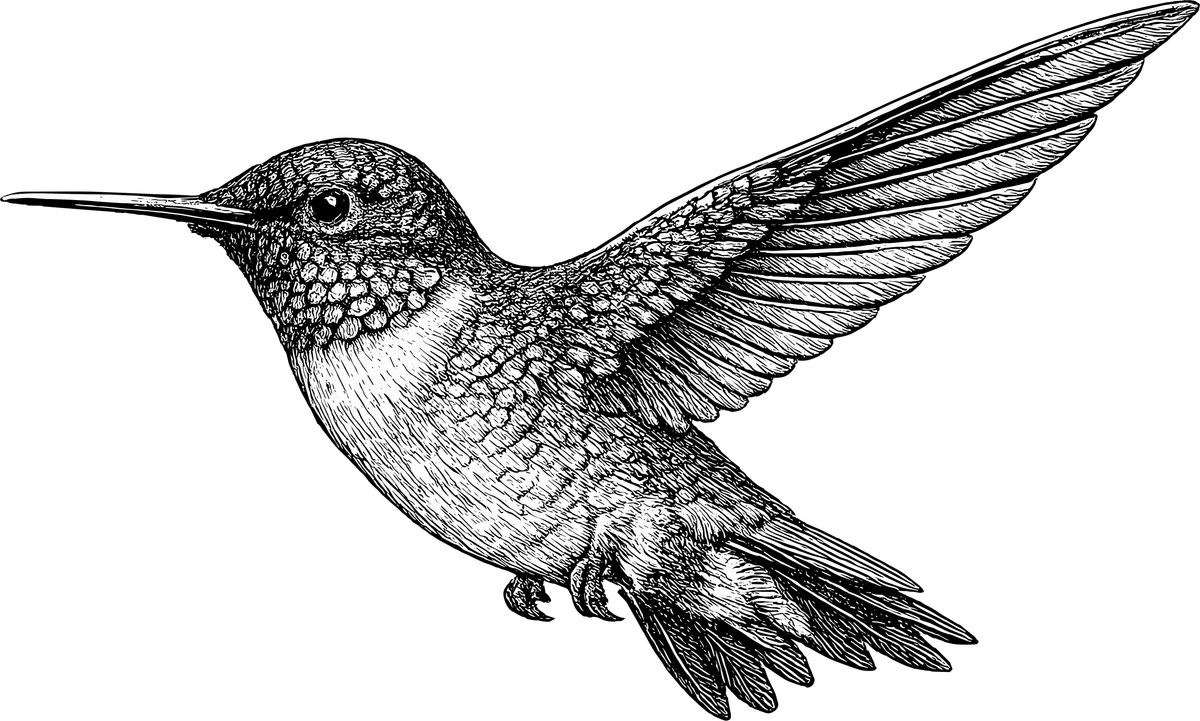
Ruby-throated Hummingbird
Archilochus colubris
The only widespread hummingbird east of the Mississippi. Three inches of iridescent muscle that hovers in mid-air, beats its wings 53 times a second, and flies non-stop across the Gulf of Mexico.
Browse the Woodcut Wild shop →Habitat
Ruby-throats breed in open deciduous woodlands, woodland edges, gardens, and orchards across the eastern half of North America — anywhere there are tubular flowers, small insects, and trees for nesting. They winter from southern Mexico through Costa Rica and Panama. Cultivated nectar gardens and sugar-water feeders have measurably extended their breeding range northward over the last fifty years.
Behavior
Hummingbirds hover by beating their wings in a figure-eight, generating lift on both the down- and up-stroke. They feed on nectar — especially from red, tubular flowers — and pluck small insects and spiders out of the air for protein. Their resting heart rate is around 250 beats per minute and climbs to 1,200 in flight; metabolism is so fast that on cold nights they enter a hibernation-like state called torpor, dropping body temperature by 30 degrees to conserve energy. Males display by diving in 50-foot J-shaped arcs in front of females, with the dive's air resistance making a sharp wing-pitched note.
Marginalia
- Twice a year, ruby-throats fly non-stop across the Gulf of Mexico — 500+ miles in about 20 hours, often doubling their body weight in fat before departure.
- Wing beats average 53 per second; in courtship display dives, the bird can hit 60 mph and pull more g-force than a fighter pilot.
- The male's iridescent ruby throat (gorget) gets its color from microscopic feather structure, not pigment — at the wrong angle it appears black.
- On cold nights, hummingbirds enter torpor: a state of suspended animation where heart rate drops from 1,200 to 50 beats per minute and body temperature falls 30°F. They appear dead until they reanimate at dawn.
- A hummingbird visits roughly 1,000 to 2,000 flowers a day, drinking up to twice its body weight in nectar.
Kin & neighbors
Common questions
What do you feed hummingbirds?
Plain white sugar dissolved in water — one part sugar to four parts water, no dye, no honey, no substitutes. Honey ferments and grows mold dangerous to the birds, and red food coloring is unnecessary and possibly harmful; a red feeder does the attracting on its own. Change the mix every few days in hot weather before it spoils.
When should you put up and take down a hummingbird feeder?
Put it up in early spring as the first migrants arrive and leave it up two weeks past your last sighting in fall. Leaving a feeder out late does not strand any bird — migration is triggered by day length, not food supply, and a hung feeder only helps stragglers fuel up for the trip south.
How long do hummingbirds live?
Longer than the frantic pace suggests. Most ruby-throats die in their first year, but a bird that survives to adulthood often lives three to five years, and banded individuals have been recovered at nine. For an animal with a heart that beats over a thousand times a minute, that is a remarkable run.
What does a hummingbird nest look like?
About the size of a thimble or a walnut shell. The female builds it alone from plant down and spider silk, which lets the cup stretch as the chicks grow, and shingles the outside with lichen for camouflage on a thin branch. She lays two eggs the size of coffee beans and raises the young with no help from the male.
What does it mean when a hummingbird visits you?
In the folklore of the Americas the hummingbird is a symbol of joy, resilience, and good fortune, and for the Aztec it was tied to Huitzilopochtli, a god whose name means 'hummingbird of the south'. Several cultures cast it as a messenger or a returning spirit. Practically, a hummingbird hovering close is usually checking whether your red shirt or feeder is a flower.