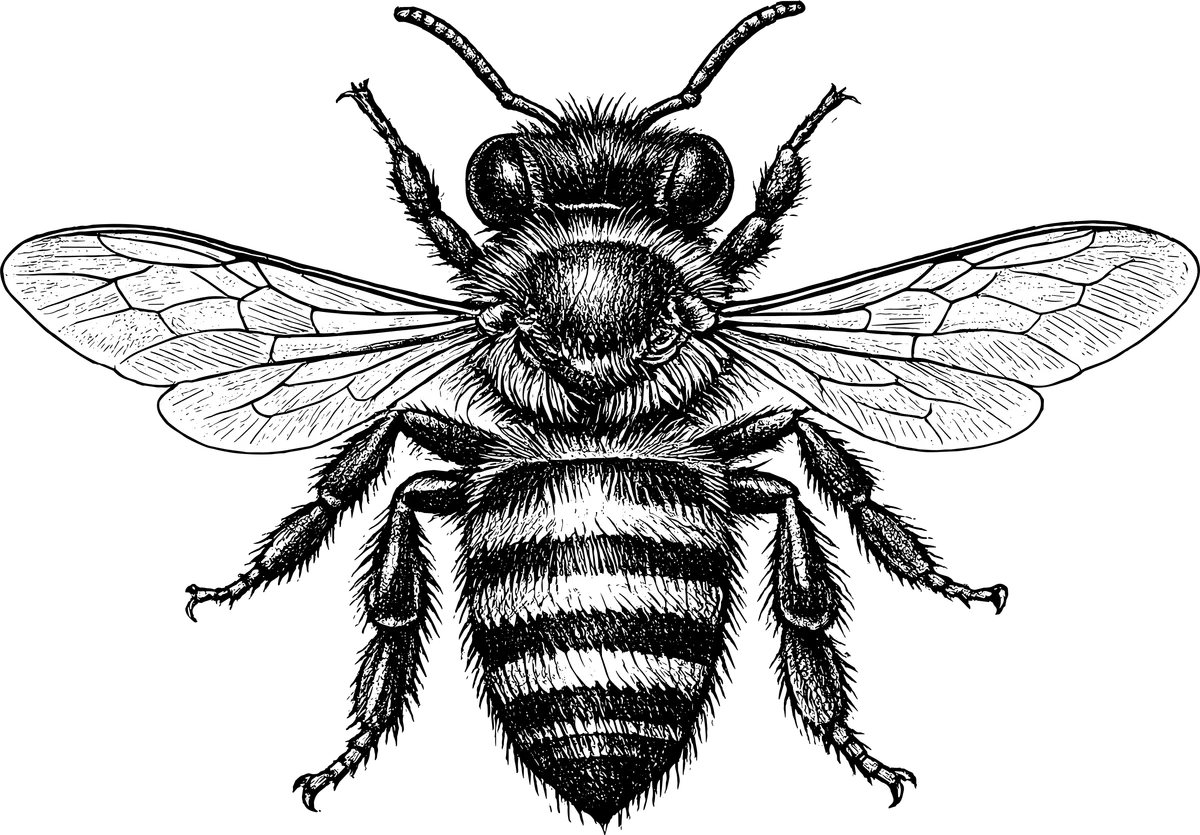
Honey Bee
Apis mellifera
The most studied insect in the world and the keystone pollinator of modern agriculture. A small, golden, hard-working architect of hexagonal wax cities — and a Nobel-winning communicator.
Browse the Woodcut Wild shop →Habitat
Honey bees live in cavities — hollow trees, rock crevices, and the wooden boxes of managed hives — anywhere they can build vertical comb shielded from rain and wind. The species is native to Europe, Africa, and Western Asia but has been carried by humans to every continent except Antarctica, and feral colonies now live across most of the temperate and tropical world.
Behavior
A honey bee colony is one of the most refined social organizations on Earth. A single fertile queen lays every egg. Twenty thousand to eighty thousand sterile female workers do every other job — foragers, nurses, guards, builders, undertakers, ventilators — rotating through roles as they age. A small number of male drones exist only to mate. Foragers communicate the direction, distance, and quality of nectar sources to their hive-mates through the waggle dance, a figure-eight choreography on the comb whose decoding won Karl von Frisch a Nobel Prize in 1973. A honey bee will visit roughly two million flowers to produce a single pound of honey.
Marginalia
- Honey bee colonies maintain the inside of the hive at a constant 95°F year-round — workers fan their wings to cool it in summer and cluster around the queen for warmth in winter.
- About a third of every bite of food eaten in the United States depends on bee pollination — almonds, apples, blueberries, melons, alfalfa, and dozens of other crops.
- A worker bee lives roughly six weeks in summer; winter bees live up to six months. The queen can live five to seven years.
- Hexagonal honeycomb is the geometrically most efficient way to divide a plane into cells of equal area — bees solved the math problem millions of years before mathematicians proved it.
- Honey is the only food made by an insect that humans eat directly. Found in Egyptian tombs and still edible after 3,000 years, it is essentially the only food that does not spoil.
Kin & neighbors

Common questions
Why do honey bees die after they sting you?
Their stinger is barbed. When a worker stings mammalian skin, the barbs lodge and the sting tears free along with part of the bee's abdomen, killing her. The detached sting keeps pumping venom on its own, so the fastest response is to scrape it out sideways rather than pinch it. Only the females sting — drones have no stinger at all — and the queen, whose stinger is smooth, can sting repeatedly and survives.
What is the difference between a honey bee and a wasp?
A honey bee is fuzzy, golden-brown, and rounded; a wasp like a yellowjacket is sleek, hairless, brightly banded, and has a pinched waist. Honey bees forage for nectar and pollen and are generally docile away from the hive. Wasps are predators and scavengers — the ones crashing your picnic in late summer — and, lacking a barbed sting, can sting again and again.
Why do honey bees swarm?
Swarming is how a colony reproduces. When a hive grows crowded, the old queen leaves with roughly half the workers to found a new colony, while a new queen is raised back home. A swarm hanging in a tree is a colony in transit, usually gorged on honey and unusually gentle — they have no nest or brood to defend yet.
What do honey bees eat?
Nectar and pollen, repackaged. Nectar becomes honey, the colony's carbohydrate store; pollen, packed into 'bee bread,' is the protein that feeds developing larvae. Nurse bees also produce royal jelly, a glandular secretion fed to all young larvae and, exclusively and for life, to the queen.
How far do honey bees travel to find food?
Commonly a mile or two from the hive, and up to five or six miles when forage is scarce. A foraging worker may fly several miles a day, and over her brief working life she covers enough distance to make the teaspoon or so of honey she ultimately contributes seem hard-won.