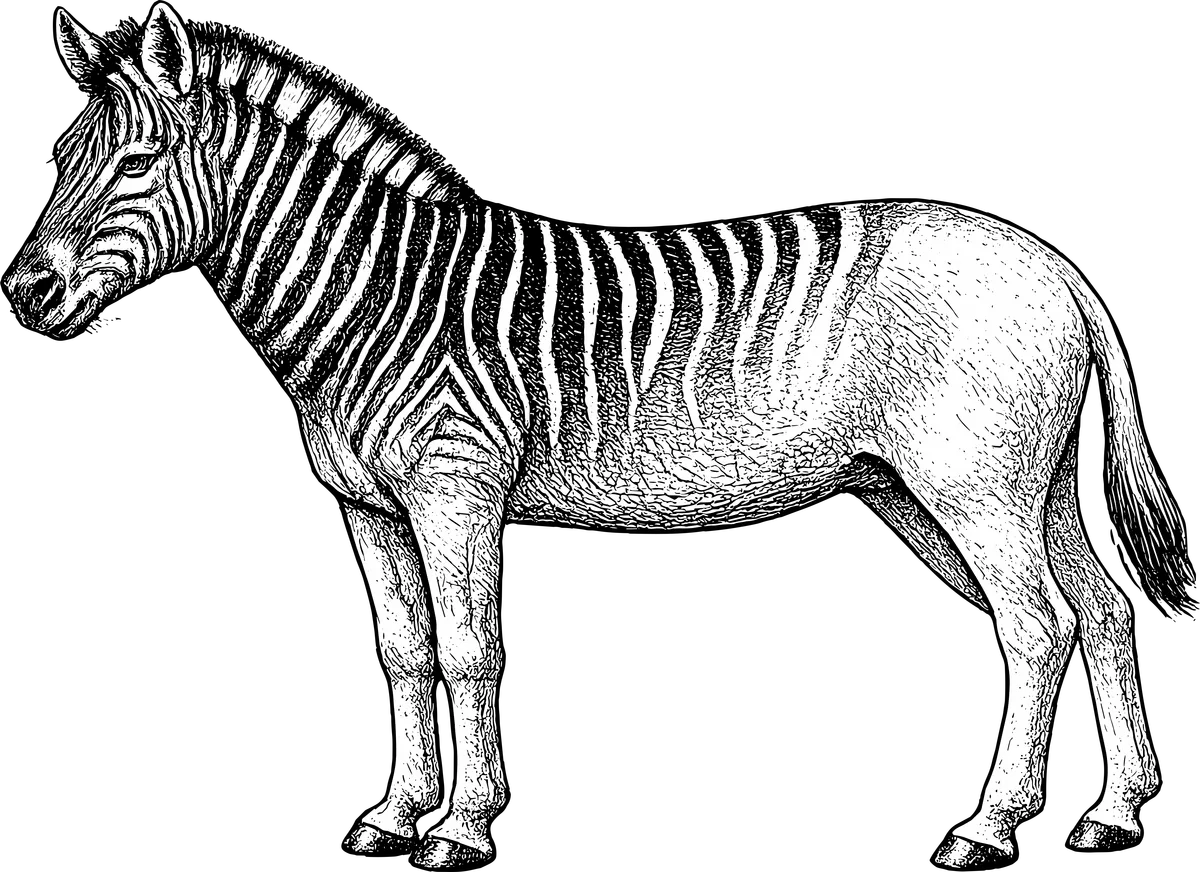
Quagga
Equus quagga quagga
Striped at the front, plain brown at the rear — the quagga was the southern subspecies of the plains zebra, hunted to extinction in the 19th century. The last one died in an Amsterdam zoo in 1883, before anyone realized there were no more left in the wild.
Browse the Woodcut Wild shop →Habitat
Quaggas grazed the open grasslands and karoo scrub of what is now South Africa's Western and Northern Cape and the western Free State. They lived in mixed herds with other plains grazers — gnu, ostrich, hartebeest — moving seasonally with the rains. They were hunted for hides and to clear pasture for sheep and cattle as Cape Colony agriculture expanded northward.
Behavior
Quaggas were typical plains zebras in social structure: small family groups led by a stallion, larger seasonal aggregations on rich grazing. The unique coat pattern — bold neck and shoulder stripes fading into a plain brown rear — may have served the usual zebra purposes of group cohesion and pest-fly confusion, though the partial striping has no satisfying explanation in modern stripe-evolution literature. The name 'quagga' is onomatopoeic, imitating the animal's barking contact call as the Khoekhoe people of the Cape recorded it.
Marginalia
- The quagga went extinct so quietly that nobody noticed at the time. The last captive died in Amsterdam in 1883; the last wild herd had already been shot out a decade earlier, but no one had connected the two events.
- DNA recovered from a museum specimen in 1984 showed the quagga was not a separate species at all — just a southern subspecies of the still-living plains zebra. The species is technically not extinct; only this distinctive coat pattern is gone.
- The Quagga Project, started in South Africa in 1987, has been selectively breeding plains zebras for reduced striping. The fifth and sixth generations — the 'Rau quaggas' — are now visually similar to historical specimens. It is a phenotype reconstruction, not a true de-extinction, but the project has produced animals that meet the historical visual description.
- Only one quagga was ever photographed alive — a mare at London Zoo. The five surviving photographs were taken between 1863 and 1870.
- The English word 'quagga' has become a generic term in conservation writing for an extinction that happened invisibly — a species that was already gone before science realized to look for it.
Kin & neighbors
Common questions
What is the difference between a quagga and a zebra?
The stripes ran out. A quagga had the bold striping of a plains zebra on its head, neck, and shoulders, then faded through a smudged middle into a plain reddish-brown rump and legs with no stripes at all. Otherwise it was a plains zebra in size, shape, and habits — which is precisely what later genetics confirmed it to be.
Could the quagga be cloned back?
Not yet, and probably not soon. No intact quagga cells survive — only dried museum skins yielding short, damaged fragments of DNA — so there is no usable genome to clone from. The animals being bred to look like quaggas today are plains zebras chosen for reduced striping, a revival of the appearance rather than the lost original.
Why did the quagga go extinct?
Shot out for land and meat. As Cape Colony farming pushed north in the 1800s, quaggas were hunted relentlessly — for their hides, for meat to feed laborers, and to clear grazing that settlers wanted for sheep and cattle. There was no legal protection and no sense that a common animal could simply run out, until it had.
Were quaggas ever tamed?
A few were. Cape farmers occasionally kept quaggas, and some were exported to Europe and broken to harness — there are 19th-century accounts of quaggas pulling carriages in London. Their alertness also made them useful as living alarms, kept among livestock to raise the call at the approach of predators.
How do we know what the quagga looked like?
From its remains and a handful of paintings. Around twenty mounted skins and skeletons survive in museums across Europe, alongside detailed life studies made by artists while the animals were still alive in menageries. Together they pin down the coat pattern closely enough that breeders can judge how near a modern look-alike comes.