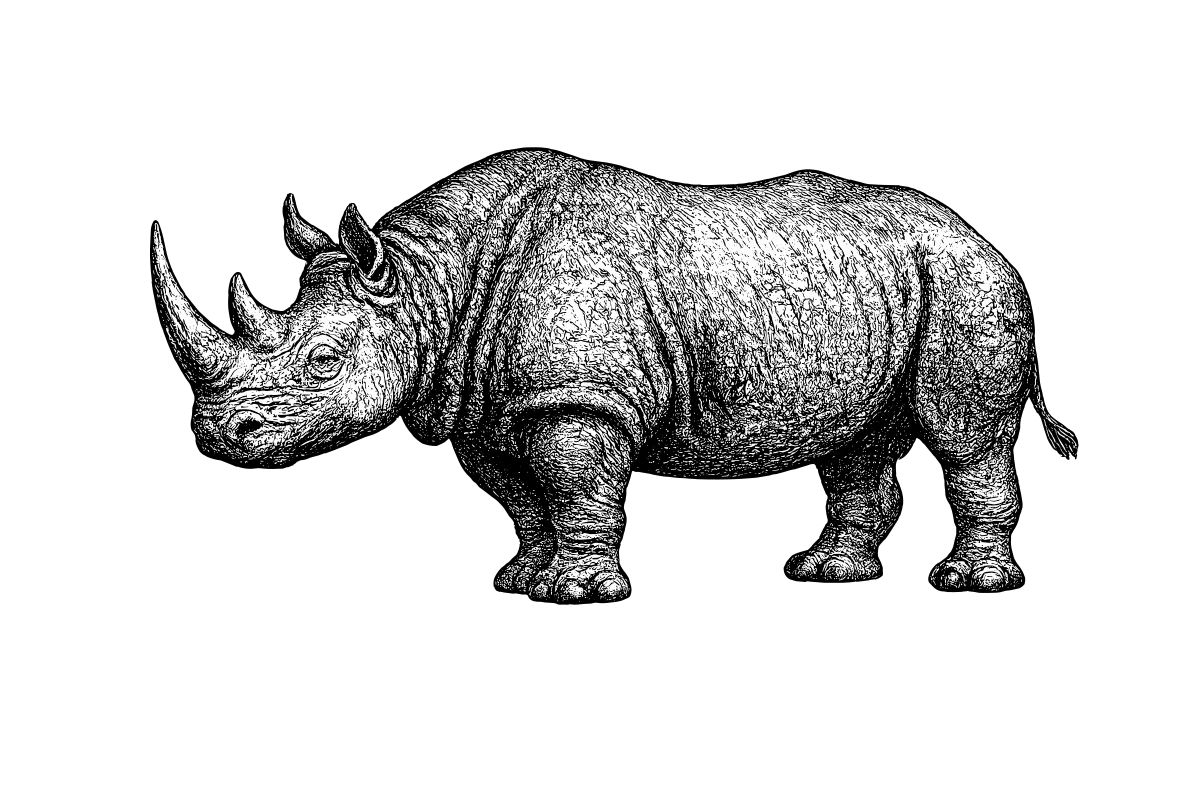
White Rhinoceros
Ceratotherium simum
Three tons of grass-grazing armor. The white rhino is the second-largest land mammal on earth and the great conservation success of its family — brought back from fewer than 100 animals to over 17,000, while three of its four cousins teeter on the edge of extinction.
Browse the Woodcut Wild shop →Habitat
White rhinos live in the savannas and grasslands of southern and east-central Africa, especially South Africa, Namibia, Zimbabwe, and Kenya. They prefer flat-to-rolling country with reliable surface water — they need to drink daily — and short grass for grazing.
Behavior
Unlike the more solitary black rhino, white rhinos are gregarious. Cows and calves form small loose groups; bulls are largely territorial but tolerate other males in their range. The name 'white' is a corruption of the Afrikaans 'wijde' — meaning 'wide' — referring to the broad, square lip adapted for grazing, not coloration. They graze, wallow in mud, dust-bathe, and rest in the heat of the day.
Marginalia
- Rhino horn is made of keratin — the same protein in human hair and fingernails — yet drives a black market valued at over $60,000 per pound.
- The northern white rhino has only two known living individuals, both female. Conservationists are attempting IVF with stored sperm to revive the subspecies.
- Despite their size, white rhinos can run 30 mph in short bursts.
- South Africa, holding 80% of the world's rhinos, lost over 1,000 a year to poaching at the peak of the 2010s crisis.
Kin & neighbors
Common questions
What is the difference between a white rhino and a black rhino?
The lip, mostly — and neither is actually colored as named. The white rhino has a wide, square lip for grazing grass close to the ground; the black rhino has a hooked, prehensile upper lip for stripping leaves off shrubs. The white rhino is the larger and more placid of the two, sociable and head-down; the black rhino is smaller, browsing, solitary, and famously bad-tempered.
How long do white rhinos live?
Around 40 to 50 years, among the longest-lived land mammals. Cows produce a single calf only once every two to three years after a gestation of roughly sixteen months, one of the longest of any mammal. That slow turnover is exactly why poaching is so destructive — a population cannot breed its way back quickly.
Are white rhinos dangerous?
Less than their reputation, but not to be tested. The white rhino is the calmer of the African rhinos and will usually flee rather than fight. Eyesight is poor, though, and a startled three-ton animal that charges in the wrong direction is lethal whether it meant harm or not — cows with calves are the ones to give room.
What animals prey on white rhinos?
An adult has none. At three tons with two horns, a healthy grown white rhino is beyond the reach of any African predator, and even lions leave them alone. Calves are the exception — lions and spotted hyenas will take an unguarded one, which is why a cow keeps her calf close and walks it ahead of her where she can watch it.
What does a baby rhino look like?
A hornless miniature, born after roughly sixteen months and already around 100 pounds. The horn is only a soft pale bump at birth and takes years to grow into a weapon. Unlike a black rhino calf, which follows behind its mother, a white rhino calf runs ahead of the cow — a small behavioral tell that separates the two species.