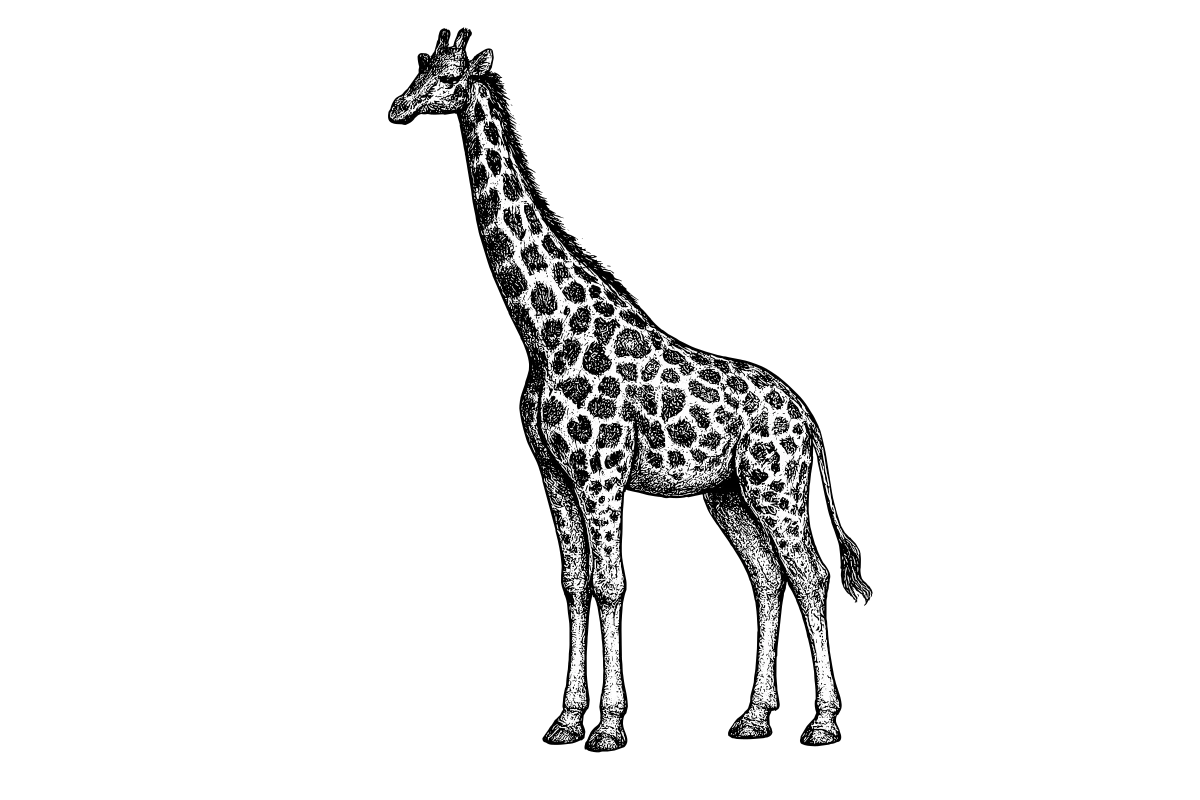
Giraffe
Giraffa camelopardalis
The tallest land animal on earth, with a heart the size of a basketball and a tongue dark enough to resist sunburn. The giraffe is one of the most-watched and least-protected megafauna in Africa.
Browse the Woodcut Wild shop →Habitat
Giraffes range across the savannas, open woodlands, and scrub of sub-Saharan Africa. They prefer acacia-dotted country where their height gives them access to leaves no other browser can reach. They drink rarely — getting most of their water from the leaves they eat — which lets them range through arid country where surface water is scarce.
Behavior
Adults browse for 16 to 20 hours a day, using their 18-inch prehensile tongue to strip leaves around acacia thorns. They live in loose, fluid social groups called towers — not the rigid herds of zebras or wildebeest. Males establish dominance through 'necking,' swinging their heads against each other at high speed. Giraffes sleep less than any other mammal, often only a few minutes at a time.
Marginalia
- Giraffes have the same number of vertebrae in their neck as humans — seven — just enormously elongated.
- Their blood pressure is roughly twice that of a human's, required to push blood up the long neck to the brain.
- Each giraffe's coat pattern is unique, like a fingerprint, and is inherited from its mother.
- Populations have declined nearly 40% in the last three decades, in what conservationists have called a 'silent extinction.'
Kin & neighbors
Common questions
Do giraffes make any sound?
They do, just rarely and quietly — the silent-giraffe idea is wrong. Researchers recording captive giraffes at night found a low humming around 92 hertz, near the bottom of human hearing, along with the occasional snort, grunt, and bleat. The long neck makes producing air-driven calls hard, so giraffes mostly communicate by sight and posture instead of voice.
What eats giraffes?
Lions, mainly, and they're the only predator that regularly tackles a healthy adult — usually in a pride and at real risk, since a giraffe kick can crush a skull. Calves are far more vulnerable: leopards, hyenas, wild dogs, and crocodiles at water take a heavy toll, and well over half of calves don't survive their first year.
Are giraffes dangerous?
To predators and to careless handlers, yes. A giraffe's defense is its kick — a forward or backward strike from a leg ending in a dinner-plate hoof, delivered with enough force to kill a lion. They are not aggressive toward people in the wild, but captive giraffes have killed keepers with a swing of the head or a kick, so the gentle reputation has limits.
How is a baby giraffe born?
Standing up, with a long drop to the ground — the mother gives birth upright, and the calf falls roughly six feet onto the dirt. The fall, jarring as it looks, helps break the sac and start it breathing. A newborn is already about six feet tall, and it is usually on its feet and nursing within an hour, because a calf that can't run is a dead calf.
How long do giraffes live?
About 25 years in the wild and a few years longer in captivity. Most of the danger is front-loaded into the first year, when predators take the majority of calves; an adult that clears that gauntlet has few enemies and can live out a full quarter-century.