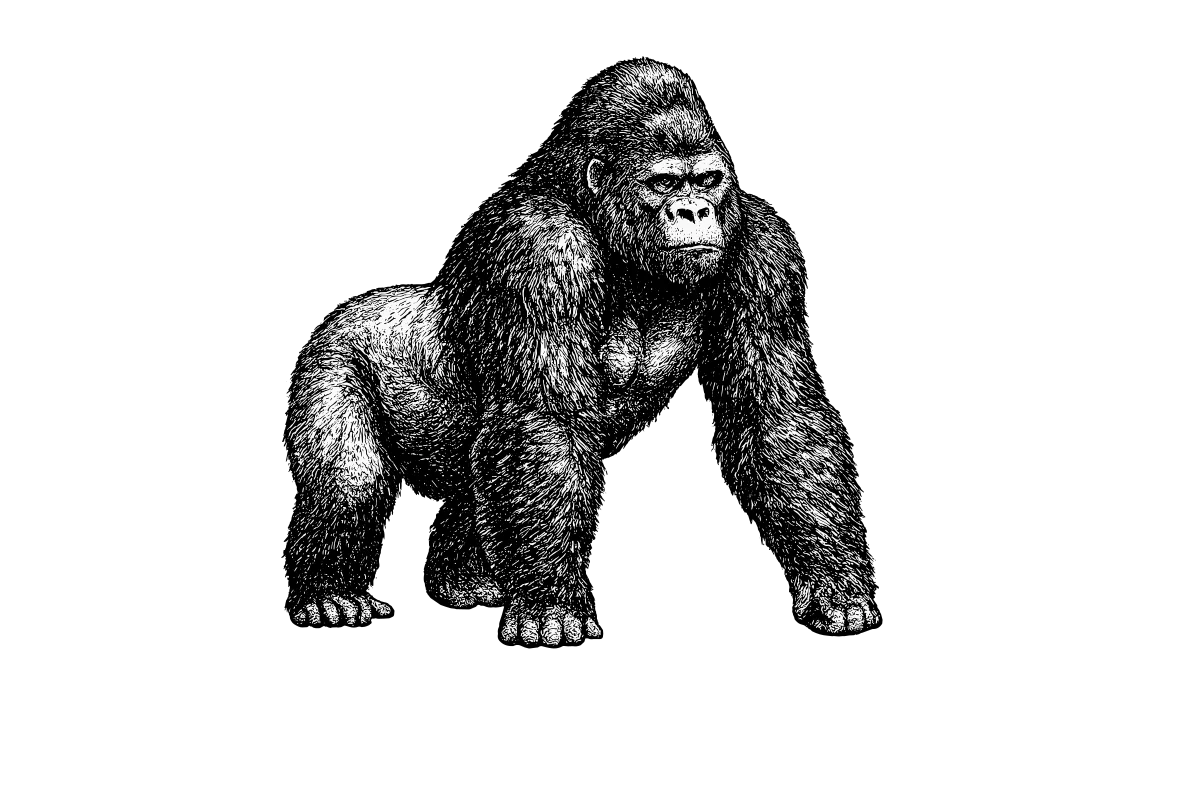
Western Lowland Gorilla
Gorilla gorilla gorilla
The largest primate on earth — silverbacks weigh upward of 400 pounds. Western lowland gorillas live in family groups led by a single dominant male, eat mostly fruit, and share 98% of their DNA with humans.
Browse the Woodcut Wild shop →Habitat
Western lowland gorillas inhabit the dense rainforest, swamp, and secondary growth of the Congo Basin — Cameroon, the Central African Republic, Equatorial Guinea, Gabon, the Republic of Congo, Angola. They prefer flat or rolling terrain with year-round fruit availability and reliable surface water.
Behavior
Gorillas live in stable family groups of 5 to 30 individuals, led by a silverback male. Days are spent foraging — fruit makes up the majority of the diet, supplemented by leaves, stems, and the occasional insect — punctuated by long midday rests. Young gorillas play, learn tool use, and observe the silverback. Communication is rich: gorillas use at least 16 distinct vocalizations and a complex body language. Despite their reputation, they are gentle animals; chest-beating is almost always display, not aggression.
Marginalia
- The Ebola virus has killed an estimated third of the wild gorilla population since the 1990s.
- Gorillas can learn sign language — Koko, the famous captive western lowland gorilla, used over 1,000 signs.
- Adult males develop silver-gray fur across their back and hips as they mature, hence 'silverback.'
- Wild gorillas have been observed using tools — sticks to test water depth and slabs of wood as bridges across boggy ground.
Kin & neighbors
Common questions
How strong is a gorilla?
Strong enough that the comparisons stop being useful. A silverback can lift and throw weights several times its own body mass, and bite-force measurements put it well above a lion's, geared for grinding tough stems rather than meat. Hard numbers are scarce because no one is going to make a wild gorilla bench-press, but the everyday feats — bending bamboo, peeling bark, tearing apart vegetation — make the point.
Are gorillas dangerous to humans?
Seldom, and almost never without cause. Gorillas are not predators and have no interest in people; a silverback's roaring, chest-beating charge is a bluff meant to make an intruder back down, and it usually works. Real attacks come when an animal is cornered, threatened, or defending its group. The greater danger runs the other way — humans have driven the species to the brink.
What is the difference between a gorilla and a chimpanzee?
Size, diet, and temperament, mostly. Gorillas are far larger — a silverback outweighs a chimp four or five times over — and live in stable groups under one dominant male, eating mainly plants. Chimpanzees are smaller, faster, live in larger fluid communities, hunt and eat meat, and are markedly more aggressive. Both are great apes, but the chimp is the closer relative to humans.
What is the difference between a western lowland gorilla and a mountain gorilla?
They are different subspecies living in different places. The western lowland gorilla of the Congo Basin is smaller, browner, shorter-haired, and eats more fruit. The mountain gorilla of the high forests of Rwanda, Uganda, and the Congo is bulkier with long shaggy black fur for the cold and eats far more leaves and stems. Almost every gorilla in a zoo is a western lowland; mountain gorillas have never survived in captivity.
How long do gorillas live?
Typically 35 to 40 years in the wild, and into their 50s in captivity, where the oldest recorded passed 60. They are slow to mature and slow to breed — a female has her first infant around age ten and one every four years after — which is part of why the species recovers so slowly from losses.