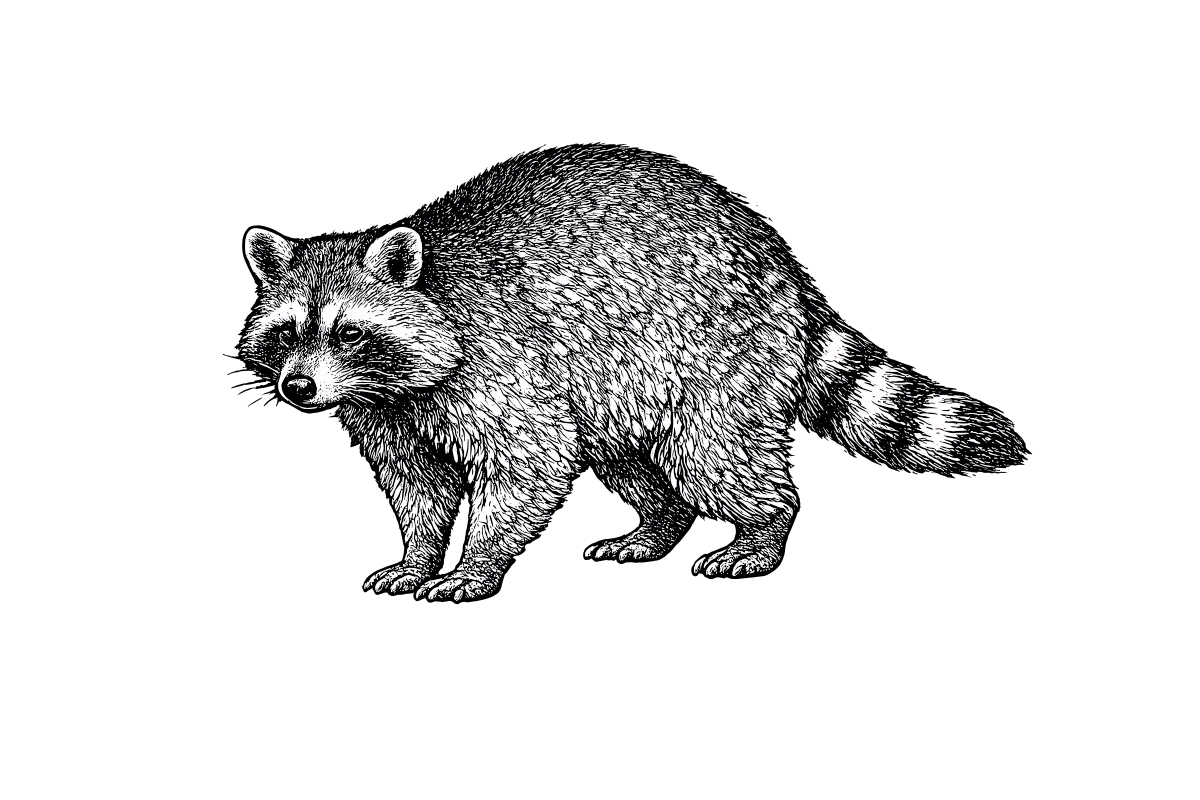
Raccoon
Procyon lotor
A small carnivore that thrives precisely because cities exist. The raccoon's combination of dexterous hands, problem-solving intelligence, and an indiscriminate diet has made it one of the few wild mammals whose numbers are higher in urban areas than in the wild.
Browse the Woodcut Wild shop →Habitat
Raccoons are native to the forests, wetlands, and riverbanks of North America but have adapted to suburb and city with unusual success. They den in tree hollows, burrows, attics, storm drains, and chimneys, and need only cover, water, and a food source — which in a city is almost everywhere.
Behavior
Raccoons are nocturnal omnivores with remarkably sensitive, dexterous front paws — much of their brain's sensory cortex is devoted to touch, and they 'see' with their hands, manipulating and inspecting food and latches in the dark. They are strong problem-solvers; urban raccoons routinely defeat 'raccoon-proof' bins and locks, and studies show they remember solutions to tasks for at least three years.
Marginalia
- The species name 'lotor' means 'washer' — captive raccoons appear to 'wash' food, but the behavior is actually about wetting the paws to heighten their already extreme sense of touch, not cleaning.
- Raccoons in cities have larger problem-solving repertoires and bolder personalities than rural ones, and urban populations are measurably evolving in real time toward greater tolerance of humans.
- The black mask is more than decoration — it reduces glare and may improve night vision, the same principle as the eye-black athletes wear.
- Raccoons were introduced to the Soviet Union and Germany in the 20th century for fur farming; escapees founded a European population now numbering over a million.
Kin & neighbors

Common questions
What do raccoons eat?
Almost anything. Raccoons are true omnivores — crayfish, frogs, insects, eggs, fruit, nuts, grubs, fish, carrion, and in a city, whatever is in the trash. They forage along water for aquatic prey and will happily raid a garden, a chicken coop, or a pet bowl left on the porch.
How long do raccoons live?
Not long in the wild — most do not reach three years, with cars, disease, and predators taking the majority young. A raccoon that survives its first hard year may make it to five or six, and captive animals have lived past twenty.
Do raccoons carry rabies?
Yes — raccoons are one of the primary rabies reservoirs in the United States, especially in the East. Most raccoons are not infected, but a raccoon that is active in daylight, staggering, or unusually aggressive should be avoided and reported. They also carry a roundworm, Baylisascaris, whose eggs in their droppings are dangerous to humans.
What sound does a raccoon make?
A surprising range of them — over a dozen distinct calls. The most startling is the fight: raccoons squabbling at night produce growls, snarls, and eerie screams that are routinely mistaken for a person or a wounded animal. Mothers and kits keep contact with soft chittering, churring, and purr-like trills.
What does a baby raccoon look like?
Like a miniature adult born faint. Kits arrive with closed eyes and a sparse coat, and the black mask and tail rings are already faintly visible at birth, darkening over the first weeks. They stay denned with the mother for two months before following her out to forage, and litters of three to five are typical.