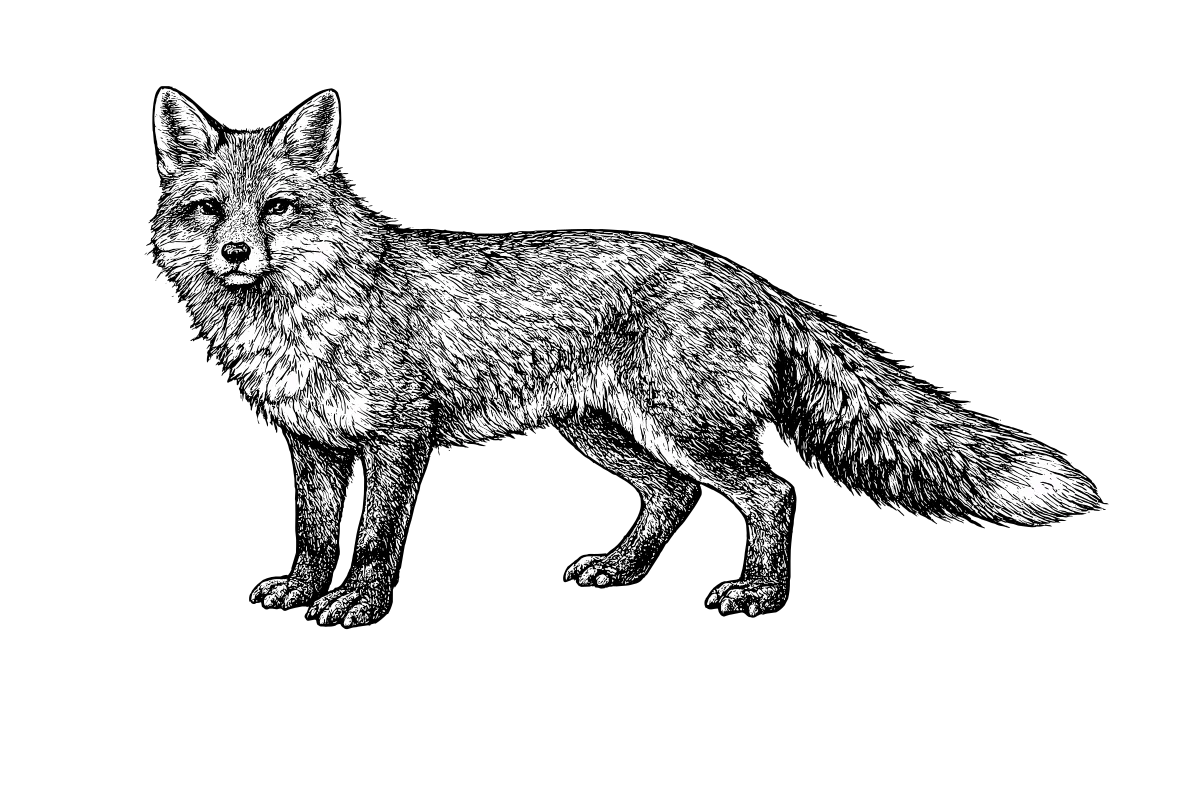
Red Fox
Vulpes vulpes
The most widely distributed wild carnivore on Earth. The red fox occupies more of the planet's land surface than any other member of the dog family — Arctic tundra to North African desert to the center of London — by being smarter and more adaptable than anything trying to eliminate it.
Browse the Woodcut Wild shop →Habitat
Red foxes live almost everywhere: forest, grassland, tundra, farmland, suburb, and dense city. They den in burrows (often appropriated from other animals), under sheds, and in culverts, and need only cover and a food supply to establish a territory.
Behavior
Foxes are solitary hunters with an omnivorous, opportunistic diet — rodents, rabbits, birds, insects, fruit, garbage. They hunt small mammals with a distinctive high pounce, leaping and pinning prey beneath the front paws, and orient these pounces using the Earth's magnetic field, the only animal known to use magnetic sense to range-find. They cache surplus food and remember the locations precisely.
Marginalia
- Red foxes can hear a mouse squeak at about 100 yards and a watch ticking at 40 — low-frequency hearing tuned precisely to the sounds of digging and gnawing prey.
- The famous Russian farm-fox experiment, breeding foxes for tameness over 60+ years, produced dog-like floppy ears, curled tails, and piebald coats — accidental evidence for how domestication reshapes a species.
- Not all 'red' foxes are red — the silver fox and the cross fox are the same species, just different color morphs, and a single litter can contain more than one.
- Urban foxes have measurably different skulls from rural foxes — shorter, stronger snouts adapted to scavenging hard human food waste rather than catching live prey.
Kin & neighbors
Common questions
Are red foxes dangerous to humans or pets?
Rarely to people — a healthy fox wants nothing to do with you and will not attack an adult. They can take small pets like chickens, ducks, rabbits, and the occasional kitten, and a fox acting tame or aggressive in daylight may be rabid and should be avoided. Bites on humans are almost always a cornered animal defending itself.
What sound does a fox make?
Nothing dog-like. The two that carry are the scream — a hoarse, drawn-out shriek heard most in winter breeding season and easily mistaken for a person in distress — and the 'gekkering', a rapid stuttering chatter foxes make in close confrontations. The vixen's scream is the one that empties out into a dark yard and raises every hair on your neck.
What does it mean when you see a fox?
In folklore the fox is the standing symbol of cunning and cleverness, from Aesop to the Japanese kitsune, a shapeshifting spirit messenger of the rice god. Across European and Native American tales the fox is the trickster — the one who wins by wit rather than strength. Practically, a fox crossing your path mostly means you are near good cover and a reliable food source.
How long do red foxes live?
Briefly in the wild. Most foxes die within two to four years — to cars, hunting, mange, and disease — and a large share never survive their first winter. The handful that beat the odds may reach ten, and foxes in captivity have lived to fourteen or more.
Can you keep a fox as a pet?
Legally fraught and rarely a good idea. Wild red foxes do not domesticate, mark their territory with a musk most owners find unbearable indoors, and are illegal to keep without a permit in many places. The tame Russian farm foxes are a separate, decades-long breeding line and are not the same as catching a wild one.