Redfish
Sciaenops ocellatus
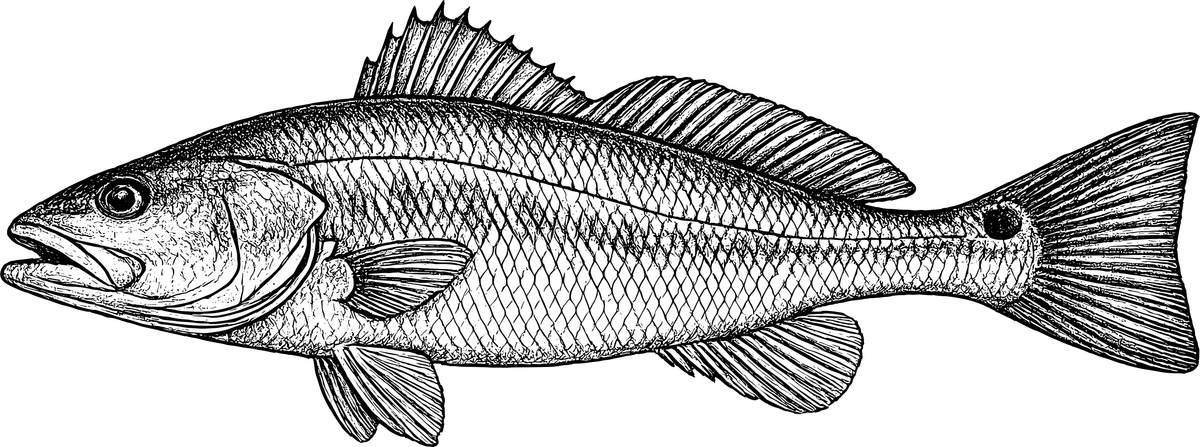
Copper-bronze, hard-pulling, and unmistakable for the dark spot near the tail. Properly the red drum — but every angler on the Gulf and Atlantic flats calls it a redfish.
Browse the Woodcut Wild shop →Habitat
Redfish are inshore predators of shallow saltwater: marsh grass edges, oyster reefs, grass flats, sand flats, beach surf, and brackish estuaries. Juveniles spend their first years in the nursery water of bays and creek mouths; large adults — 'bull reds' — leave the estuaries and stage along outer beaches and inlets to spawn. The species tolerates wide salinity and is occasionally found well into freshwater rivers.
Behavior
Redfish 'tail' on shallow flats — feeding head-down on crabs and shrimp with the tail breaking the water surface, fanning slowly in the air. It is the marquee sight-fishing event of inshore saltwater fly fishing. They also school in large groups along beaches in summer and fall and can be seen pushing water in big, slow wakes. The species was crashed in the 1980s by the blackened-redfish craze and the commercial purse-seine fishery that followed; recovery has been steady under tight state regulation.
Marginalia
- Named for the dark eyespot — usually one but sometimes multiple — near the base of the tail. The species name ocellatus is Latin for 'little eye'. The spot may function as a predator decoy, drawing strikes away from the head.
- A redfish can live over 40 years. Big bull reds in the Gulf are often older than the boats fishing for them.
- The 1980s 'blackened redfish' craze — popularized by chef Paul Prudhomme — drove the species to collapse in less than a decade. Texas, Florida, and other states banned commercial harvest and protected breeding-size fish in response.
- Redfish 'drum' — males vibrate a muscle against their swim bladder to produce a low croak during spawning season, audible from the deck of a boat over still water.
- The fly cast to a tailing redfish on a grass flat at dawn is one of the foundational images of modern saltwater fly fishing.
Kin & neighbors
Common questions
How do you catch a redfish?
Put a bait or fly in front of its nose — redfish feed by sight and smell down on the bottom, not up in the water column. On the flats, anglers pole quietly and cast ahead of a tailing or cruising fish with a shrimp or crab pattern, a gold spoon, or a soft plastic worked slow. Live or cut bait on the bottom near oyster reefs and marsh edges takes them just as well.
Is redfish good to eat?
Very — firm, mild, slightly sweet white meat that holds up to a hot skillet, which is exactly what made the blackened-redfish craze possible. The catch is the rules: most states protect the big breeding 'bull reds' and allow you to keep only fish within a narrow slot, so the legal keeper is a younger, eating-size fish.
What is a slot limit on redfish?
A range of legal lengths — keep only a fish between roughly the high teens and the high 20s of inches, depending on the state, and release anything shorter or longer. The upper cap protects the large, old females that do most of the spawning; the rule is the backbone of the recovery that brought the species back from its 1980s collapse.
When is the best time to fish for redfish?
Dawn and the moving tide. A rising or falling tide pushes redfish onto and off the flats to feed, and early light makes tailing fish easiest to spot before the wind builds. Fall is the marquee season, when big schools and bull reds stack along the beaches and inlets to spawn.
What is the difference between a redfish and a black drum?
Both are drum and both root crabs off the bottom, but the redfish is copper-bronze with that black tail spot and no chin barbels, while the black drum is gray-to-silver, often vertically barred when young, and wears whiskery barbels under its chin. The black drum grows heavier and coarser; its big specimens turn wormy and tough, where redfish stays good table fare.