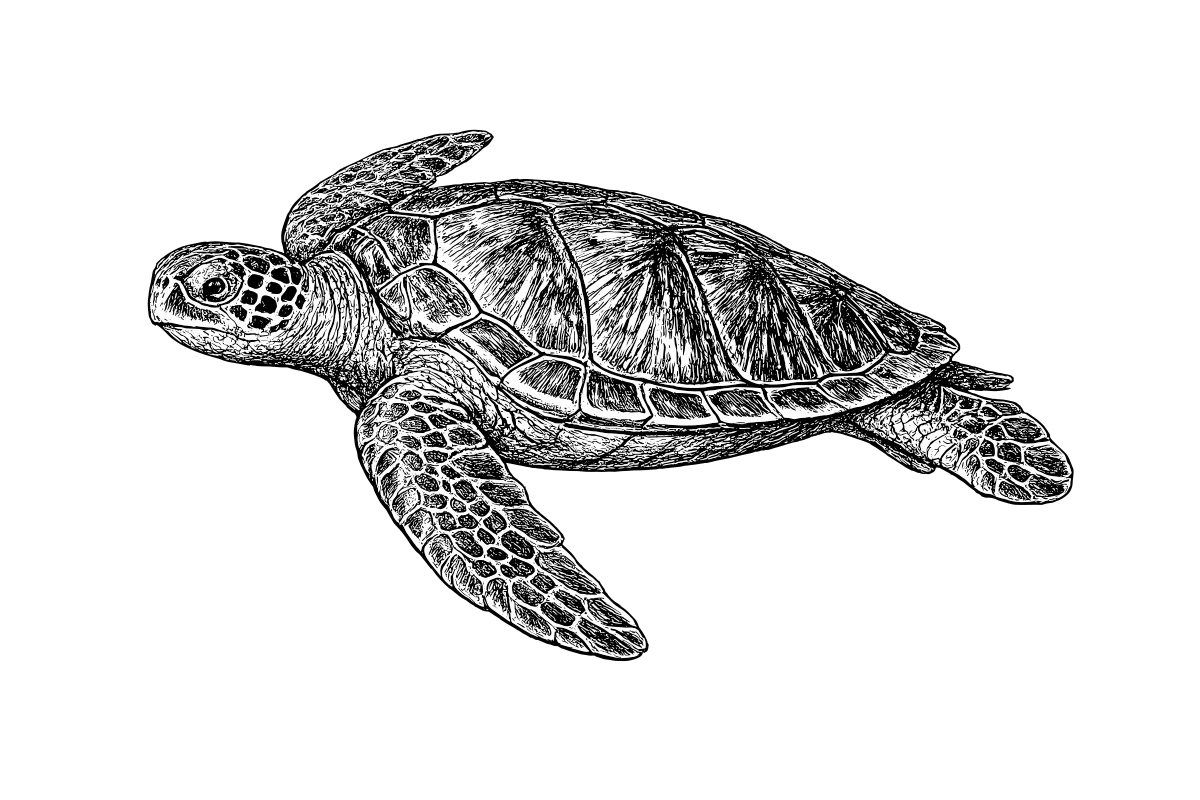
Green Sea Turtle
Chelonia mydas
A reptile that navigates open ocean by magnetic sense and returns, decades later, to lay its eggs on the exact beach where it hatched. The green sea turtle has been doing this since before the continents reached their current positions — a body plan essentially unchanged for over 100 million years.
Browse the Woodcut Wild shop →Habitat
Green sea turtles live in shallow coastal waters, seagrass beds, and coral reefs in tropical and subtropical oceans worldwide. Adults are tied to seagrass meadows, which they graze; hatchlings spend their first years in the open ocean, drifting with currents and feeding on plankton.
Behavior
Uniquely among sea turtles, adult green turtles are herbivores, grazing seagrass and algae — a diet that gives their body fat its green color and their name. Females return to their natal beach to nest, hauling out at night, digging a chamber, and laying around a hundred eggs before returning to the sea; the temperature of the sand determines the sex of the hatchlings. They navigate thousands of miles using the Earth's magnetic field, imprinting on the magnetic signature of their birth beach.
Marginalia
- Hatchling sex is set by sand temperature — warmer nests produce females, cooler nests males — so climate warming is skewing some populations dramatically toward female.
- Green turtles can hold their breath for hours while resting and slow their heart rate to as little as one beat every several minutes.
- They imprint on the magnetic field of their natal beach as hatchlings and use it to return as adults decades later, finding a specific stretch of coast across an entire ocean.
- Individual green turtles are thought to live 60 to 70 years or more, reaching sexual maturity only at 25 to 35 years of age.
Kin & neighbors
Common questions
Why are green sea turtles endangered?
Mostly by us, at every life stage. Adults drown in fishing nets and on longlines, nesting beaches are lost to development and lights that disorient hatchlings, eggs and meat are still poached, and floating plastic looks enough like jellyfish to kill them. A tumor disease called fibropapillomatosis, linked to coastal pollution, blinds and weakens turtles across warm waters.
What are the odds a baby sea turtle survives?
Long — perhaps one in a thousand reaches adulthood. From the moment hatchlings boil out of the nest and scramble for the surf, crabs, gulls, frigatebirds, and fish pick them off, and the gauntlet continues for years in the open ocean. The hundred-egg clutches and decades of nesting are evolution's answer to those odds.
Is it legal to touch a sea turtle?
No — in the United States and most countries it is illegal to touch, ride, chase, or feed a wild sea turtle, which are protected by law. Even well-meaning contact can stress the animal or spread disease. The rule for a turtle on the beach or the reef is the same: keep your distance and let it be.
Do sea turtles sleep underwater?
Yes — they wedge under ledges or rest on the bottom and sleep submerged, surfacing only when they need a breath. A resting turtle's slowed heart rate lets it stay down for hours at a stretch. Hatchlings and small juveniles sleep adrift at the surface, riding the same currents that carry them.
What does a sea turtle symbolize?
Longevity, patience, and steady endurance across most cultures that live beside them. In Hawaiian tradition the green turtle, the honu, is an 'aumakua — a guardian spirit and a symbol of good luck and safe passage. Older mythologies from India to the Iroquois place the whole world on the back of a great turtle.