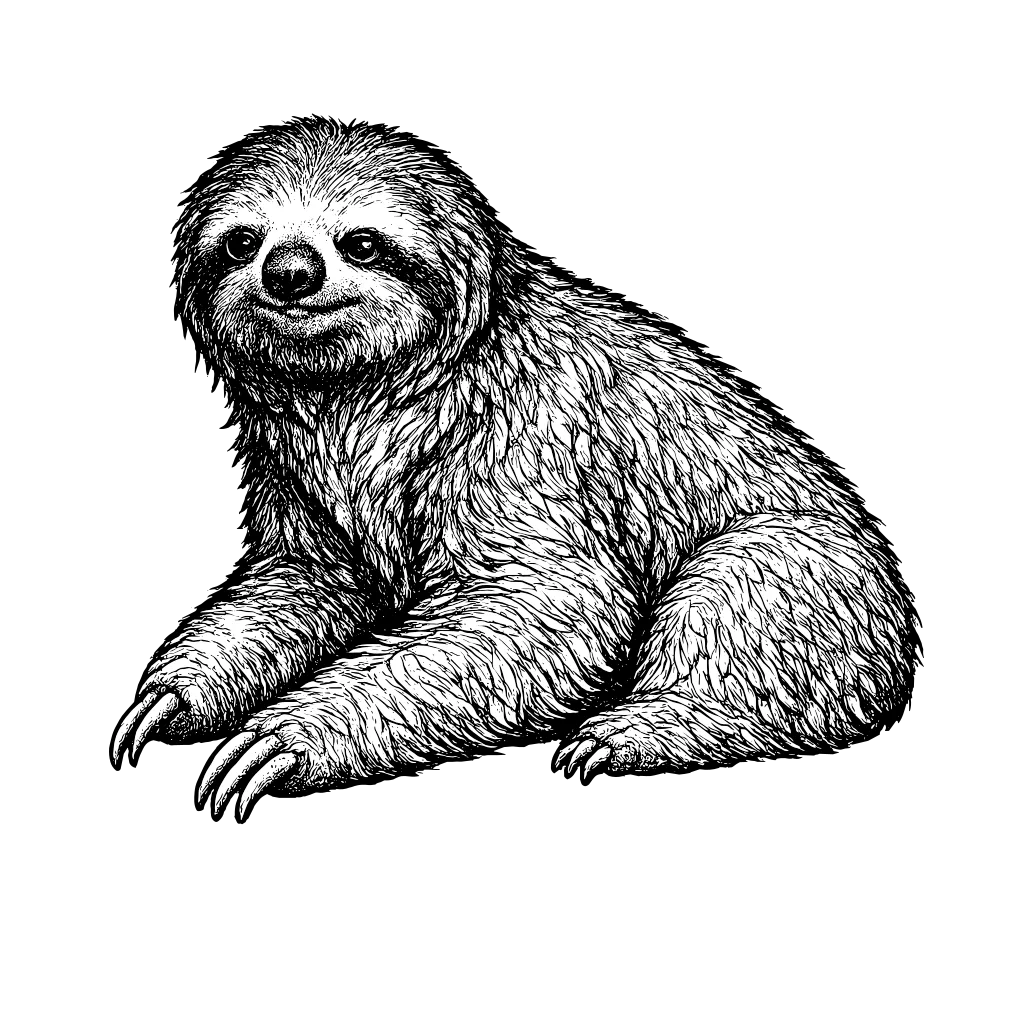
Three-toed Sloth
Bradypus variegatus
An animal that turned slowness into a survival strategy. The three-toed sloth moves so little and so slowly that an entire ecosystem of algae, moths, and beetles lives in its fur — and that slowness is precisely what keeps it invisible to the hawks and cats that hunt by detecting motion.
Browse the Woodcut Wild shop →Habitat
Three-toed sloths live in the canopy of tropical rainforests across Central and South America. They spend almost their entire lives in trees, descending only about once a week — and only to defecate, a journey that is the most dangerous thing they regularly do.
Behavior
Sloths are arboreal folivores, eating mostly leaves — a diet so low in energy that they conserve every calorie. They move at a few feet per minute, sleep eight to ten hours a day, and have a multi-chambered stomach that takes up to a month to digest a single meal. Their slow movement makes them nearly invisible to predators that detect prey by motion, and a symbiotic community of algae, moths, and beetles lives in the grooved fur, the algae tinting the sloth green for camouflage.
Marginalia
- Sloths descend to the ground to defecate only about once a week, losing up to a third of their body weight in one event — the riskiest behavior in their lives, and one biologists still don't fully understand.
- Their fur hosts a tiny ecosystem: algae that camouflages them and provides nutrients, plus moths that live nowhere else and whose life cycle is tied to the sloth's weekly trip to the ground.
- Sloths can rotate their heads nearly 270 degrees thanks to extra neck vertebrae, letting them survey the canopy without moving their bodies.
- They are surprisingly strong swimmers — up to three times faster in water than on land — and can slow their heart rate to hold their breath for up to 40 minutes.
Kin & neighbors
Common questions
What is the difference between a two-toed and a three-toed sloth?
More than a toe. The names come from the front claws — both have three toes on the hind feet — and the two are not even close relatives, having evolved their tree-dwelling slowness separately. Three-toed sloths hang face-up, have a stubby tail and a permanent smile-shaped face, feed almost entirely on leaves, and are slower; two-toed sloths are larger, more nocturnal, eat a broader diet, and are faster and crankier.
How long do sloths live?
Surprisingly long for the energy they take in — wild three-toed sloths are thought to reach their 30s, and animals in captivity have lived to 40 and beyond. The slow metabolism that makes them seem fragile is the same thing that stretches their lives out.
Are sloths dangerous? Do they bite?
Not aggressive, but not a toy. A cornered or handled sloth will bite and slash with claws built for hanging full body weight from a branch, and the wounds can be deep. They carry no venom and want only to be left in the canopy; nearly every injury comes from a person picking one up.
What does a baby sloth look like?
A miniature of the adult that rides everywhere on its mother. A single infant is born fully furred with open eyes and claws already working, and it clings to her belly for months, learning which leaves to eat by tasting from her mouth. There is no nest — the mother is the home.
Can you keep a sloth as a pet?
You should not, and in many places you cannot legally. Sloths need a warm, humid canopy and a specialized leaf diet that is nearly impossible to recreate, they stress and sicken in captivity, and the pet trade fuels poaching that kills mothers to take the babies. The healthy ones in human care are in sanctuaries and zoos.