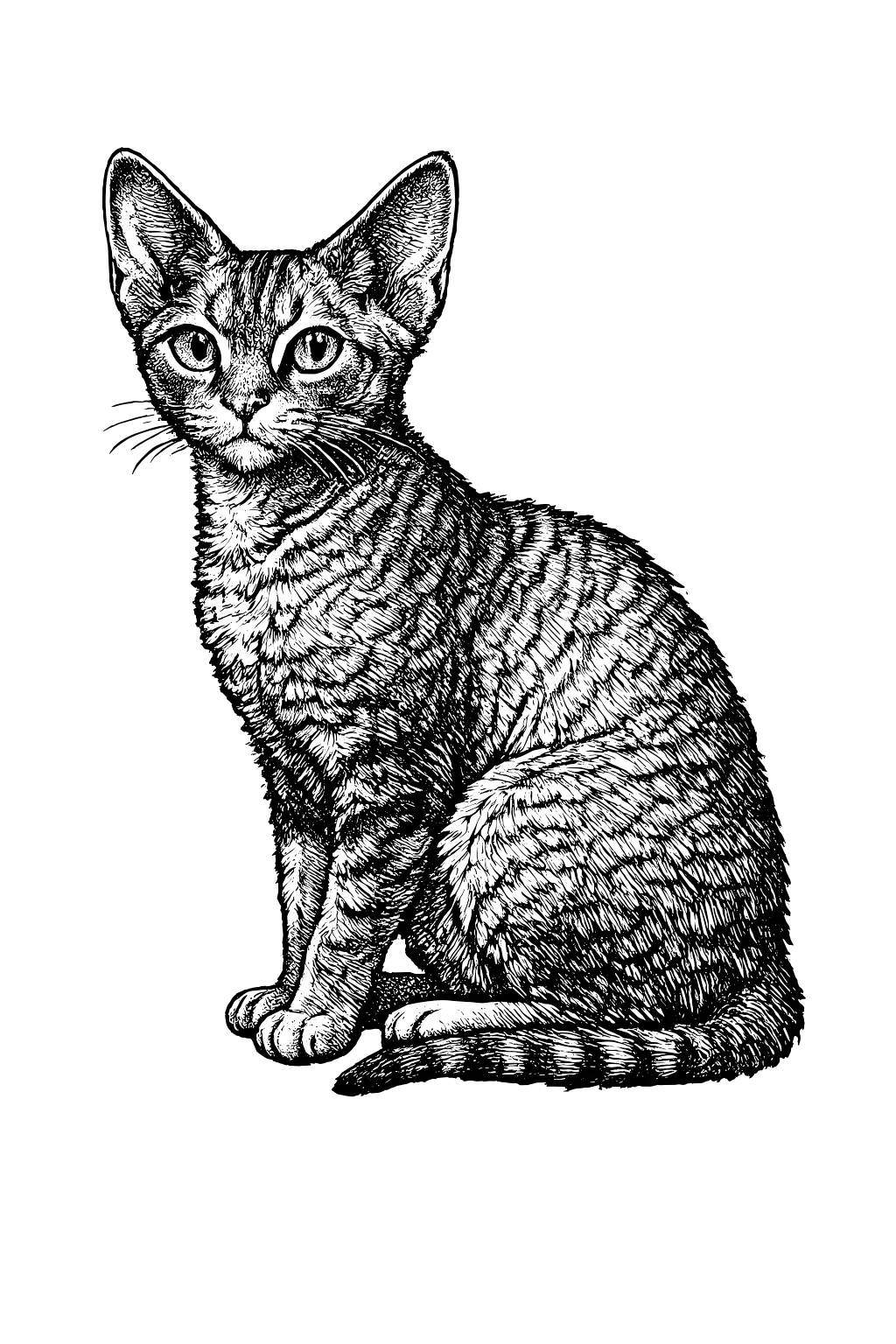
Devon Rex
Buckfastleigh, Devon, England, 1959
A short, wiry, large-eared cat with a curly coat caused by a mutation in the keratin gene that produces its hair. The Devon Rex is one of two main curly-coated cat breeds — and despite the visual similarity to the Cornish Rex, the two were independent mutations and produce different coat genetics.
Browse the Woodcut Wild shop →Origin & history
The breed traces to Kirlee, a curly-coated kitten born in 1959 to a feral mother near Buckfastleigh in Devon, England. Beryl Cox, the woman who found him, initially tried to breed Kirlee into the Cornish Rex program (the Cornish curly mutation had been discovered nearby a decade earlier), but the crosses produced only straight-coated kittens — proving the two breeds carried different mutations in different genes. Devon Rex breeding programs continued independently, and the breed was formally recognized in the UK in 1967. The Devon's curly gene mutates the same KRT71 keratin gene responsible for curly hair in some humans and curly-coated dogs (Lagotto Romagnolo, Poodle).
Temperament & behavior
Devon Rexes are unusually extroverted and active for a small cat — most breeders compare the behavior to a small dog or a primate rather than a typical cat. They climb relentlessly (curtains, screens, owners), follow people from room to room, and many learn to retrieve. They are physically warmer to the touch than most cats due to the thin coat. Despite the popular claim, Devon Rexes are NOT hypoallergenic — they produce normal levels of the Fel d 1 protein responsible for cat allergies, though the reduced shedding means less allergen is distributed to surfaces.
Marginalia
- The whiskers of a Devon Rex are themselves curly and frequently break off — most adult Devons have stubby or absent whiskers as a result.
- Devon Rex coats vary noticeably in density over the cat's life — most Devons go through a 'baldness' phase between 2 and 8 months as the coat sheds the kitten texture and grows in the adult form.
- The breed standard explicitly calls for 'pixie' features — a wedge-shaped face, very large low-set ears, and large eyes set high on the face.
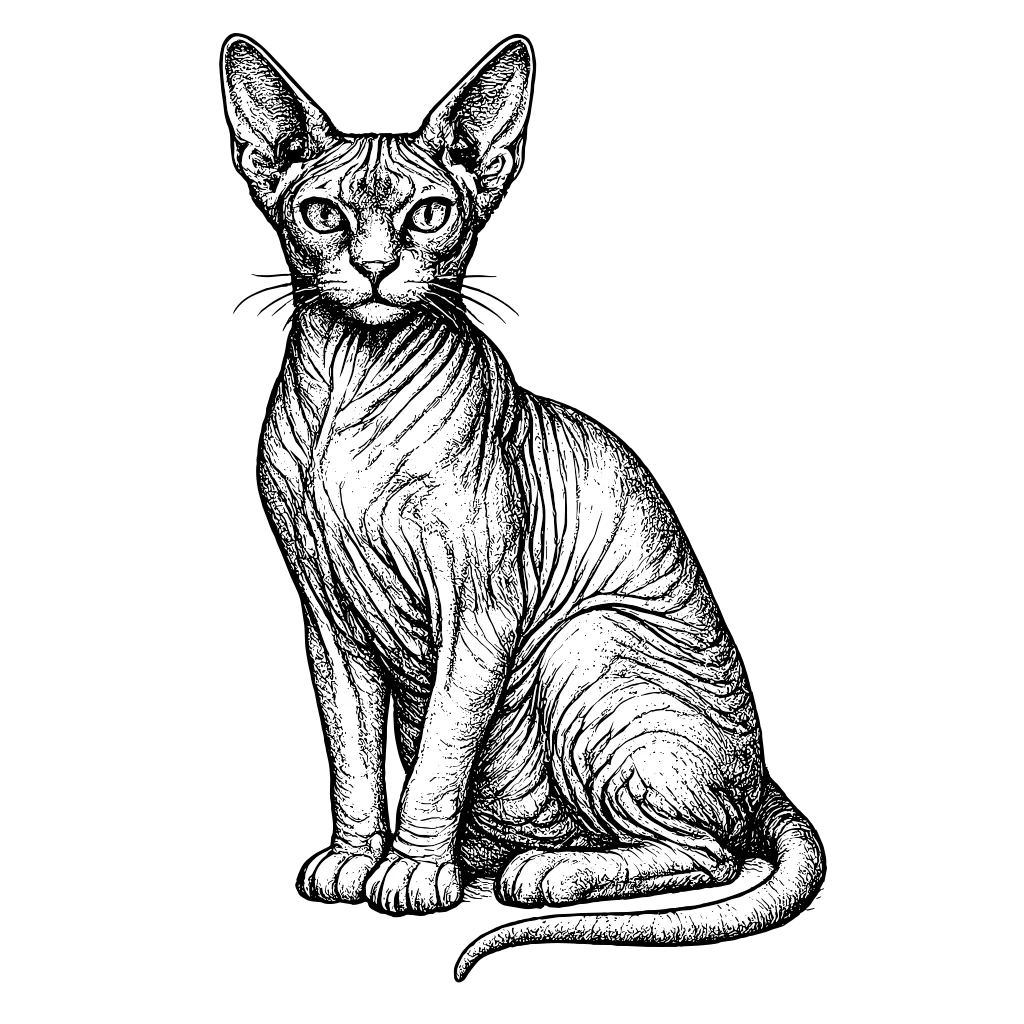
- Devon Rex × Sphynx crosses are used in some Sphynx breeding programs to expand the Sphynx gene pool; the resulting hairless offspring are valid Sphynxes.
Related breeds
Common questions
Do Devon Rex cats shed, and how much grooming do they need?
They barely shed, but the grooming need is real — it is just skin and ears, not brushing. Devons produce skin oils that the sparse fur cannot absorb, so they need periodic wiping or gentle bathing and routine ear cleaning, because the large open ears collect wax fast. Brushing is the one chore you can skip; everything else, you cannot.
Are Devon Rex cats good with kids and other pets?
Very. The extroversion that makes them exhausting also makes them sociable — Devons tend to greet dogs, tolerate busy children, and recruit other cats into play rather than hiding. They want to be in the middle of whatever the household is doing.
What health problems are Devon Rex cats prone to?
A few breed-specific ones. Devons can carry hypertrophic cardiomyopathy, a hereditary muscle weakness called Devon Rex myopathy, and patellar luxation (slipping kneecaps), and the open ears and oily skin make them prone to yeast and wax buildup. Reputable breeders screen the parents and can show the results.
Are Devon Rex cats affectionate, and do they like to be held?
Aggressively so, and yes to being held. A Devon will pick a person and attach to them like a small dog, riding on shoulders, burrowing under blankets, and turning up wherever the warmth is. The thin coat means they genuinely seek body heat, so the cuddling is part affection and part thermoregulation — being picked up is a reward, not an imposition.
Are Devon Rex cats good for first-time owners?
Easy to handle, hard to satisfy. A Devon is friendly and undemanding to groom, but it is one of the most owner-dependent breeds — left alone it gets destructive or withdrawn rather than napping the hours away. A first-timer who is home often, or who provides a companion animal, will do fine; one who works long days will not.