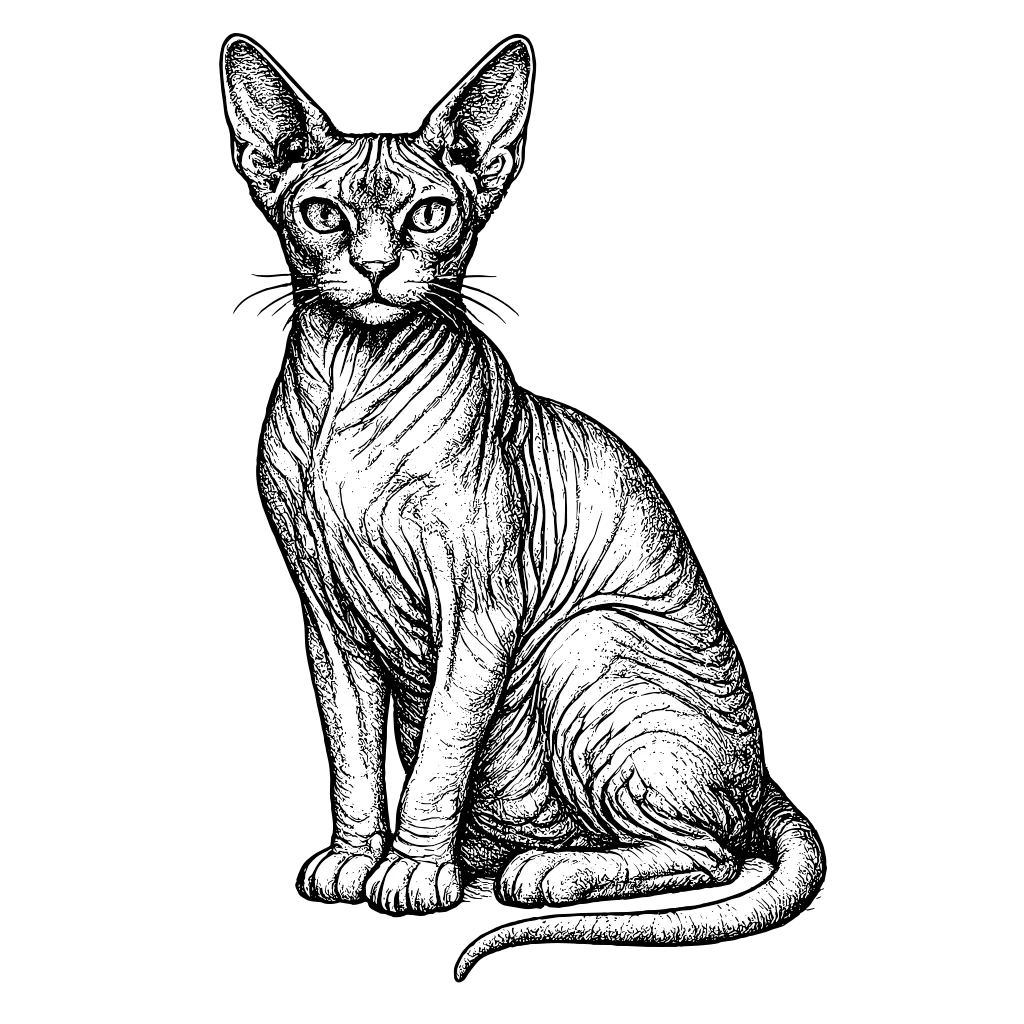
Sphynx
Toronto, Canada, 1966
A cat that looks like it was sculpted in clay and left unfinished. The breed traces to a single hairless kitten born in Toronto in 1966 — a natural mutation, since selectively propagated, that produced one of the most distinct silhouettes in the domestic cat world.
Browse the Woodcut Wild shop →Origin & history
In 1966 a black-and-white domestic cat in Toronto gave birth to a hairless male kitten named Prune — the result of a spontaneous recessive mutation. Breeders selectively crossed Prune's descendants with Devon Rex and shorthaired domestic cats to expand the gene pool while preserving the hairless trait. The breed was originally called the Canadian Hairless and is unrelated to earlier hairless cats recorded in pre-Columbian Mexico, which were a separate (and now extinct) line. The CFA recognized the breed in 2002.
Temperament & behavior
The lack of fur changes nearly everything about Sphynx behavior. They run a higher surface temperature than other cats (their metabolism compensates for heat loss), they seek out warm bodies aggressively, and they are unusually tactile — many Sphynxes sleep under blankets, on shoulders, or pressed against another cat. They require regular bathing because their skin secretes oils that fur would normally absorb. The breed is also notably extroverted: Sphynxes greet strangers, follow owners between rooms, and are widely reported to be the breed most likely to seem actively unhappy when left alone.
Marginalia
- Despite being called 'hairless,' Sphynxes are covered in a fine vellus down that feels closer to chamois leather than skin.
- The breed is NOT hypoallergenic — cat allergies are triggered by the Fel d 1 protein in saliva and skin oils, both of which Sphynxes produce in normal amounts.
- The 'wrinkled' look around the face and shoulders is most pronounced in kittens and tends to smooth out with age.
- The character Mr. Bigglesworth in the Austin Powers films was played by a Sphynx named Ted Nudegent.
Related breeds
Common questions
Do Sphynx cats shed, and how much grooming do they need?
They do not shed fur, but they are not low-maintenance — the grooming just moves to the skin. With no coat to absorb them, the oils a cat's skin secretes build up directly on the body, so a Sphynx needs regular bathing, usually every week or two, to keep from feeling greasy and developing skin issues. The same oils cake in the large open ears and around the nail beds, which also need weekly wiping. You skip the brushing and pay it back several times over.
Are Sphynx cats good with kids and other pets?
Among the most sociable for it. The relentless extroversion means a Sphynx generally welcomes children, dogs, and other cats, and it often actively recruits a companion to curl up against for warmth. A second pet is close to a feature rather than a complication for this breed.
What health problems are Sphynx cats prone to?
Chiefly the heart. The breed carries an elevated risk of hypertrophic cardiomyopathy, so responsible breeders screen the parents by echocardiogram and a buyer should ask for those results. They are also prone to dental disease and, because of the bare skin, to sunburn and skin issues that a coated cat is spared.
Are Sphynx cats affectionate, and do they like to be held?
Intensely, and yes — being held is the point. A Sphynx seeks skin contact constantly, sleeping under blankets, riding on shoulders, and pressing against any available warm body, partly out of affection and partly because the bare skin loses heat fast. It is one of the few cats that will object to being put down rather than to being picked up.
Do Sphynx cats need sweaters or extra warmth?
In a cold home, yes. With no coat to trap heat a Sphynx genuinely gets cold, so owners provide heated beds, blankets, and sometimes sweaters in winter — and keep them out of direct sun and off hot surfaces, because the bare skin both burns and chills easily. The animal will tell you by hunting down the warmest spot in the house.