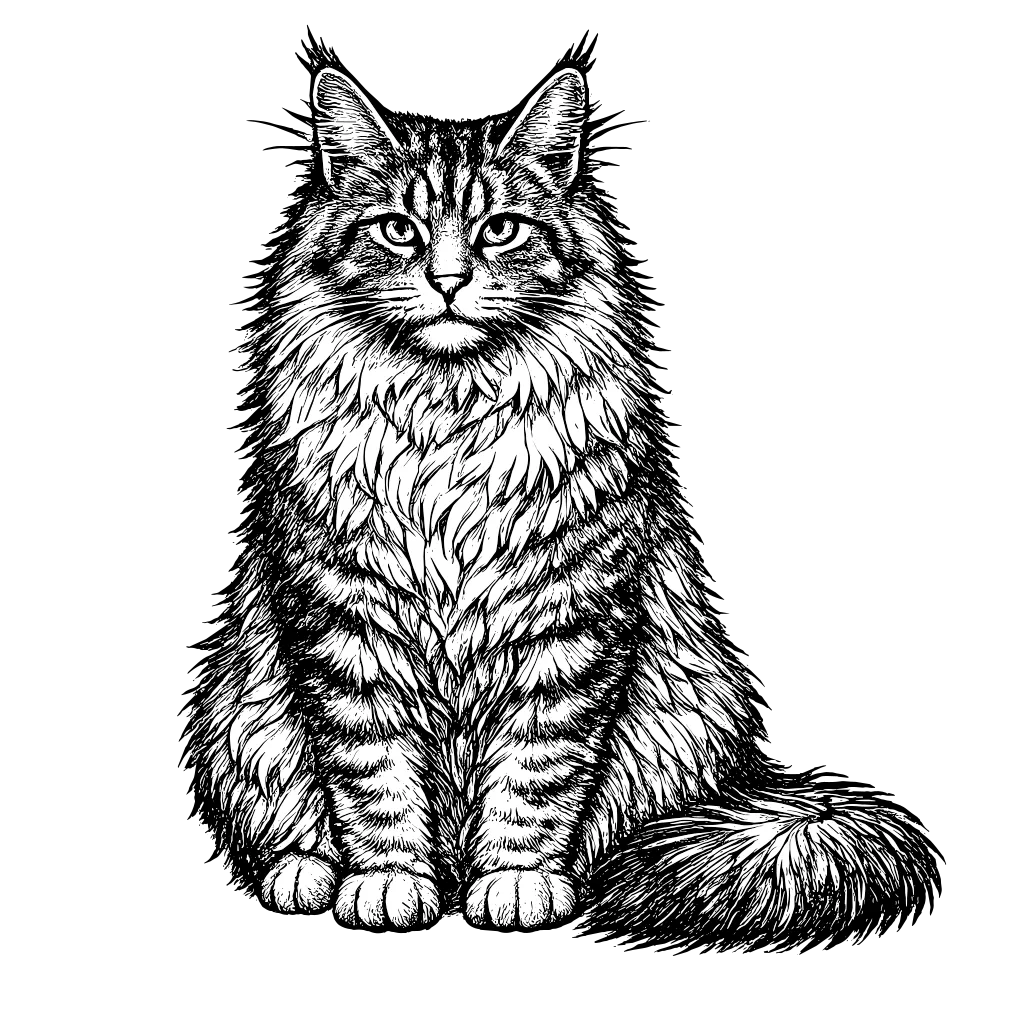
Maine Coon
Maine, United States, 19th century
The largest domestic cat breed and the only one developed natively in North America. Adapted by New England winters into something built for snow — tufted feet, water-resistant fur, a tail long enough to wrap around the body for warmth.
Browse the Woodcut Wild shop →Origin & history
The breed is genuinely native to Maine, where it was a common working farm cat by the mid-1800s, prized for catching rats in barns and on ships. Its origins are uncertain — the popular folk theory that it descends from Marie Antoinette's longhaired cats fleeing the French Revolution is romantic but unsupported; genetic studies place the breed's ancestors among ordinary shorthaired North American farm cats that developed long coats in response to the climate. The Maine Coon was the most popular show cat in the late 19th century, was eclipsed by imported Persians by the 1900s, and was rebuilt from near-extinction by a handful of breeders in the 1950s–70s. It is now the second-most-popular pedigreed cat breed in the United States.
Temperament & behavior
Maine Coons mature slowly — they may take three to five years to reach full size — and retain a juvenile playfulness throughout adulthood. They are unusually vocal but rarely meow; the breed's signature sound is a chirp or trill. Many willingly walk on a leash, play fetch, and tolerate water, which is unusual for domestic cats and consistent with the breed's working-cat history.
Marginalia
- The current Guinness record-holder for longest domestic cat — Barivel, an Italian Maine Coon — measured 47.2 inches from nose to tail tip.
- Polydactyly (extra toes) was historically common in the breed; some early Maine Coons had as many as seven toes per paw, an asset for traction on snow.
- The breed standard explicitly calls for lynx-like tufts on the ear tips.
- Maine Coons were nearly written off as extinct in the 1950s — a single breeder, the Central Maine Cat Club, is credited with bringing the breed back.
Related breeds
Common questions
Do Maine Coons shed, and how much grooming do they need?
They shed heavily and need real upkeep. The long double coat sheds year-round and blows out seasonally, so plan on brushing two or three times a week to stay ahead of mats, especially the ruff, belly, and the feathering behind the legs. It is not a daily Persian-level chore, but it is not a wash-and-go cat either.
Are Maine Coons good with kids and other pets?
Among the best for it. The combination of size, patience, and dog-like sociability means a Maine Coon generally tolerates children, coexists with other cats, and often befriends dogs outright. The bulk that intimidates people on paper is paired with an unusually gentle disposition.
What health problems are Maine Coons prone to?
Three are well documented. The breed carries elevated risk of hypertrophic cardiomyopathy, hip dysplasia, and spinal muscular atrophy — an unusual cluster for a cat, and partly a consequence of the breed's size. Responsible breeders DNA-test for the HCM and SMA mutations and screen hips before pairing cats.
Are Maine Coons affectionate, and do they like to be held?
Affectionate yes, carried no. Maine Coons want to be near their people and will follow you room to room, but most prefer to sit beside you rather than be picked up — a cat this large does not enjoy being scooped. They tend to supervise from an adjacent surface rather than a lap.
Are Maine Coons good for first-time owners?
Yes, with one caveat about scale. The temperament is forgiving — gentle, sociable, slow to anger — which makes the breed easy for a beginner. The catch is that everything costs more: a large, athletic cat needs sturdy oversized climbing furniture, a big litter box, more food, and several brushings a week. Budget for the size, not the difficulty.