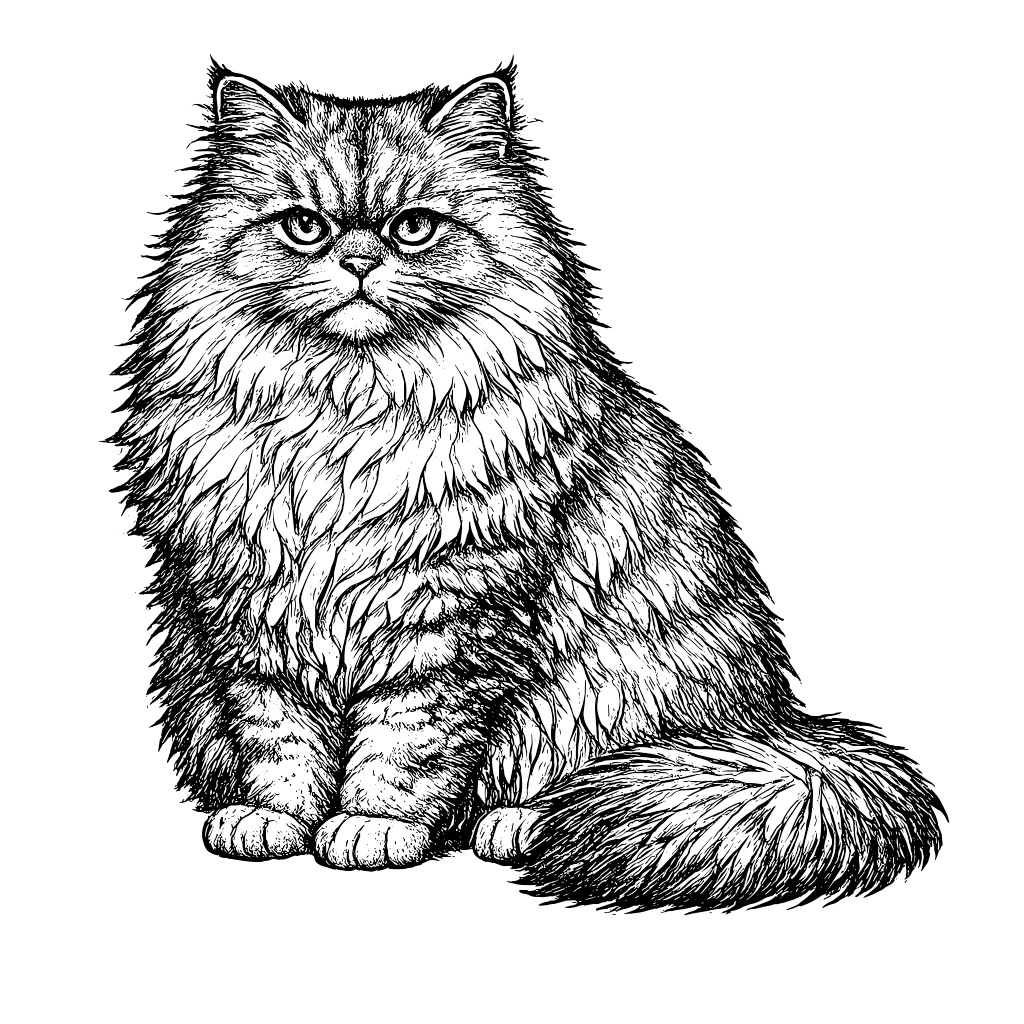
Persian
Persia (modern Iran), introduced to Europe in the 17th century
One of the oldest and most artificially reshaped breeds in the domestic cat world. Originally a long-haired cat from the Iranian plateau, the Persian was bred over a century in Britain and North America into the flat-faced 'peke-faced' modern form — a face so radically modified that the breed has, in some lines, lost the ability to drain its own tears.
Browse the Woodcut Wild shop →Origin & history
Long-haired cats were imported to Italy from Persia by traveler Pietro della Valle in 1620, then to France by Nicolas-Claude Fabri de Peiresc. These cats were the foundation of all modern Western longhair breeds. Selective breeding in 19th-century Britain produced an increasingly stocky, round-faced cat; by the 1950s American breeders began producing the extreme 'peke-faced' Persian, with a flattened face nearly perpendicular to the skull. The CFA recognized the peke-face Persian as the breed standard. In response to mounting health concerns the CFA modified the standard in 2007 to disallow the most extreme faces, but the breed remains one of the most brachycephalic cats. A separate 'Traditional' or 'Doll-Face' Persian movement is reviving the older, longer-muzzled type.
Temperament & behavior
Persians are remarkably inert by domestic cat standards — they sleep most of the day, vocalize rarely, and tend not to climb, hunt, or roam. They tolerate being held longer than most breeds and are unusually patient with children and slow handling. The defining medical concern is the brachycephalic face: most Persians cannot drain their tear ducts normally and develop chronic tear staining; many have respiratory issues; the breed is also genetically predisposed to polycystic kidney disease (PKD), and responsible breeders test for the PKD1 mutation before pairing cats. The coat requires daily grooming to prevent matting — an underappreciated commitment.
Marginalia
- The Persian has been the most-registered breed in the CFA every year since the registry's founding in 1906 except for a brief period in the late 1990s when the Maine Coon temporarily overtook it.
- The colorpoint variation of the Persian is registered as a separate breed (the Himalayan) by the CFA but as a Persian colorpoint division by TICA — the same animal in either case.
- Persian eyes are particularly large and round in the show standard; the trait was selected for in the early 20th century by breeders explicitly seeking a 'doll' appearance.
- A Persian cat named Trim accompanied Captain Matthew Flinders on his circumnavigation of Australia (1801–1803) and is credited in Flinders's journal as the first cat to sail around the continent.
Related breeds
Common questions
Do Persians shed, and how much grooming do they need?
Constantly, and they cannot manage it alone. The long, fine coat sheds year-round and mats within days if it is not brushed, so a Persian is a daily-grooming commitment whether the owner planned on one or not — plus a bath every few weeks, because the coat traps oil and litter that brushing cannot remove. Skip the routine and you end up paying a groomer to shave out the mats.
Are Persians good with kids and other pets?
Usually, as long as the household is calm. The placid, patient temperament tolerates gentle children and coexists easily with quiet cats and dogs, and a Persian rarely starts conflict. Its low energy makes it a poor match for a boisterous dog or a hyperactive kitten, though — it would rather be left in peace than chased off the cushion.
What health problems are Persians prone to?
Two clusters, both well documented. The breed is genetically predisposed to polycystic kidney disease (PKD), and responsible breeders test for the PKD1 mutation before pairing cats. The flat 'peke' face causes the rest: blocked tear ducts and chronic eye staining, breathing difficulty, and poor heat tolerance, since the cat cannot pant or shed heat efficiently. Keep one indoors and cool — a hot room or car is a genuine risk.
Are Persians affectionate, and do they like to be held?
Yes, and more tolerant of handling than most cats. Persians are undemonstrative but genuinely fond of their people — they will settle on a lap and stay, and most accept being picked up and carried with the same placid patience they bring to everything else. They want quiet company, not a chase; affection here looks like a warm cat that simply does not leave.
How do you clean a Persian's face and eyes?
Daily, with a soft damp cloth under each eye. The flat face leaves most Persians unable to clear their own tears, so fluid runs down the muzzle and crusts into the fur; wiping it off every day prevents staining and skin infection in the folds. It is a permanent part of owning the breed, not an occasional touch-up.