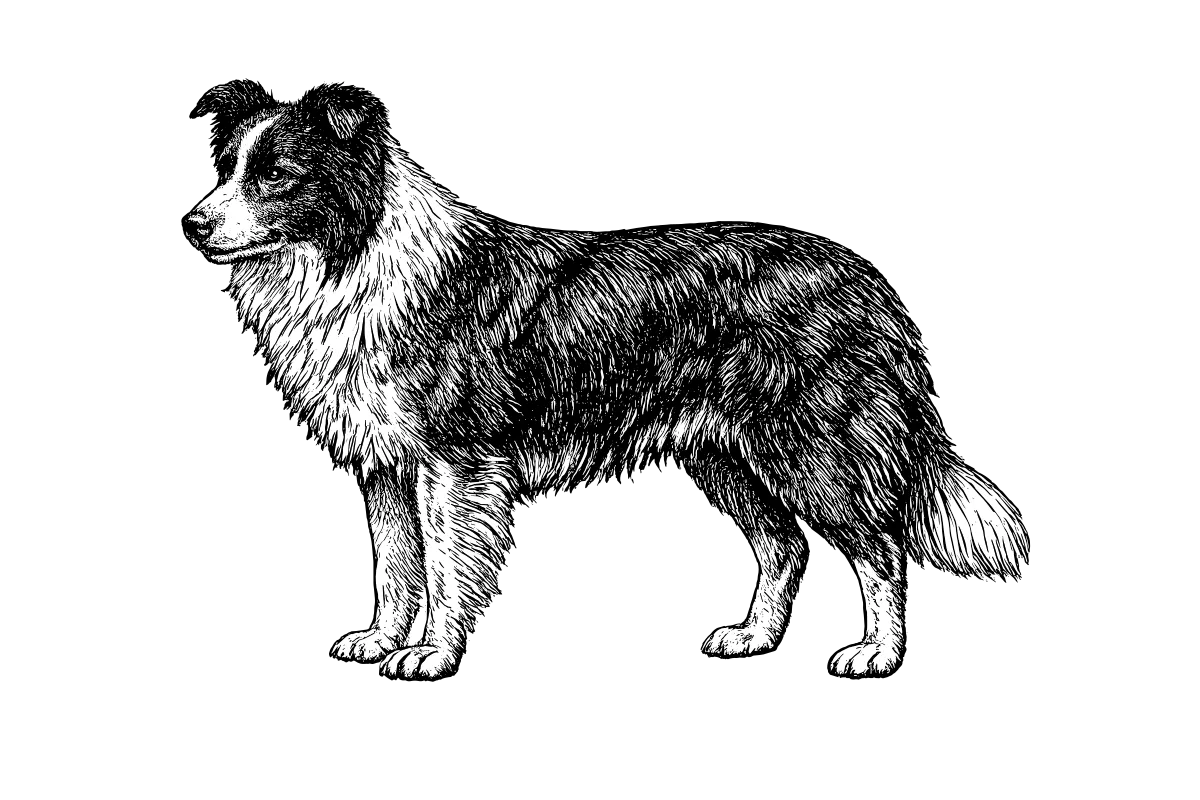
Border Collie
Herding group · Anglo-Scottish border region, late 19th century
The most intelligent breed of dog by every measurable standard, and the one most likely to be unhappy in a normal home. Bred for a single purpose — moving livestock by stare alone — and never fully translated to anything else.
Browse the Woodcut Wild shop →Origin & history
The breed traces to Old Hemp, a tricolor dog born in Northumberland in 1893 whose quiet, stalking herding style was so effective it became the prototype for every working sheepdog descended from him. The name 'Border Collie' was coined in 1915 to distinguish the working strain from the show-bred Rough Collie. The breed was not formally recognized by the AKC until 1995 — many working-dog breeders opposed recognition on the grounds that bench standards would dilute working ability. Most serious herding lines are still registered with the International Sheep Dog Society rather than national kennel clubs.
Temperament & behavior
Border Collies herd by 'eye' — they crouch, stalk, and fix livestock with an intense unbroken stare rather than barking or nipping. The same drive applied to a suburban home becomes pacing, fixating on shadows, and herding children. They learn commands in fewer repetitions than any other breed and have been shown to acquire vocabularies of over a thousand object names. They are also among the breeds most prone to anxiety disorders when under-stimulated.
Originally bred for
Gathering and driving sheep across the broken hill country of the Scottish and Welsh borders.
Marginalia
- A Border Collie named Chaser was documented learning the names of 1,022 distinct objects — the largest known vocabulary of any non-human animal.
- The 'eye' — the fixed predatory stare used on sheep — is genetically heritable and trained for in working lines.
- Old Hemp, the breed's foundation sire, never lost a sheepdog trial in his life.
- World Sheepdog Trials are still won almost exclusively by unregistered ISDS-line Border Collies; show-bench Border Collies are a separate, mostly non-working strain.
Related breeds
Common questions
Do Border Collies shed?
Yes, steadily, with two heavier seasonal blowouts a year. The medium double coat — rough or smooth — needs weekly brushing most of the year and daily during shedding season. It is a moderate-maintenance coat, not a heavy one, but it is not a low-shedding breed.
Are Border Collies good with kids and other pets?
Affectionate with their family's children, but the herding instinct complicates it. Many will circle, stare down, and nip at the heels of running children, smaller dogs, and cats — not aggression but reflex, trying to gather them like a flock. It is manageable with training and supervision, but small children and a high-drive collie need watching.
What health problems are Border Collies prone to?
Generally a hardy breed, but prone to hip dysplasia, Collie eye anomaly, and progressive retinal atrophy. Some lines carry sensitivity to certain drugs via the MDR1 gene mutation, and epilepsy appears in some families. Reputable breeders screen eyes, hips, and MDR1 status.
How much exercise do Border Collies need?
More than almost any other breed — hours of daily physical and mental work, not a walk around the block. The problem is rarely the body but the mind: an under-stimulated Border Collie redirects the drive into pacing, barking, shadow-chasing, and compulsive disorders. Running, herding, or dog sports are the realistic baseline.
Are Border Collies good for first-time owners?
Generally not. The intelligence that makes the breed appealing on paper is exactly what overwhelms inexperienced owners — a bored, untrained Border Collie outthinks the household and develops problems faster than a novice can correct them. They reward experienced, active owners and frustrate everyone else.